
LocationRome, Italy · June 2026
UbicaciónRoma, Italia · junio de 2026
A few of our own moments from the trip — from the flight over and an evening at the opera to the great sights of the city. These are the pictures of us, Robert and Karla, that frame all the monuments and art that follow.
Algunos de nuestros propios momentos del viaje — desde el vuelo de ida y una velada en la ópera hasta los grandes lugares de la ciudad. Estas son las fotos de nosotros, Robert y Karla, que enmarcan todos los monumentos y obras de arte que siguen.
LocationPiazza della Rotonda, Rome
UbicaciónPiazza della Rotonda, Roma
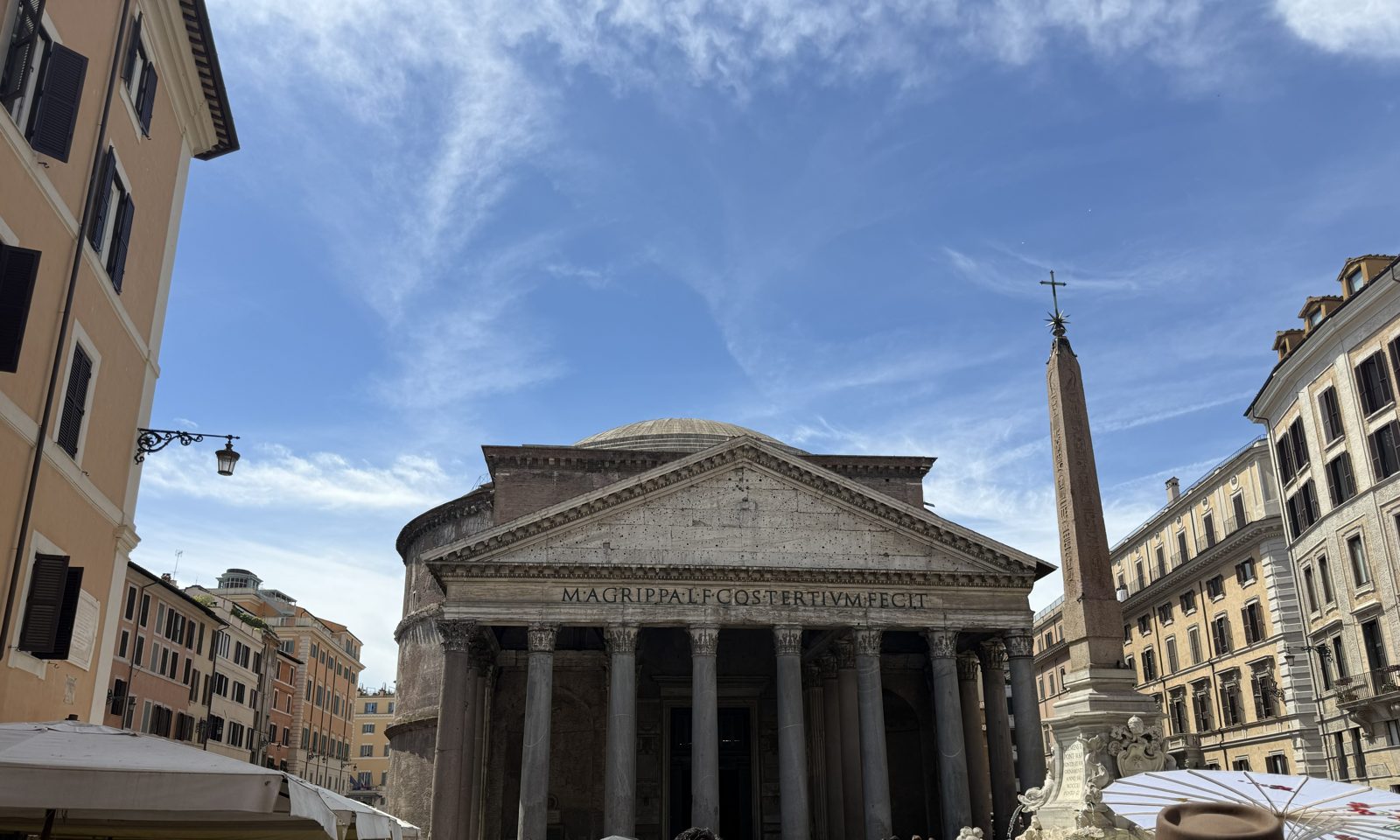
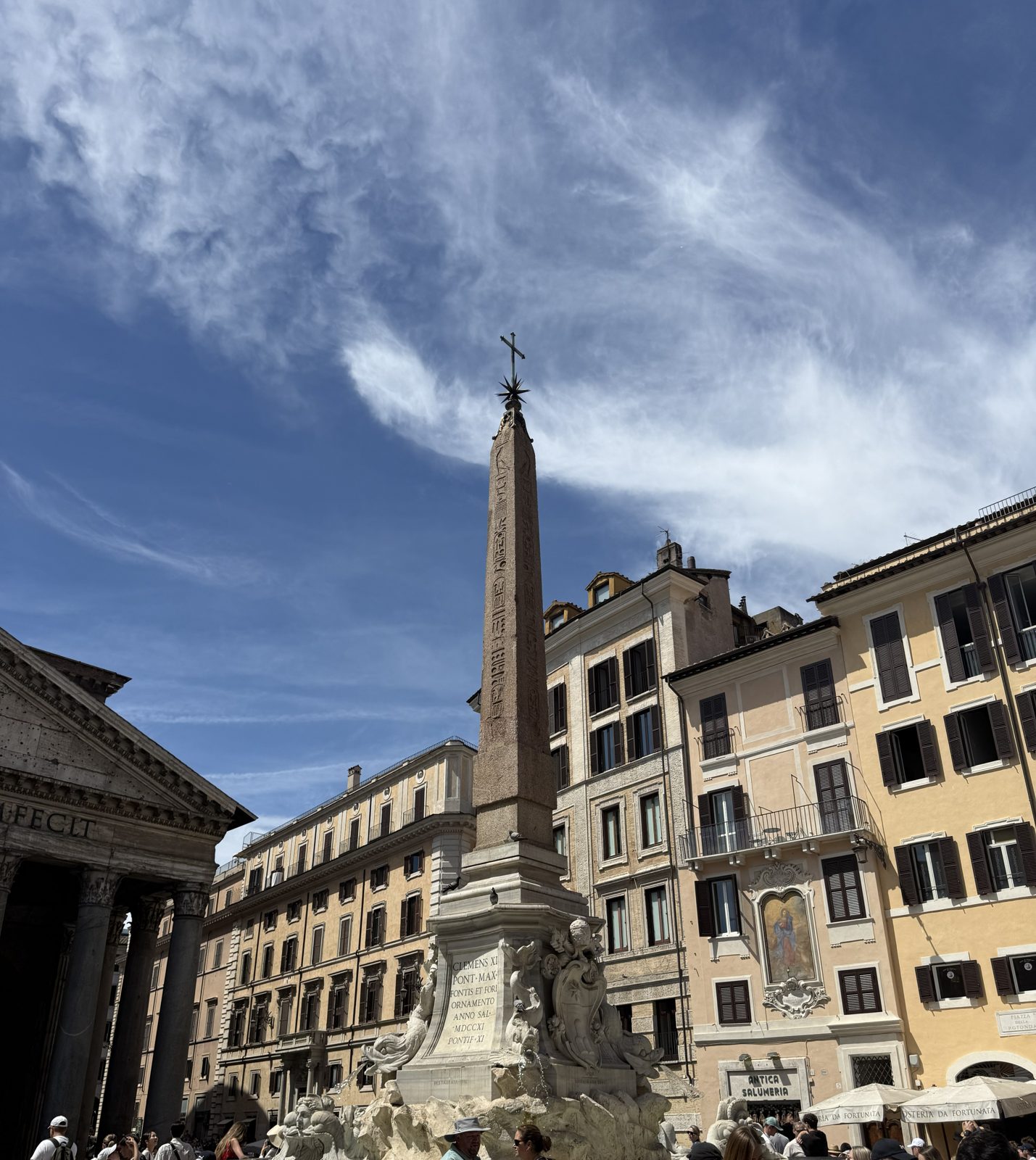
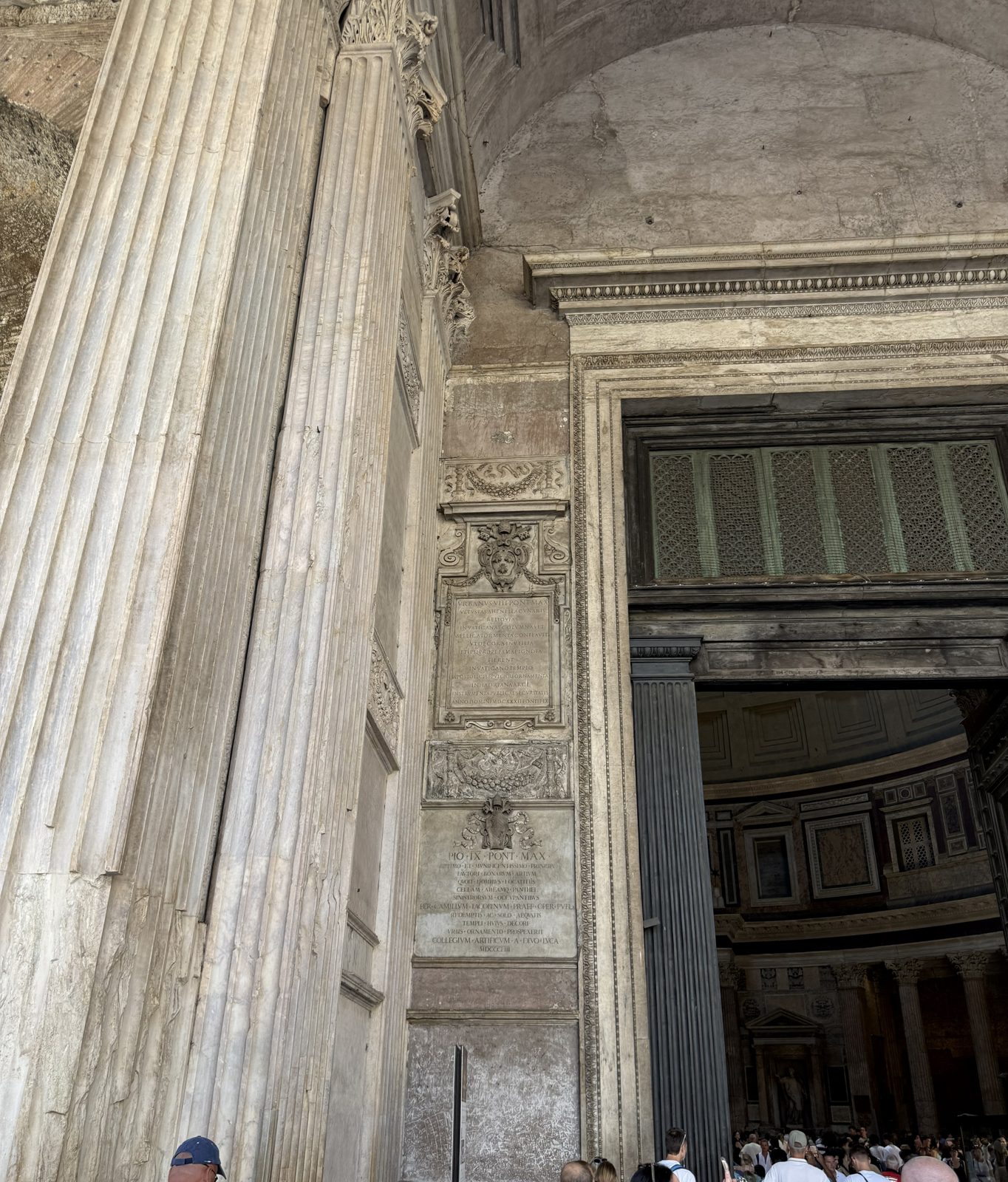
Three views of the Pantheon's exterior and entrance: the temple front, with its deep portico of monolithic grey-granite Corinthian columns and a triangular pediment, fronting the great domed rotunda; the Fontana del Pantheon, crowned by an Egyptian obelisk, in the square; and the portico interior with its colossal columns, the ancient bronze doors, and papal commemorative plaques.
Tres vistas del exterior y la entrada del Panteón: el frente del templo, con su pórtico profundo de columnas corintias monolíticas de granito gris y un frontón triangular, ante la gran rotonda con cúpula; la Fontana del Pantheon, coronada por un obelisco egipcio, en la plaza; y el interior del pórtico con sus columnas colosales, las antiguas puertas de bronce y placas conmemorativas papales.
“Marcus Agrippa, son of Lucius, consul for the third time, made this.” The fountain carries a second inscription of Pope Clement XI (1711) recording his adornment of the fountain and the square.
“Marco Agripa, hijo de Lucio, cónsul por tercera vez, hizo esto.” La fuente lleva una segunda inscripción del papa Clemente XI (1711) que recuerda el embellecimiento de la fuente y la plaza.
The building was rebuilt by the Emperor Hadrian c. 113–125 AD — roughly 1,900 years old — on the site of an earlier temple of Marcus Agrippa (c. 27 BC), whose dedication Hadrian preserved on the new façade.
El edificio fue reconstruido por el emperador Adriano hacia 113–125 d.C. — unos 1,900 años de antigüedad — sobre un templo anterior de Marco Agripa (c. 27 a.C.), cuya dedicatoria Adriano conservó en la nueva fachada.
Hadrian commissioned the rebuilding (the architect is unknown). The Fontana del Pantheon was designed by Giacomo della Porta (1575) and carved by Leonardo Sormani; the ancient Egyptian obelisk (reign of Ramesses II, 13th c. BC) was placed on it in 1711 under Clement XI. The portico's two marble plaques commemorate Urban VIII (1632) and Pope Pius IX with the Virtuosi artists (1853).
Adriano mandó la reconstrucción (se desconoce el arquitecto). La Fontana del Pantheon fue diseñada por Giacomo della Porta (1575) y tallada por Leonardo Sormani; el antiguo obelisco egipcio (reinado de Ramsés II, siglo XIII a.C.) se colocó sobre ella en 1711 bajo Clemente XI. Las dos placas de mármol del pórtico conmemoran a Urbano VIII (1632) y al papa Pío IX con los artistas Virtuosi (1853).
The best-preserved monument of ancient Rome, with the largest unreinforced concrete dome in the world, open at its centre through the oculus. It survived the centuries because it was consecrated as the church of Santa Maria ad Martyres in 609 AD.
El monumento mejor conservado de la antigua Roma, con la mayor cúpula de concreto sin refuerzo del mundo, abierta en su centro por el óculo. Se conservó porque fue consagrado como la iglesia de Santa Maria ad Martyres en el año 609 d.C.
LocationPantheon (Santa Maria ad Martyres), Rome
UbicaciónPanteón (Santa Maria ad Martyres), Roma
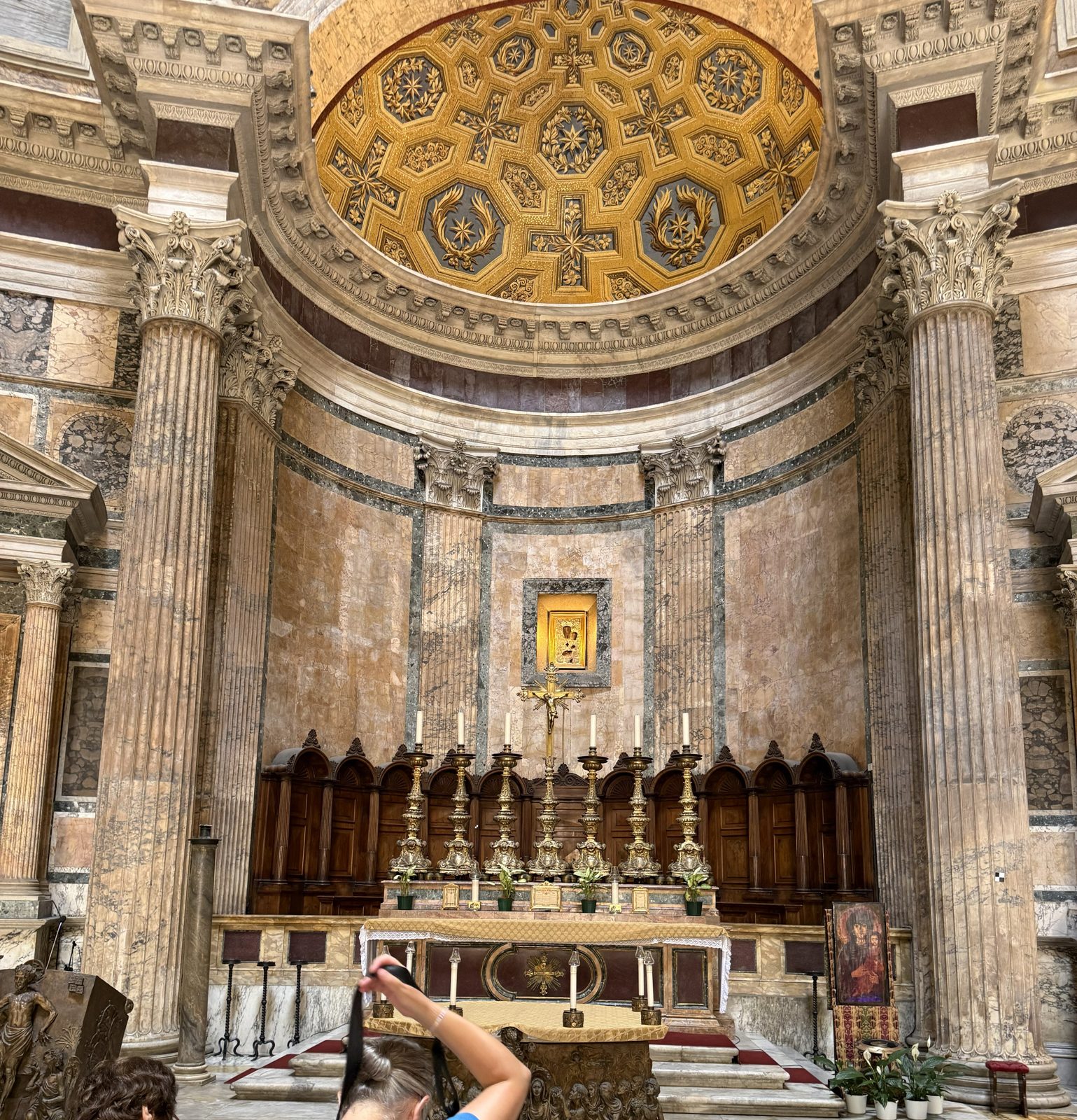
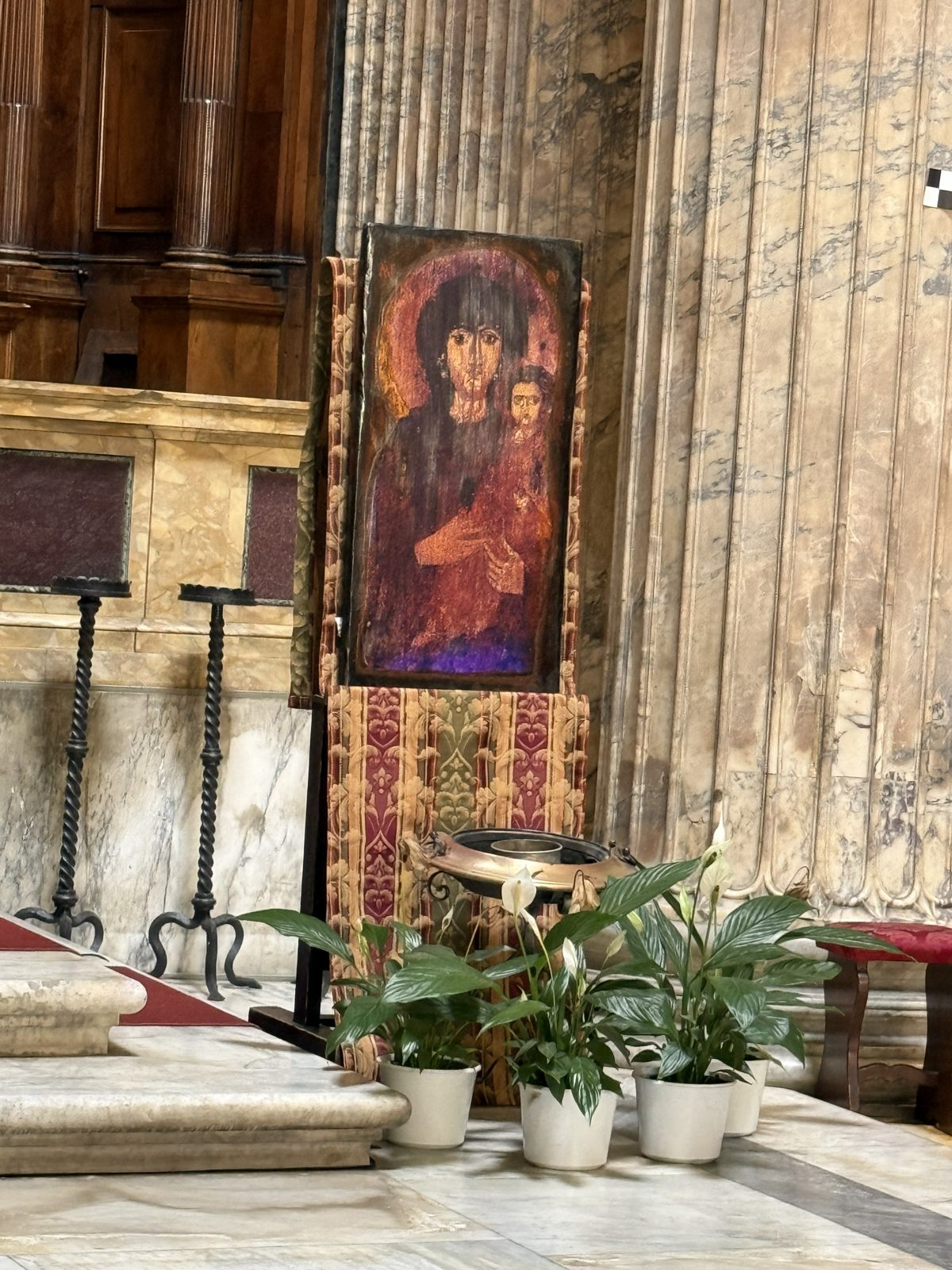
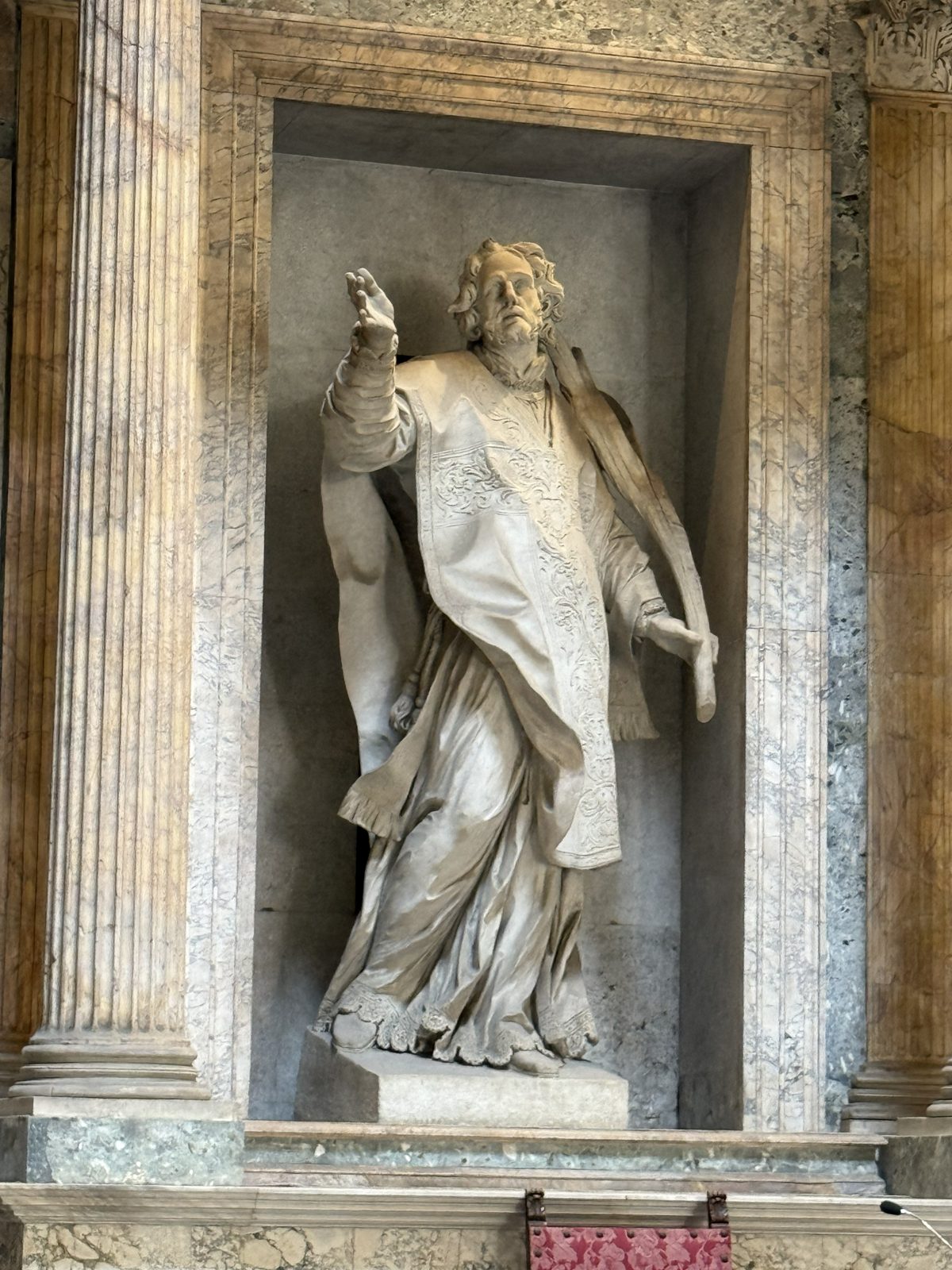
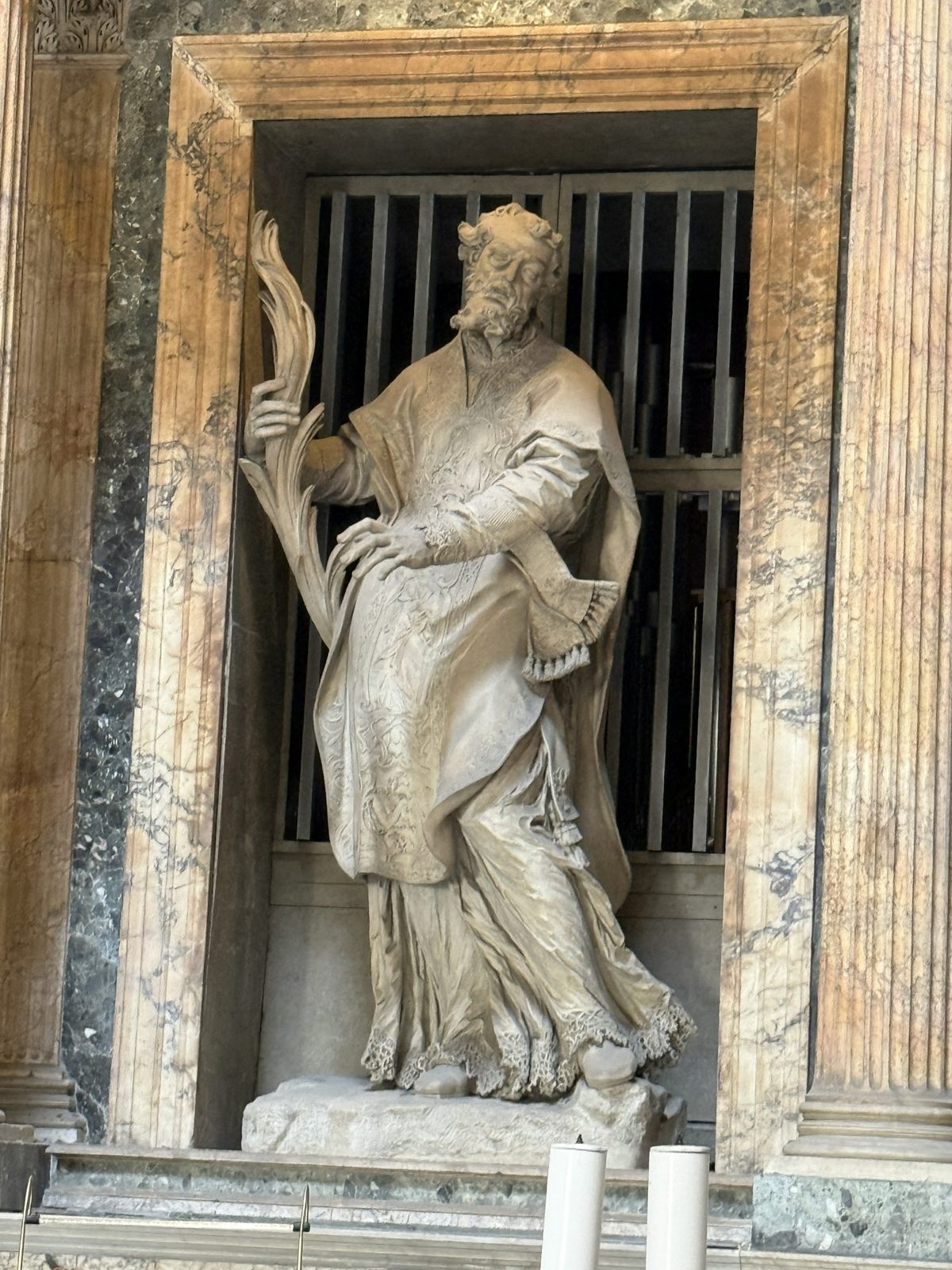
The apse on the central axis, capped by a gilded coffered semi-dome, with the high altar and the venerated icon of the Madonna and Child; and the two flanking marble martyr-saints set in their niches.
El ábside en el eje central, rematado por una semicúpula artesonada dorada, con el altar mayor y el venerado ícono de la Virgen con el Niño; y los dos santos mártires de mármol en sus nichos laterales.
“For the archpriest and the canons.”
“Para el arcipreste y los canónigos.”
The present apse and high altar were commissioned by Pope Clement XI (reigned 1700–1721); the Madonna icon follows a 7th-century original associated with the church's consecration in 609 AD.
El ábside y el altar mayor actuales fueron encargados por el papa Clemente XI (1700–1721); el ícono de la Virgen sigue un original del siglo VII vinculado a la consagración de la iglesia en el 609 d.C.
The high altar was designed by Alessandro Specchi (early 18th c.). The Byzantine icon of the Virgin (a Hodegetria, the “Madonna of St Luke”) in the apse is a copy; the 7th-century original is kept in an inner chapel. The dark choir stalls were added by Luigi Poletti (1840), and the gilt-bronze altar in front was sculpted by Federico Severino (2018). The flanking statues are San Rasio by Bernardino Cametti (1725) and Sant'Anastasio by Francesco Moderati (1717), both commissioned by Clement XI to mark the discovery of those martyrs' relics.
El altar mayor fue diseñado por Alessandro Specchi (principios del siglo XVIII). El ícono bizantino de la Virgen (una Hodegetria, la “Virgen de San Lucas”) en el ábside es una copia; el original del siglo VII se conserva en una capilla interior. La sillería de coro fue añadida por Luigi Poletti (1840), y el altar de bronce dorado al frente fue esculpido por Federico Severino (2018). Las estatuas laterales son San Rasio, de Bernardino Cametti (1725), y San Anastasio, de Francesco Moderati (1717), encargadas por Clemente XI para conmemorar el hallazgo de las reliquias de esos mártires.
The spiritual heart of the Christianized temple; the icon ties the basilica directly to its founding as a church in 609 AD.
El corazón espiritual del templo cristianizado; el ícono vincula la basílica directamente con su fundación como iglesia en el 609 d.C.
LocationChapel of the Annunciation, Pantheon, Rome
UbicaciónCapilla de la Anunciación, Panteón, Roma
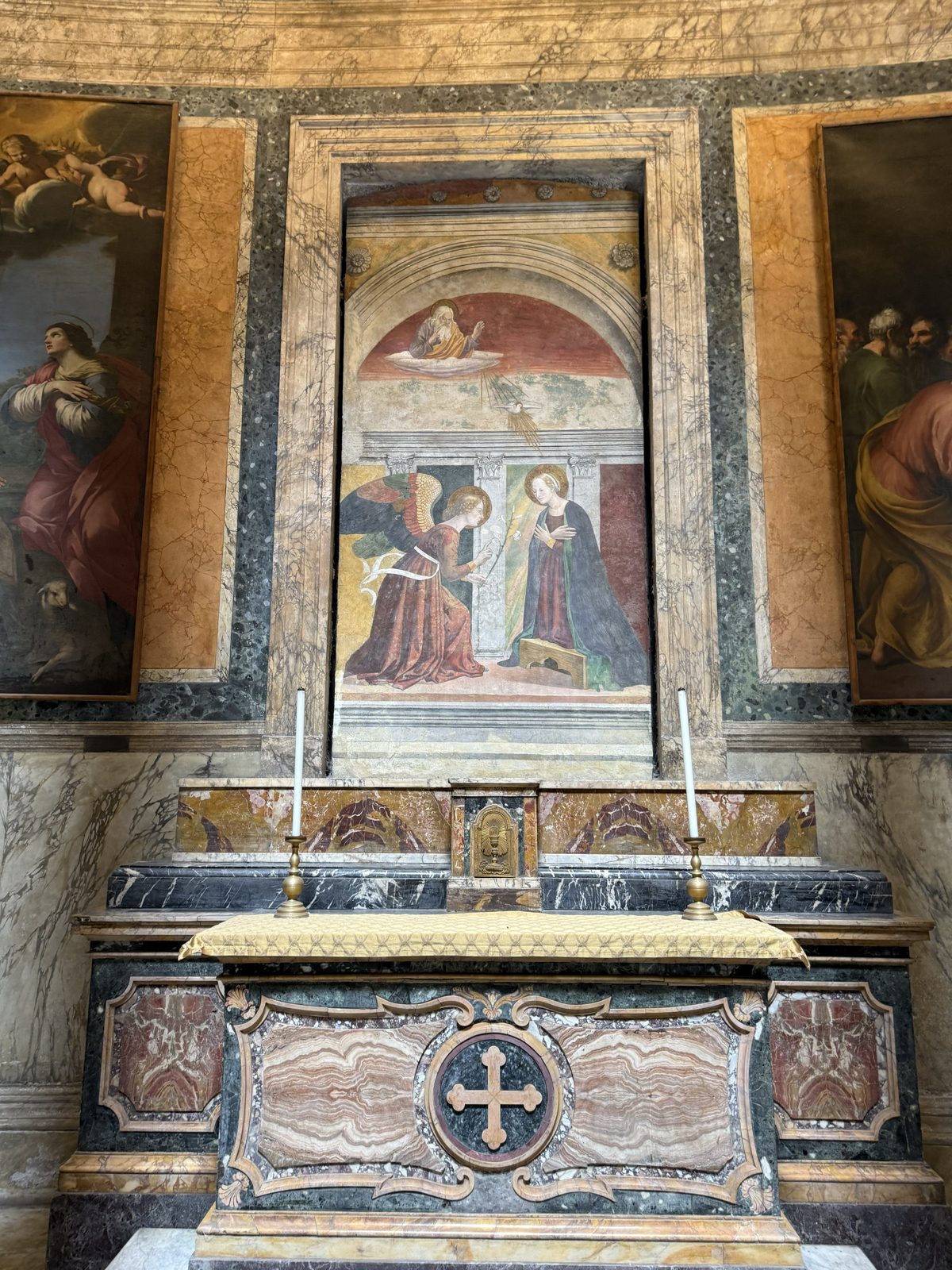
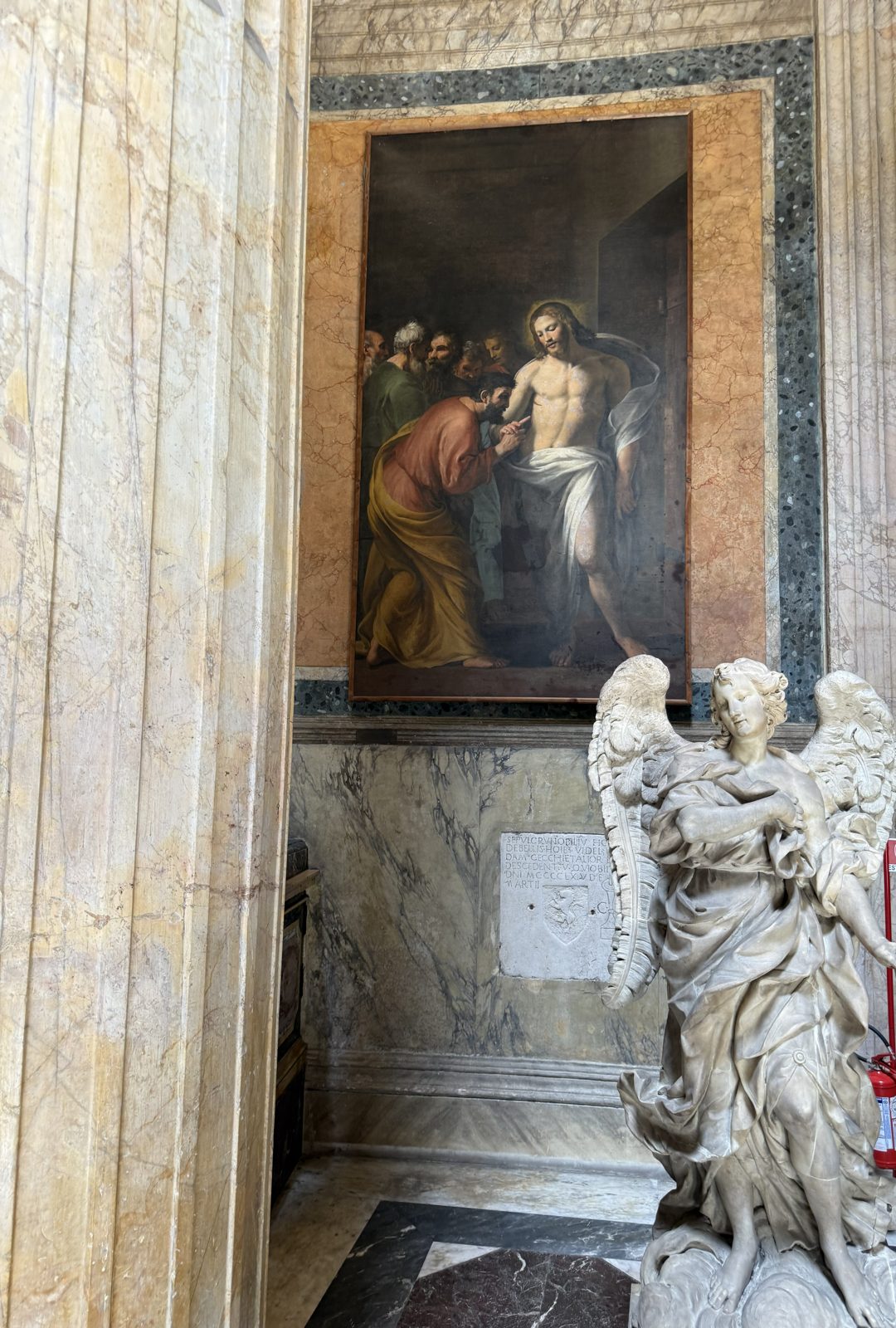
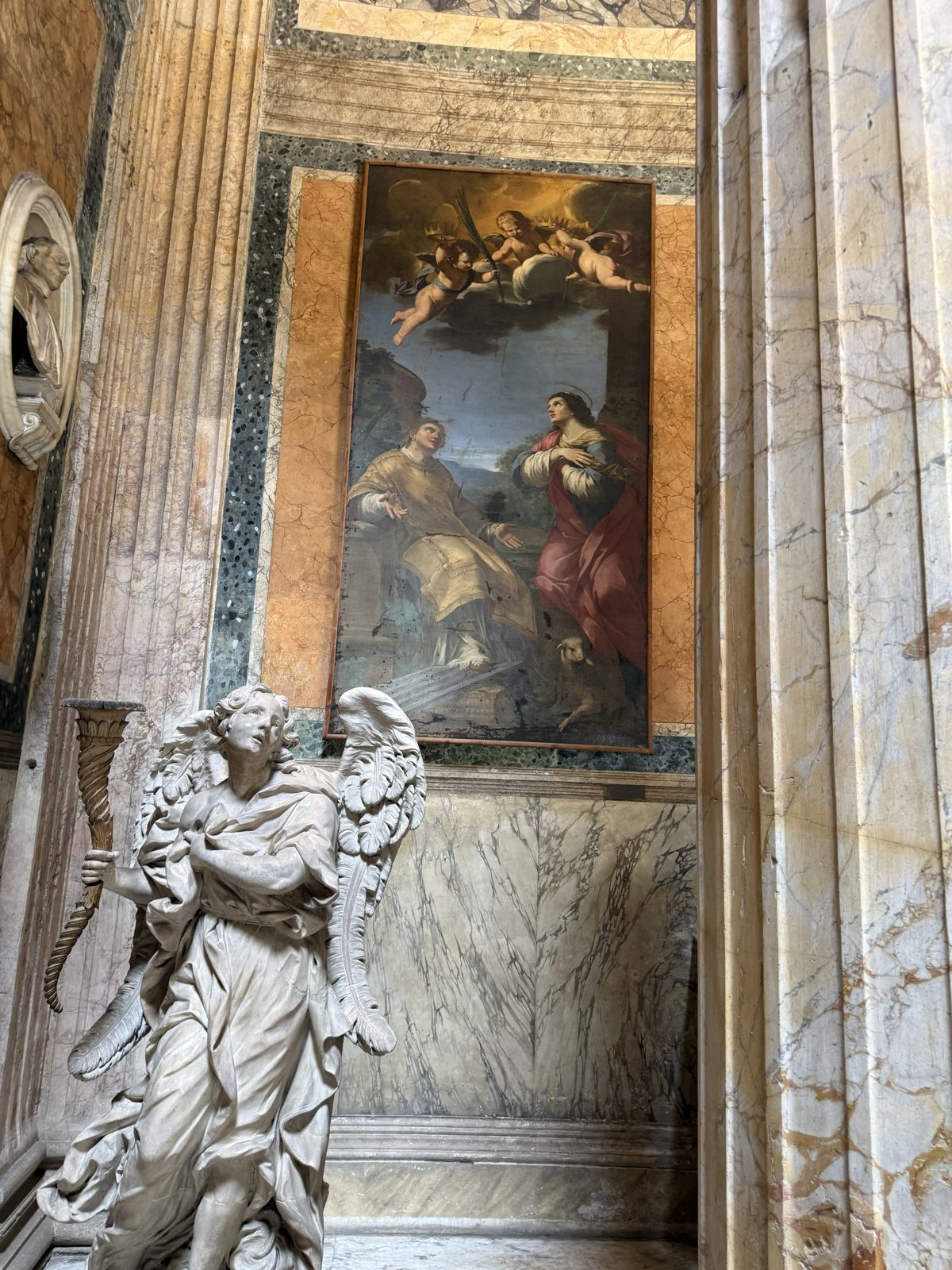
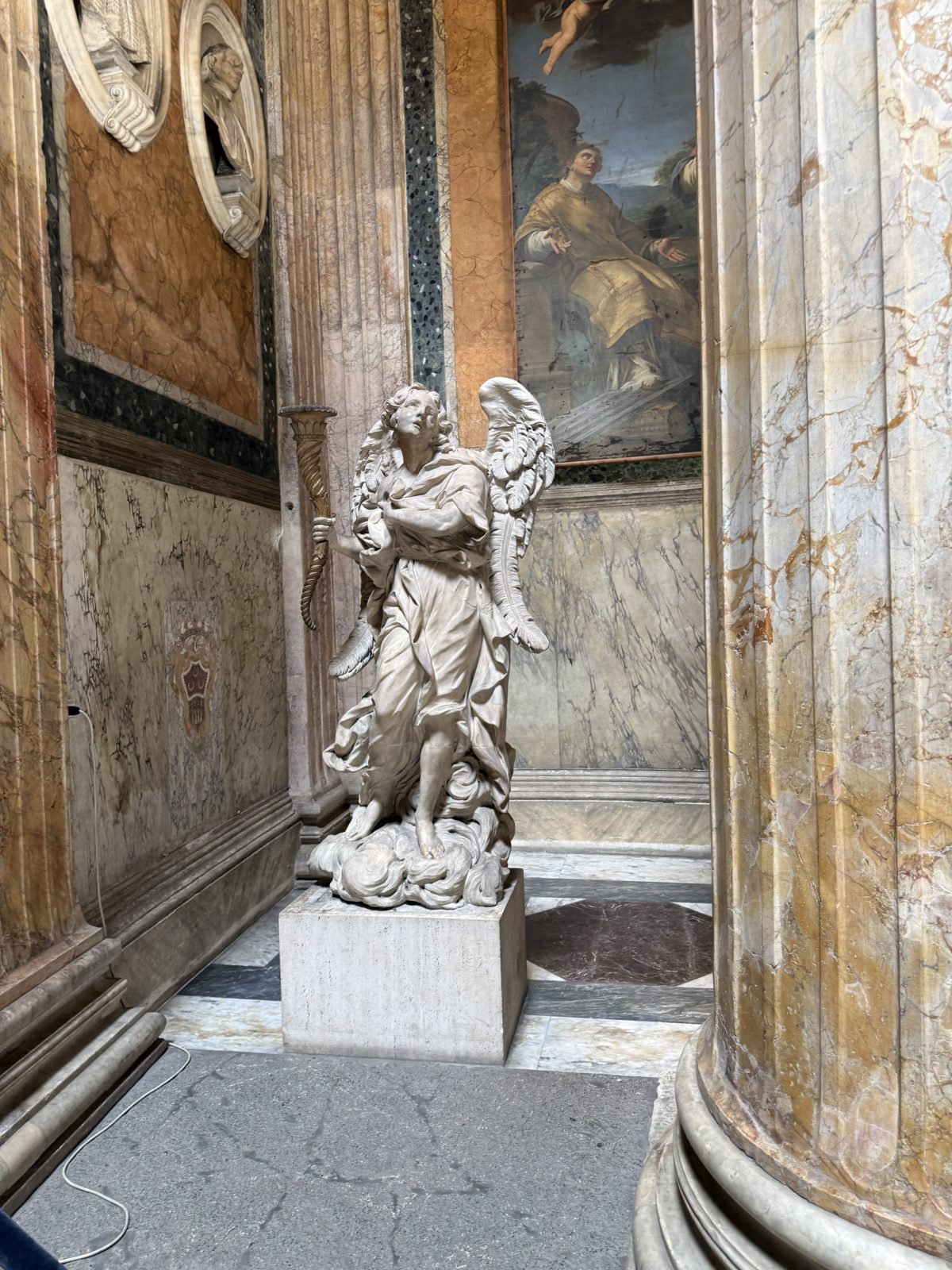
The chapel's altar wall, with a fresco of the Annunciation set in a marble aedicule and flanked by two paintings — the Incredulity of St Thomas and St Lawrence with St Agnes — together with one of the chapel's two marble angels.
El muro del altar de la capilla, con un fresco de la Anunciación en una edícula de mármol y flanqueado por dos pinturas — la Incredulidad de Santo Tomás y San Lorenzo con Santa Inés — junto a uno de los dos ángeles de mármol de la capilla.
The Annunciation fresco dates to the early 16th century; the flanking canvases and the marble angels are 17th-century works.
El fresco de la Anunciación data de principios del siglo XVI; los lienzos laterales y los ángeles de mármol son obras del siglo XVII.
The Annunciation fresco is attributed to Melozzo da Forlì. The Incredulity of St Thomas is by Pietro Paolo Bonzi, called Il Gobbo dei Carracci (1633); St Lawrence and St Agnes is by Clemente Maioli (c. 1645–50). The pair of marble angels is associated with the workshop of Gian Lorenzo Bernini and was donated to the Pantheon by Cardinal Tomasi in 1696.
El fresco de la Anunciación se atribuye a Melozzo da Forlì. La Incredulidad de Santo Tomás es de Pietro Paolo Bonzi, llamado Il Gobbo dei Carracci (1633); San Lorenzo y Santa Inés es de Clemente Maioli (c. 1645–50). La pareja de ángeles de mármol se relaciona con el taller de Gian Lorenzo Bernini y fue donada al Panteón por el cardenal Tomasi en 1696.
A chapel that gathers four centuries of devotion in one bay — a Renaissance fresco, two Baroque altarpieces, and sculpture from the circle of Bernini.
Una capilla que reúne cuatro siglos de devoción en un solo tramo: un fresco renacentista, dos retablos barrocos y escultura del círculo de Bernini.
LocationAedicules of the Pantheon, Rome
UbicaciónEdículos del Panteón, Roma
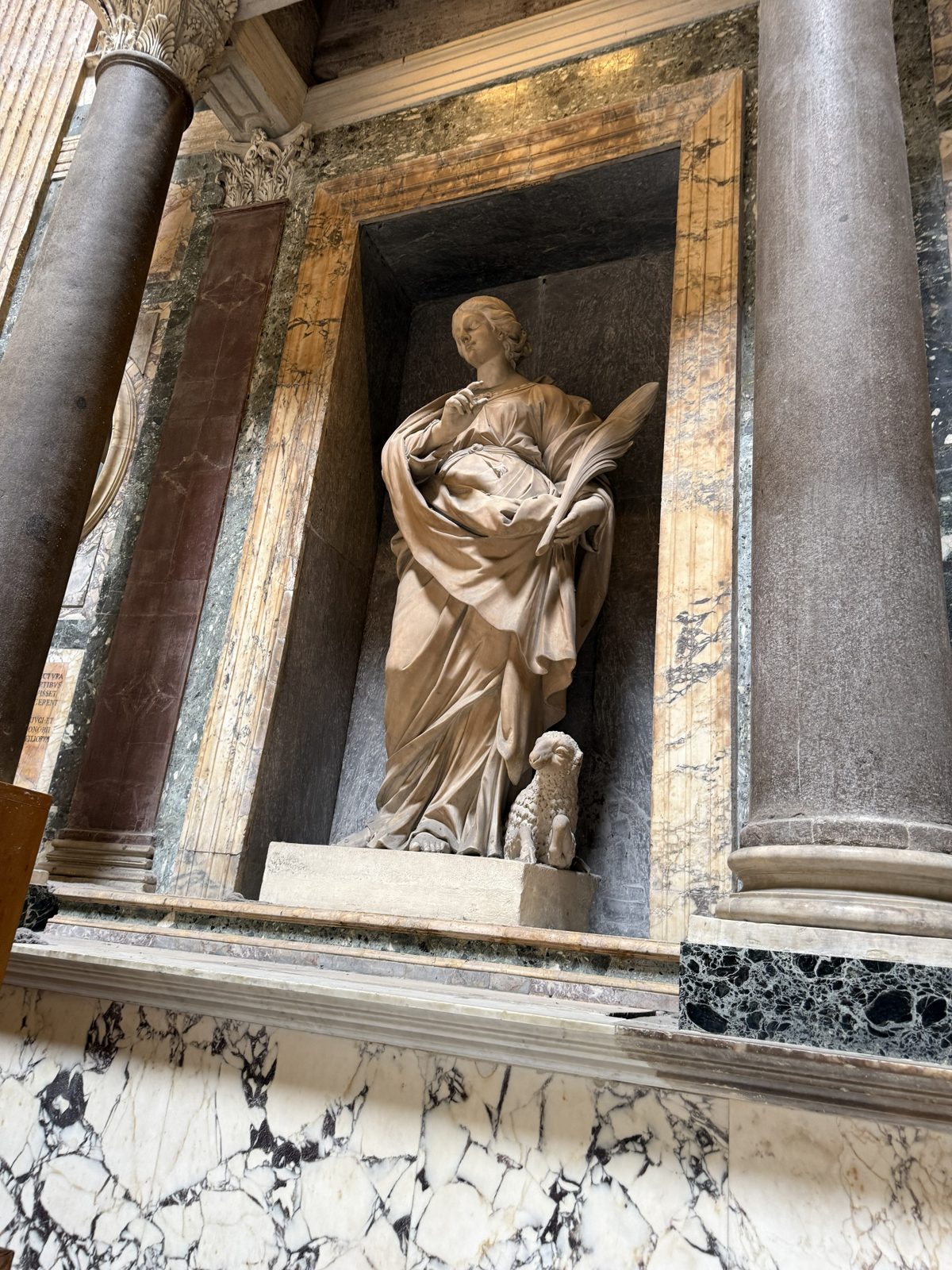
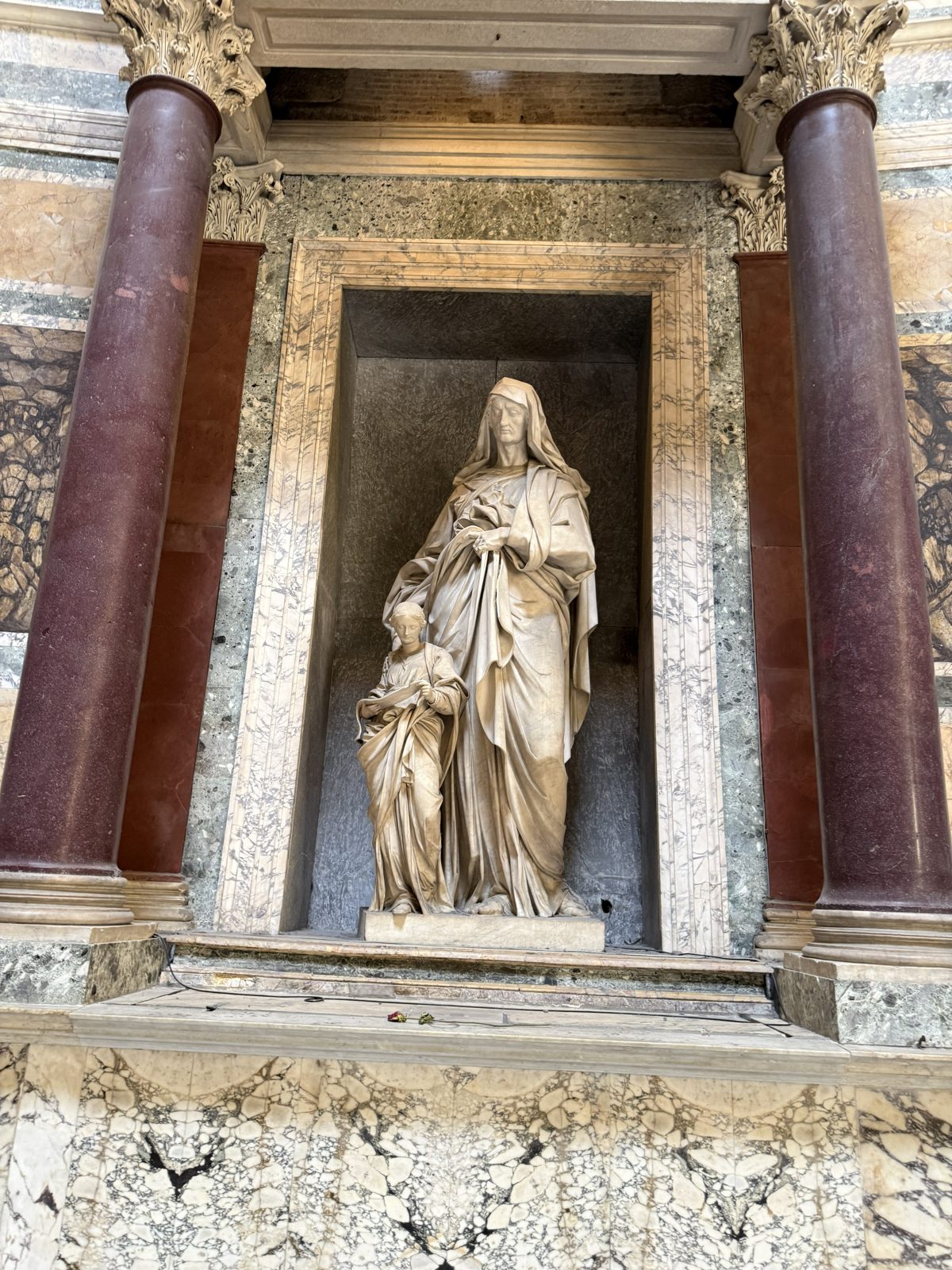
Two marble groups in the Pantheon's aedicules: St Agnes, a young woman holding the martyr's palm with a lamb at her feet; and St Anne watching over her young daughter, the Virgin Mary, who reads.
Dos grupos de mármol en los edículos del Panteón: Santa Inés, una joven que sostiene la palma del martirio con un cordero a sus pies; y Santa Ana cuidando a su hija pequeña, la Virgen María, que lee.
Both are early-18th-century works.
Ambas son obras de principios del siglo XVIII.
St Agnes was carved by Vincenzo Felici (c. 1700); St Anne and the Virgin is by Lorenzo Ottoni, nicknamed Il Lorenzone (c. 1715–16). Both sculptors belonged to the Virtuosi al Pantheon.
Santa Inés fue tallada por Vincenzo Felici (c. 1700); Santa Ana y la Virgen es de Lorenzo Ottoni, apodado Il Lorenzone (c. 1715–16). Ambos escultores pertenecían a los Virtuosi al Pantheon.
St Agnes's lamb is a play on her name (Latin agnus); the St Anne group is a tender image of the Virgin's own childhood and learning.
El cordero de Santa Inés es un juego con su nombre (en latín agnus); el grupo de Santa Ana es una imagen tierna de la infancia y el aprendizaje de la Virgen.
LocationThird aedicule, Pantheon, Rome
UbicaciónTercer edículo, Panteón, Roma
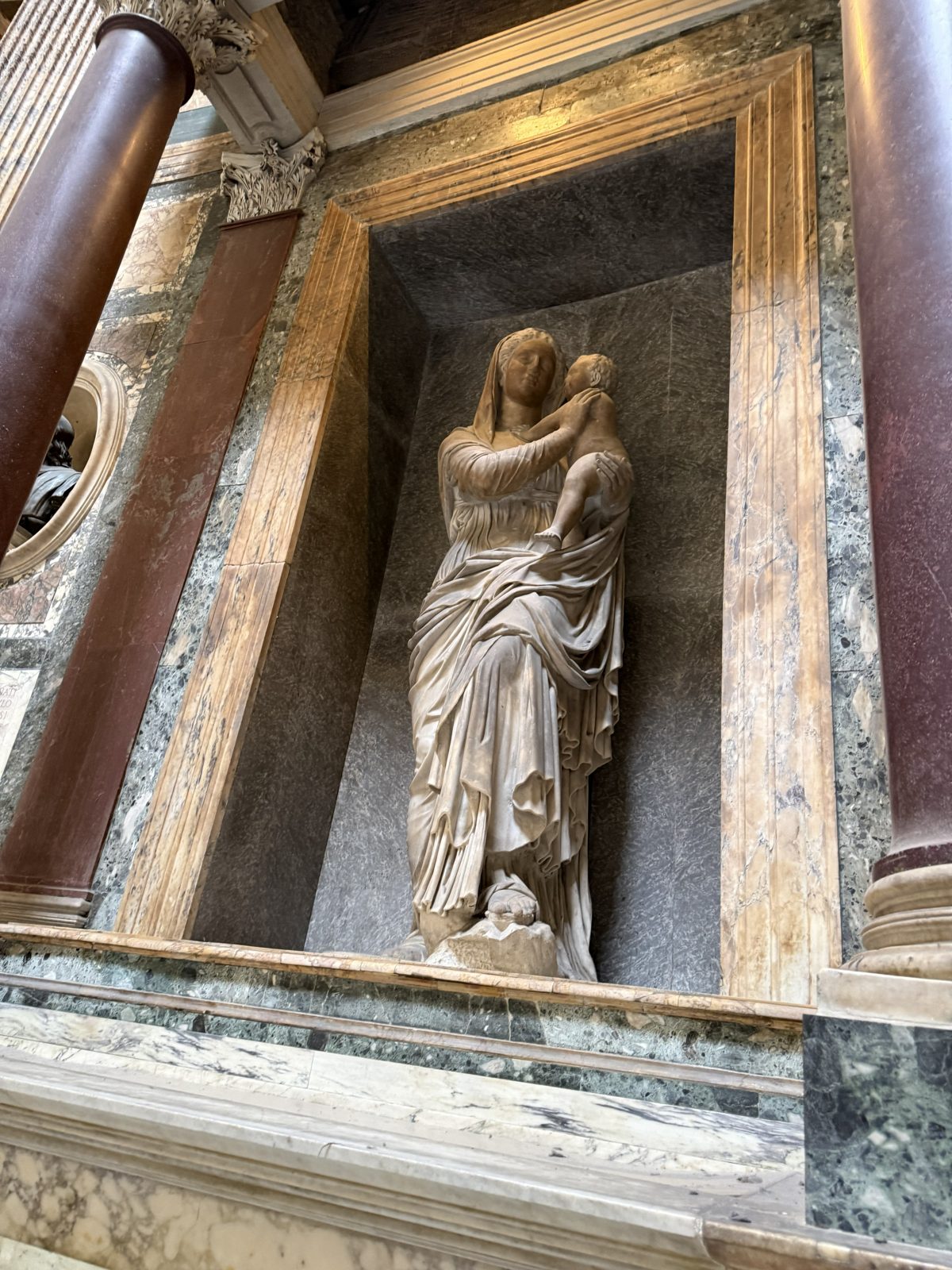
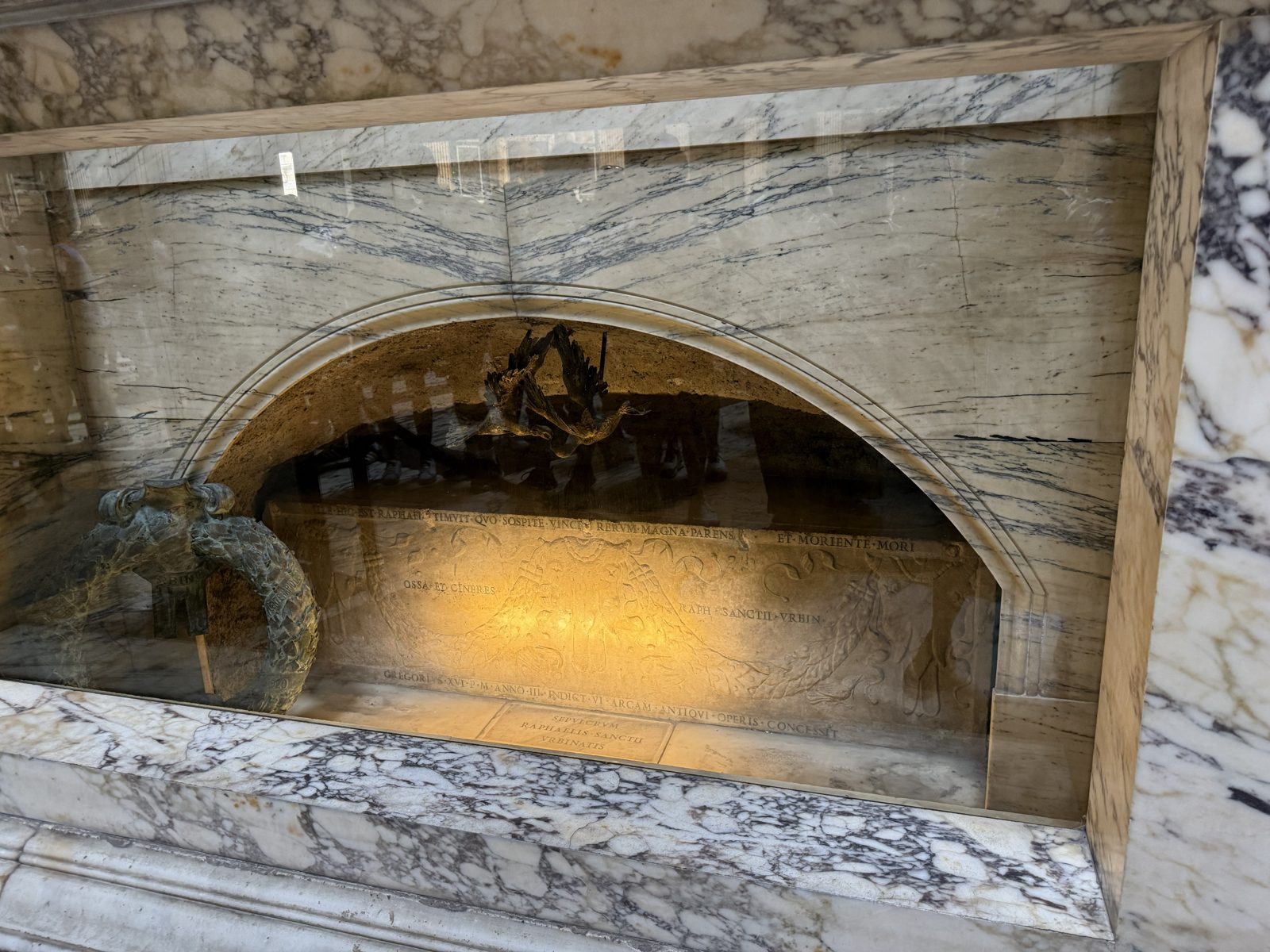
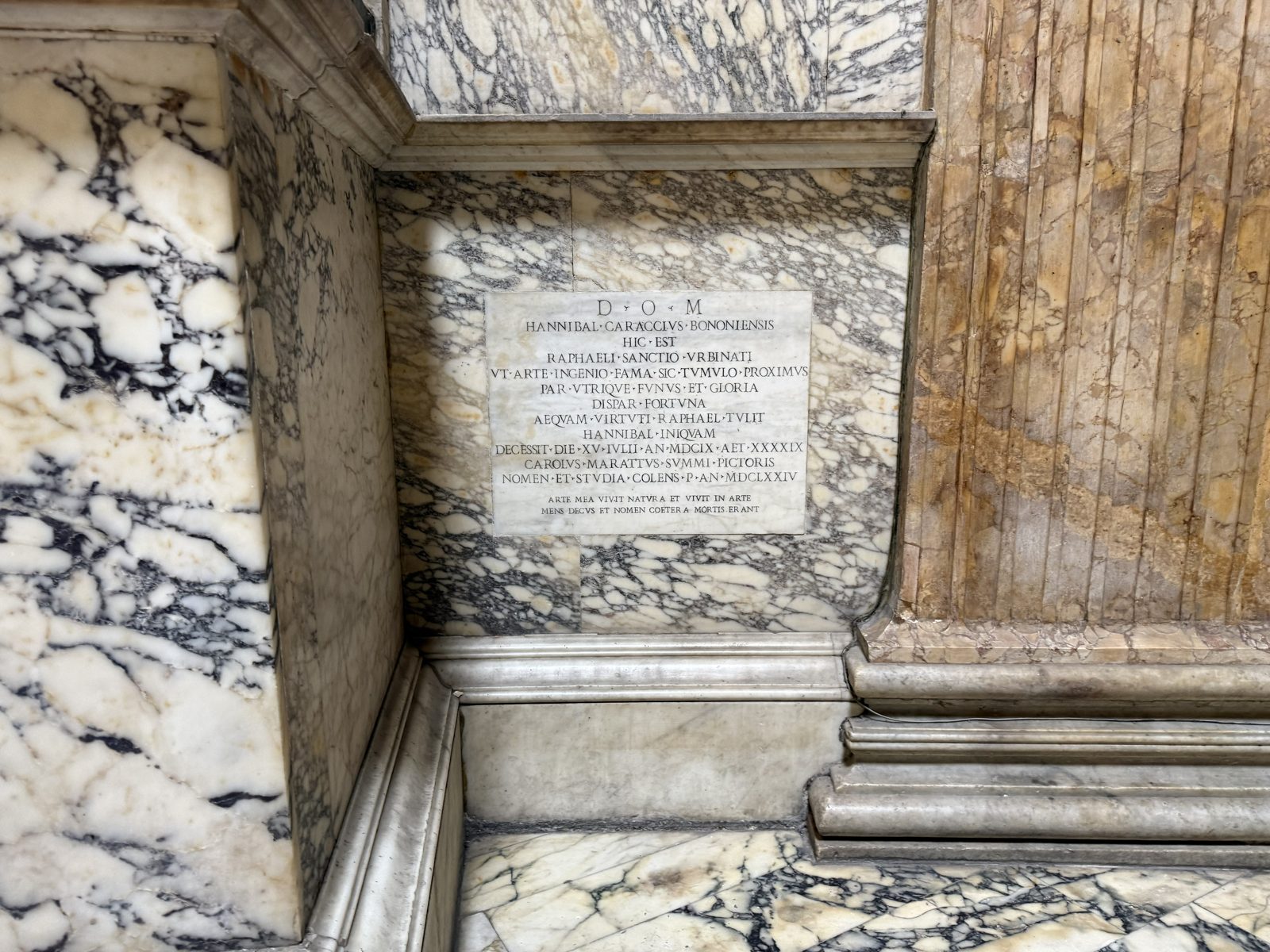
The tomb of the painter Raphael: a marble Madonna and Child above an ancient Roman sarcophagus, accompanied by the memorial epitaphs of Raphael, of his betrothed Maria Bibbiena, and of the painter Annibale Carracci, who is buried nearby.
La tumba del pintor Rafael: una Virgen con el Niño de mármol sobre un sarcófago romano antiguo, acompañada por los epitafios conmemorativos de Rafael, de su prometida Maria Bibbiena y del pintor Annibale Carracci, sepultado cerca.
“Here lies that Raphael by whom, while he lived, Mother Nature feared to be outdone, and when he died, feared to die herself.” — the epitaph composed by Pietro Bembo.
“Aquí yace aquel Rafael por quien, mientras vivió, la Madre Naturaleza temió ser superada, y al morir él, temió morir ella misma.” — epitafio compuesto por Pietro Bembo.
Raphael lived 1483–1520 and asked to be buried here; the Madonna above the tomb was made in 1523–24, and the Carracci memorial was placed in 1674.
Rafael vivió 1483–1520 y pidió ser sepultado aquí; la Virgen sobre la tumba se realizó en 1523–24, y el monumento a Carracci se colocó en 1674.
The Madonna del Sasso (“Madonna of the Stone”) was carved by Lorenzo Lotti, called Lorenzetto (1523–24), to Raphael's own commission — the first statue set up in the Pantheon after its Christian consecration. Raphael's remains lie in a reused ancient Roman sarcophagus granted by Pope Gregory XVI. The Annibale Carracci epitaph nearby was promoted by the painter Carlo Maratta (1674), and the Bust of Raphael is by Giuseppe Fabris (1833).
La Madonna del Sasso (“Virgen de la Piedra”) fue tallada por Lorenzo Lotti, llamado Lorenzetto (1523–24), por encargo del propio Rafael — la primera estatua colocada en el Panteón tras su consagración cristiana. Los restos de Rafael reposan en un sarcófago romano antiguo reutilizado, donado por el papa Gregorio XVI. El epitafio de Annibale Carracci, cercano, fue promovido por el pintor Carlo Maratta (1674), y el Busto de Rafael es de Giuseppe Fabris (1833).
The grave of the most celebrated painter of the High Renaissance, whose burial in the Pantheon made the building a shrine for illustrious artists.
La tumba del pintor más célebre del Alto Renacimiento, cuyo entierro en el Panteón convirtió al edificio en un santuario para artistas ilustres.
LocationPantheon, Rome
UbicaciónPanteón, Roma
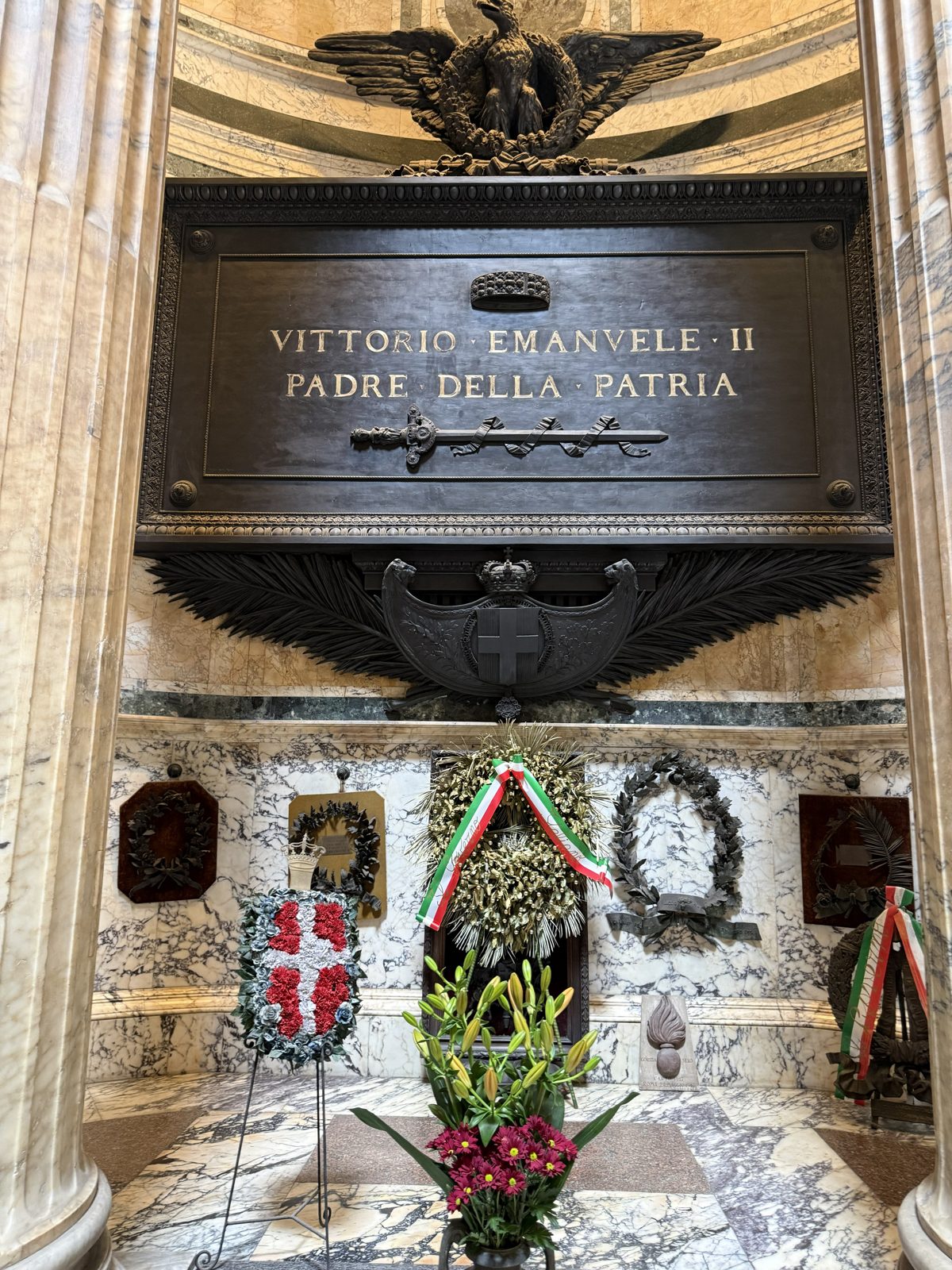
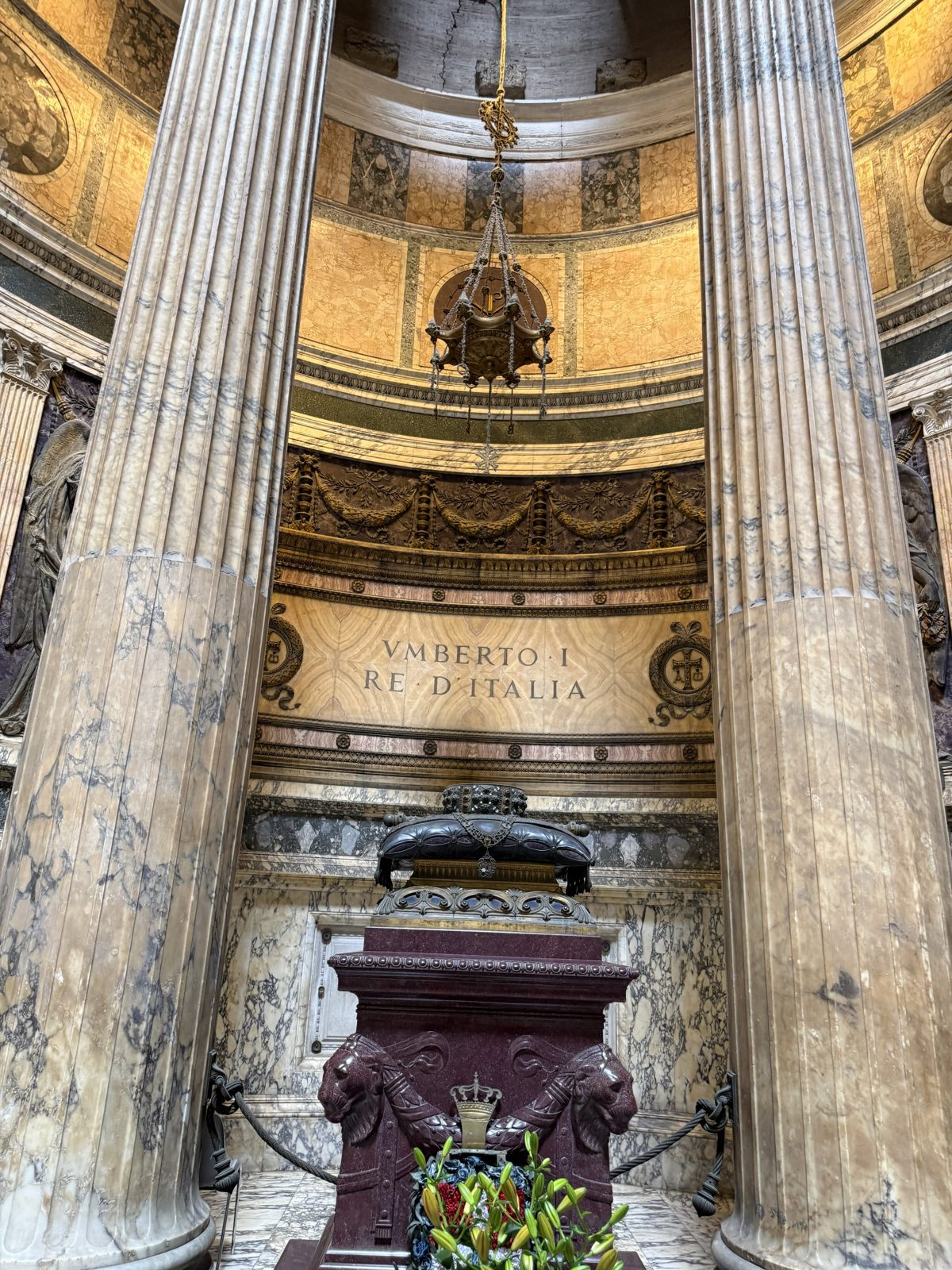
The tombs of the first two kings of a united Italy. The tomb of Vittorio Emanuele II is a great bronze tablet beneath a spread-winged imperial eagle; opposite, the tomb of Umberto I and Queen Margherita is a deep-red porphyry sarcophagus with bronze lion heads, crowned by a royal crown on a cushion.
Las tumbas de los dos primeros reyes de una Italia unida. La tumba de Víctor Manuel II es una gran placa de bronce bajo un águila imperial con las alas extendidas; enfrente, la tumba de Umberto I y la reina Margarita es un sarcófago de pórfido rojo oscuro con cabezas de león de bronce, coronado por una corona real sobre un cojín.
“Victor Emmanuel II, Father of the Fatherland.” / “Umberto I, King of Italy.”
“Víctor Manuel II, Padre de la Patria.” / “Umberto I, Rey de Italia.”
Vittorio Emanuele II (1820–1878); his tomb was built 1885–1888. Umberto I (1844–1900) and Queen Margherita (1851–1926); their tomb dates to 1910.
Víctor Manuel II (1820–1878); su tumba se construyó en 1885–1888. Umberto I (1844–1900) y la reina Margarita (1851–1926); su tumba data de 1910.
The tomb of Vittorio Emanuele II was designed by the architect Manfredo Manfredi (1885–1888). The tomb of Umberto I and Margherita is by Giuseppe Sacconi (1910), the architect of the Vittoriano. Umberto I was assassinated in 1900.
La tumba de Víctor Manuel II fue diseñada por el arquitecto Manfredo Manfredi (1885–1888). La tumba de Umberto I y Margarita es de Giuseppe Sacconi (1910), el arquitecto del Vittoriano. Umberto I fue asesinado en 1900.
The Pantheon as a national shrine of the Italian monarchy; a volunteer honour guard still keeps watch at the royal tombs.
El Panteón como santuario nacional de la monarquía italiana; una guardia de honor voluntaria todavía vela ante las tumbas reales.
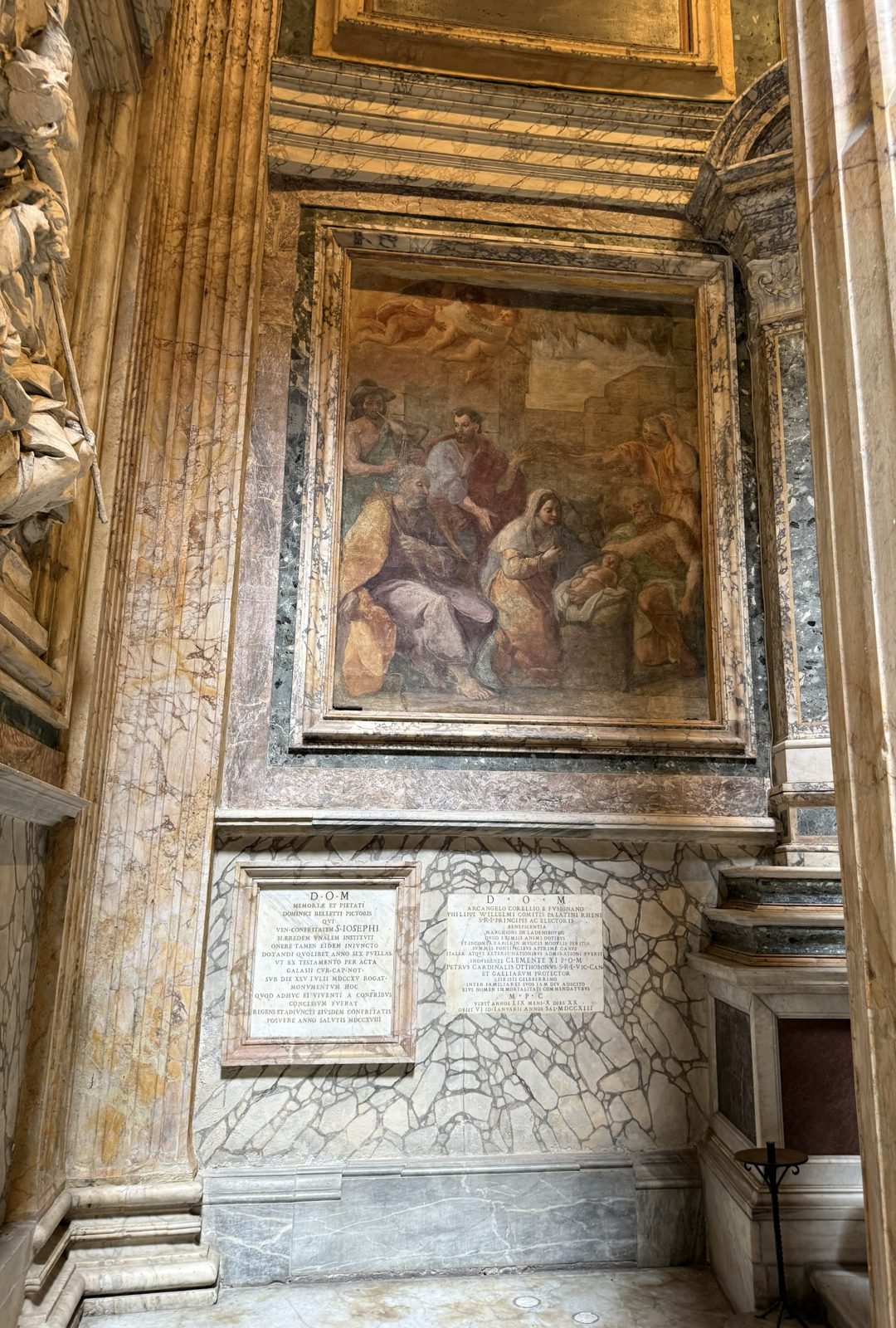
LocationChapel of St Joseph, Pantheon, Rome
UbicaciónCapilla de San José, Panteón, Roma
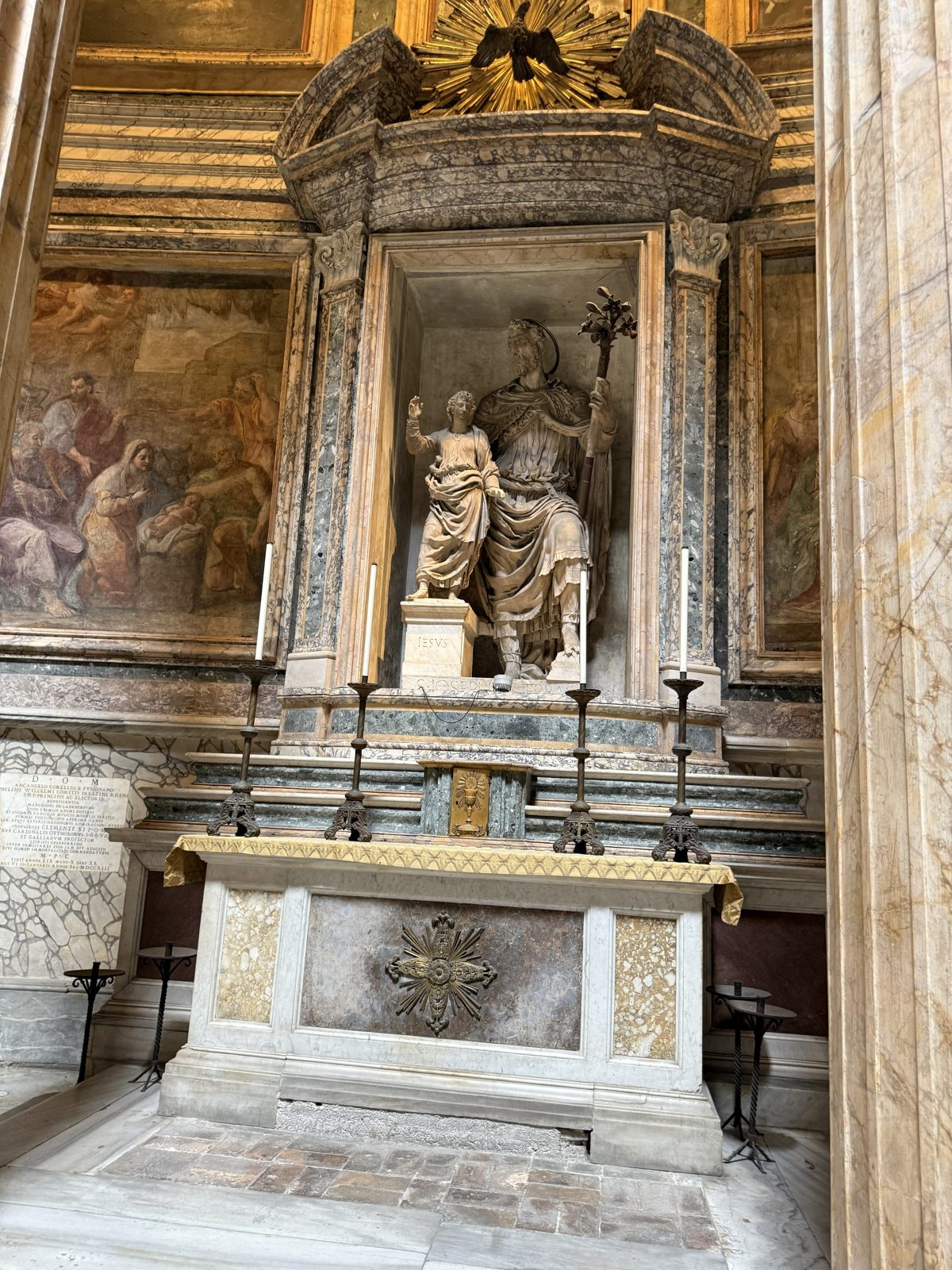
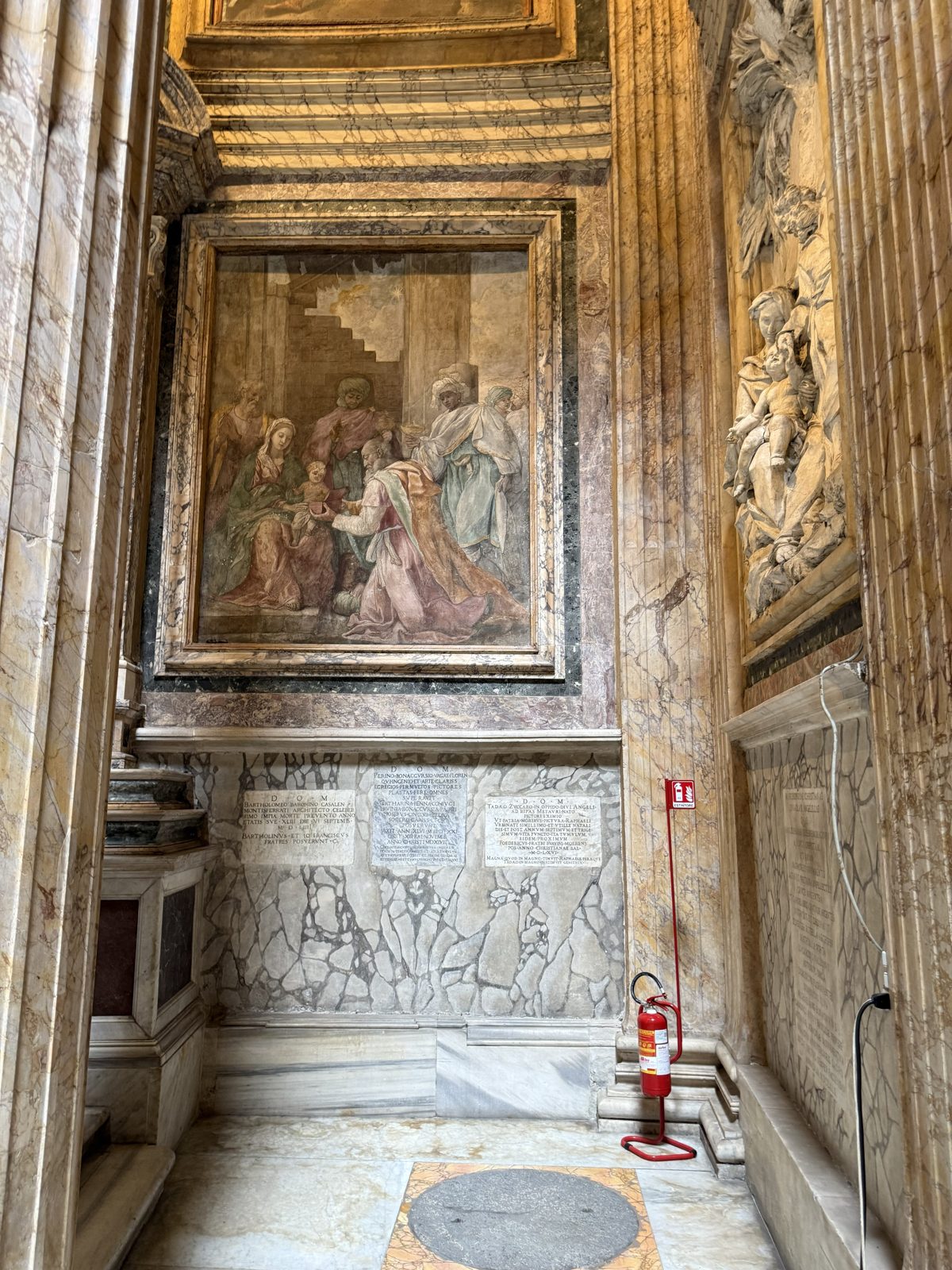
The chapel of the Accademia dei Virtuosi al Pantheon. Its altar holds a marble group of St Joseph with the Christ Child; the side walls carry Cozza's Adoration of the Shepherds and Adoration of the Magi; and the lower walls bear the tombs of illustrious artists, among them the composer Arcangelo Corelli.
La capilla de la Accademia dei Virtuosi al Pantheon. Su altar contiene un grupo de mármol de San José con el Niño Jesús; los muros laterales muestran la Adoración de los Pastores y la Adoración de los Magos de Cozza; y los muros inferiores guardan las tumbas de artistas ilustres, entre ellos el compositor Arcangelo Corelli.
From the Corelli memorial: “To Arcangelo Corelli ... he lived 59 years ... he died on 6 January 1713.”
Del monumento a Corelli: “A Arcangelo Corelli ... vivió 59 años ... murió el 6 de enero de 1713.”
The St Joseph statue dates to 1548 and Cozza's two canvases to 1661; the artists' tombs span the 16th to 18th centuries.
La estatua de San José data de 1548 y los dos lienzos de Cozza de 1661; las tumbas de los artistas abarcan del siglo XVI al XVIII.
The St Joseph and the Holy Child is by Vincenzo de' Rossi (1548); the Adoration of the Shepherds and Adoration of the Magi are by Francesco Cozza (1661), himself one of the Virtuosi. Buried here are members of the academy — among them the composer Arcangelo Corelli (1653–1713, his monument promoted by Cardinal Pietro Ottoboni), the sculptor Flaminio Vacca, the painters Perino del Vaga and Taddeo Zuccari, and the architect Bartolomeo Baronino.
El San José con el Niño es de Vincenzo de' Rossi (1548); la Adoración de los Pastores y la Adoración de los Magos son de Francesco Cozza (1661), él mismo uno de los Virtuosi. Aquí están sepultados miembros de la academia — entre ellos el compositor Arcangelo Corelli (1653–1713, su monumento promovido por el cardenal Pietro Ottoboni), el escultor Flaminio Vacca, los pintores Perino del Vaga y Taddeo Zuccari, y el arquitecto Bartolomeo Baronino.
The seat of the Pantheon's academy of artists and the resting place of some of Italy's great painters, sculptors and musicians.
La sede de la academia de artistas del Panteón y el lugar de descanso de algunos de los grandes pintores, escultores y músicos de Italia.
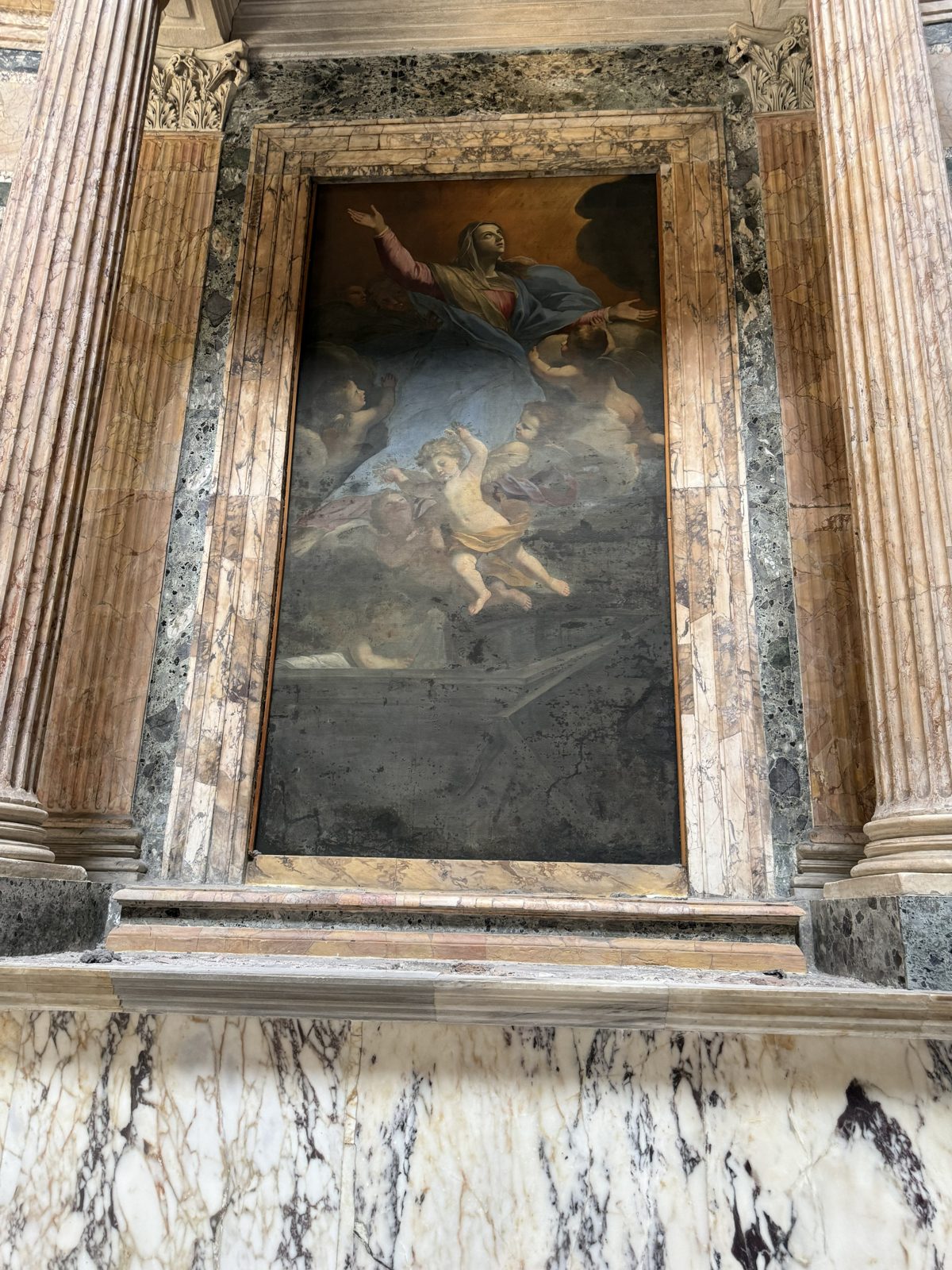
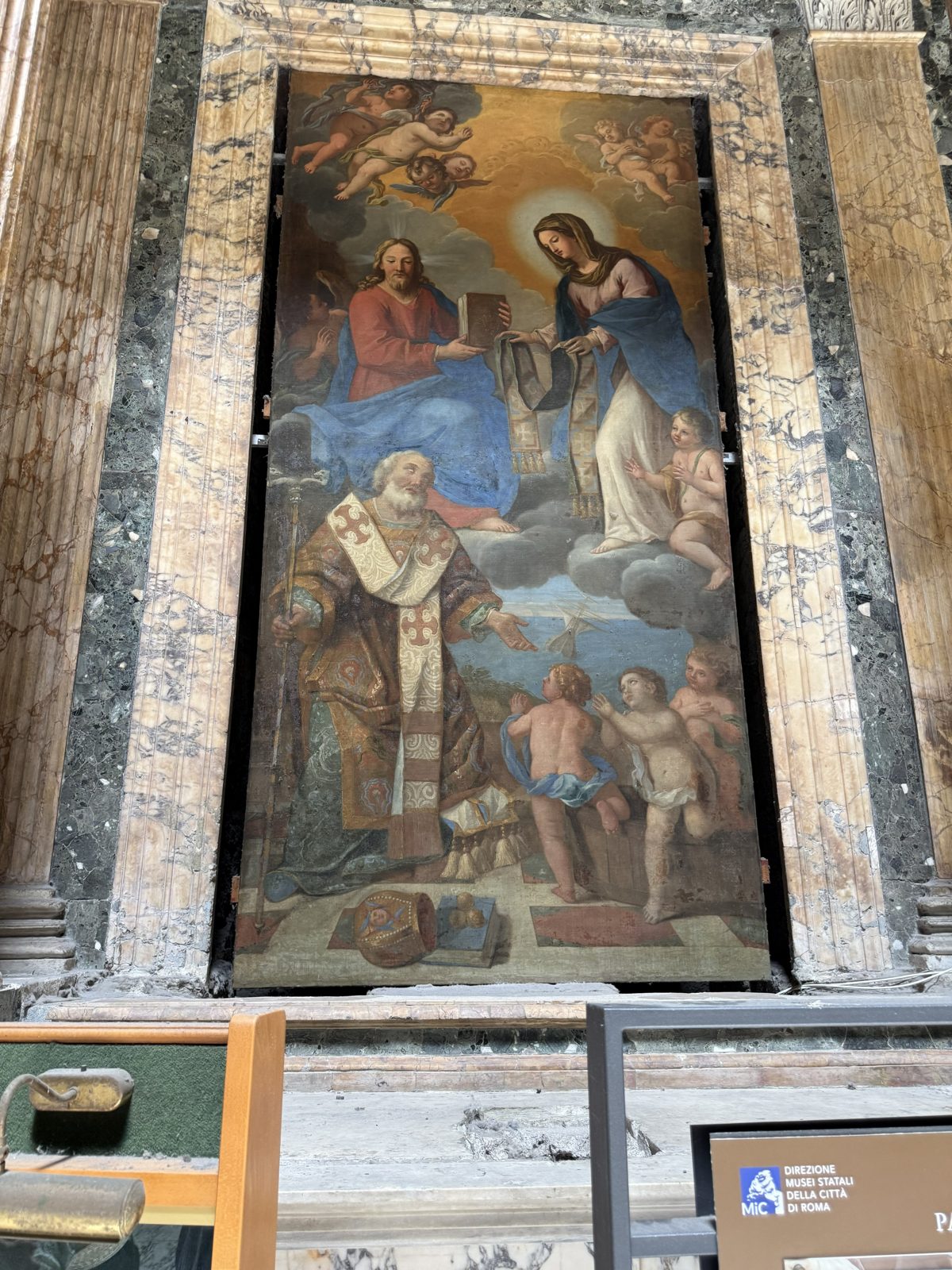
LocationAedicules of the Pantheon, Rome
UbicaciónEdículos del Panteón, Roma
Two altarpieces. The Assumption of the Virgin shows Mary rising heavenward from her tomb, borne by angels; the Madonna of the Girdle with St Nicholas of Bari shows the Virgin handing down her girdle to the bishop saint, with a ship at sea below.
Dos retablos. La Asunción de la Virgen muestra a María ascendiendo al cielo desde su tumba, llevada por ángeles; la Virgen del Cíngulo con San Nicolás de Bari muestra a la Virgen entregando su cíngulo al santo obispo, con un barco en el mar abajo.
The Assumption dates to 1638; the Madonna of the Girdle with St Nicholas to 1686.
La Asunción data de 1638; la Virgen del Cíngulo con San Nicolás, de 1686.
The Assumption is by Andrea Camassei (1638), a pupil of Domenichino. The Madonna of the Girdle and St Nicholas of Bari (1686) is by an unknown artist. When photographed, the St Nicholas canvas had been taken out of its frame for restoration.
La Asunción es de Andrea Camassei (1638), discípulo de Domenichino. La Virgen del Cíngulo y San Nicolás de Bari (1686) es de un artista desconocido. Al fotografiarse, el lienzo de San Nicolás había sido retirado de su marco para su restauración.
Two of the Pantheon's Baroque side altars; St Nicholas, shown with his ship, is the patron saint of sailors.
Dos de los altares laterales barrocos del Panteón; San Nicolás, representado con su barco, es el santo patrono de los marineros.
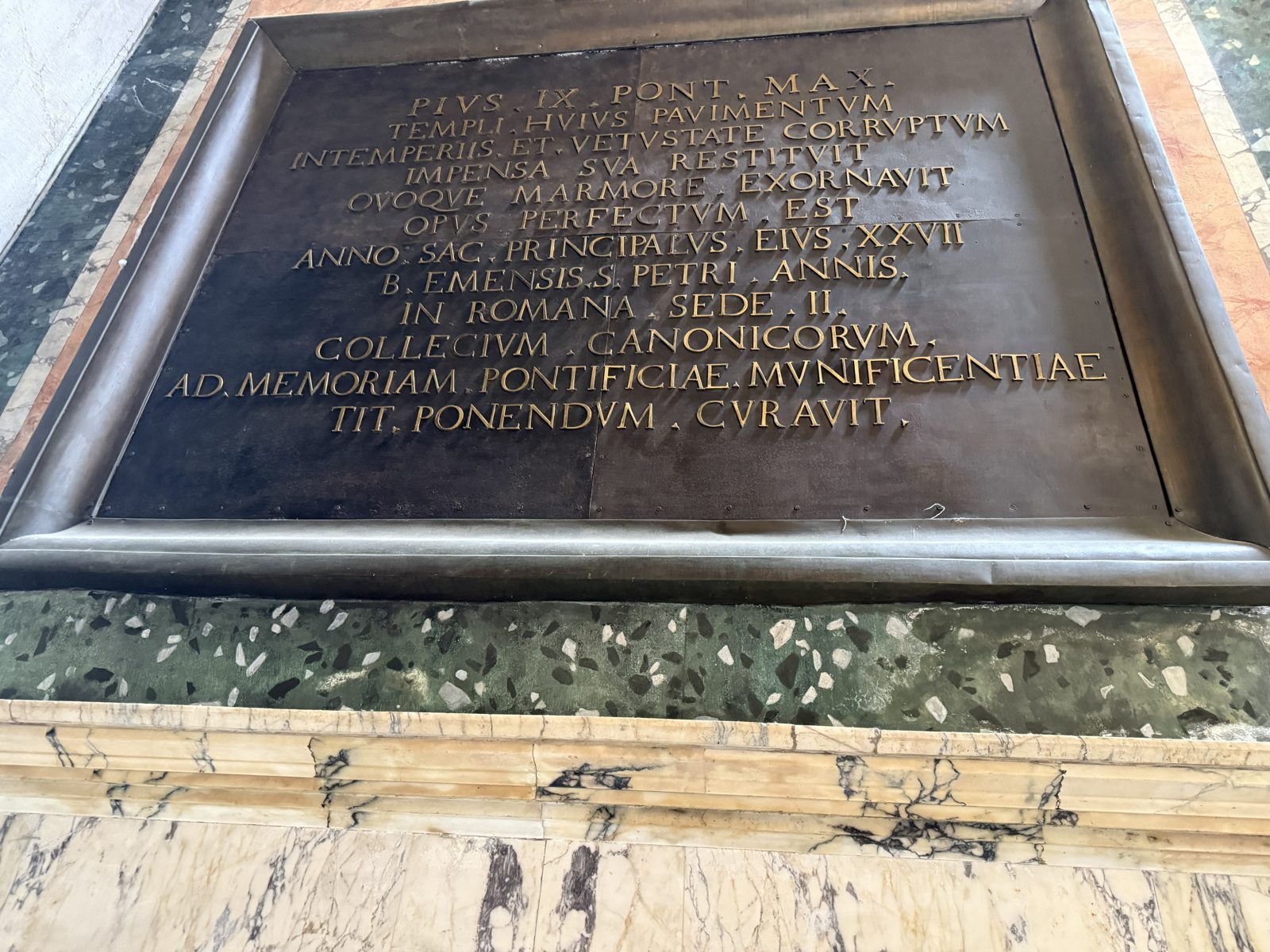
LocationPantheon (Santa Maria ad Martyres), Rome
UbicaciónPanteón (Santa Maria ad Martyres), Roma
Commemorative marble and bronze inscriptions that record the basilica's papal patrons — including the bronze plaque of Pope Pius IX recording his 19th-century restoration of the temple's floor.
Inscripciones conmemorativas de mármol y bronce que registran a los patronos papales de la basílica — incluida la placa de bronce del papa Pío IX que recuerda su restauración del piso del templo en el siglo XIX.
“Pius IX, Supreme Pontiff, restored at his own expense the pavement of this temple, corrupted by weather and age, and adorned it with marble.”
“Pío IX, Sumo Pontífice, restauró a su propia costa el pavimento de este templo, dañado por la intemperie y la vejez, y lo adornó con mármol.”
The floor restoration was completed in the 27th year of Pius IX's pontificate, about 1872–73. Earlier papal works recorded in the Pantheon include those of Urban VIII (1632) and the indulgence bull of Clement XI (early 18th century).
La restauración del piso se completó en el año 27 del pontificado de Pío IX, hacia 1872–73. Otras obras papales registradas en el Panteón incluyen las de Urbano VIII (1632) y la bula de indulgencia de Clemente XI (principios del siglo XVIII).
The pavement plaque was placed by the Pantheon's College of Canons under Pope Pius IX (reigned 1846–1878).
La placa del pavimento fue colocada por el Colegio de Canónigos del Panteón bajo el papa Pío IX (reinó 1846–1878).
These inscriptions trace the long Christian custody of the building — from its consecration in 609 AD through the papal restorations that kept it standing.
Estas inscripciones trazan la larga custodia cristiana del edificio — desde su consagración en el 609 d.C. hasta las restauraciones papales que lo mantuvieron en pie.
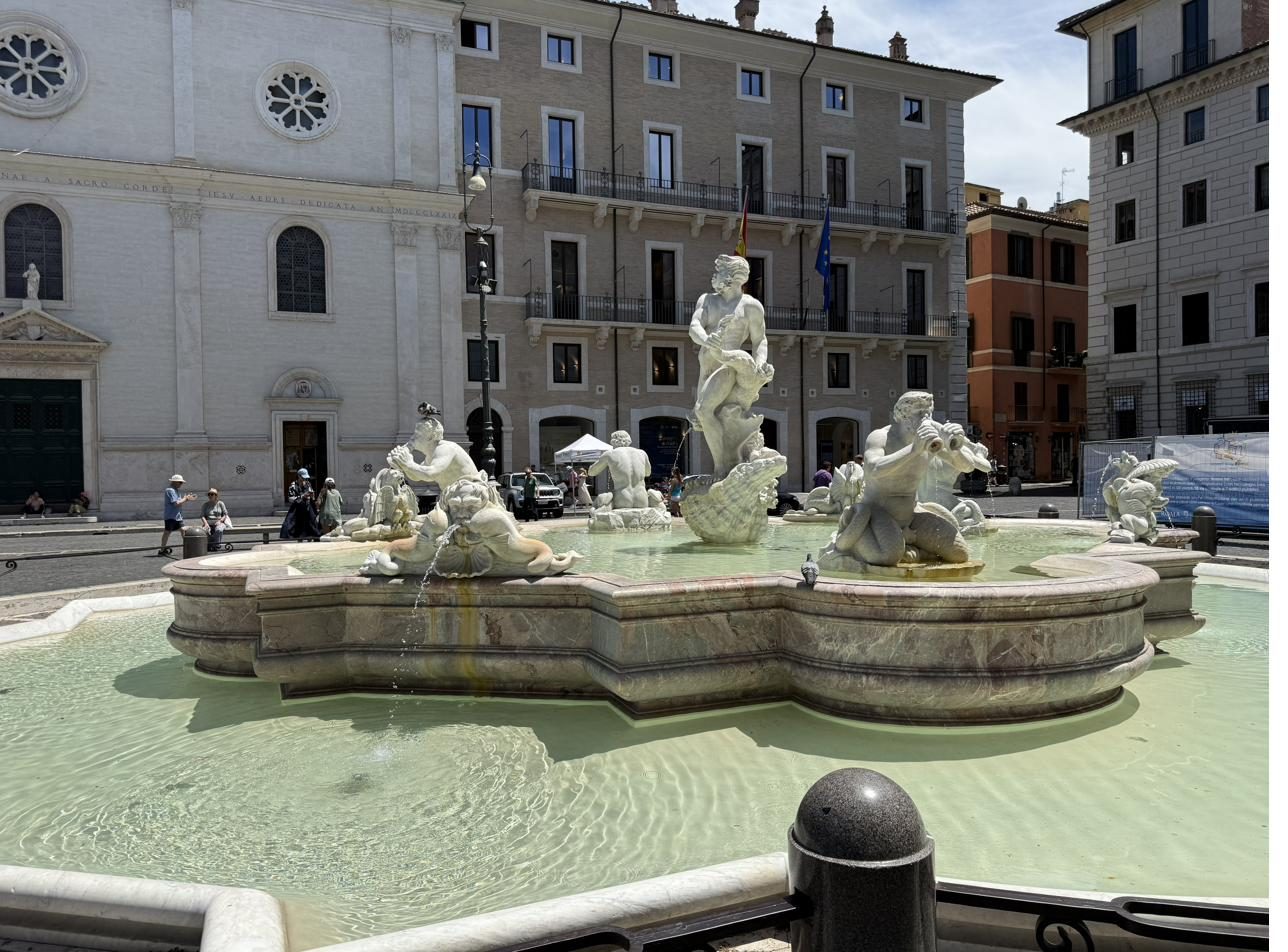
LocationSouthern end of Piazza Navona, Rome
UbicaciónExtremo sur de la Piazza Navona, Roma
A monumental Baroque fountain set in a rose-and-white marble basin of concave lobes. At its center a powerfully muscled marine figure — popularly called ‘the Moor’ — stands on a large conch shell, gripping and wrestling a dolphin whose mouth jets water. Four Tritons and marine masks ride the rim around him. The fountain stands before the Palazzo Pamphilj and the white church of Nostra Signora del Sacro Cuore; looking north up the square, the obelisk of Bernini’s Fountain of the Four Rivers rises beyond. These four views were taken around the basin to show the central group from the front, side and rear.
Una monumental fuente barroca dispuesta en una pila de mármol rosado y blanco de lóbulos cóncavos. En su centro, una figura marina de poderosa musculatura — llamada popularmente ‘el Moro’ — se yergue sobre una gran concha, sujetando y luchando con un delfín de cuya boca brota el agua. Cuatro tritones y mascarones marinos rodean el borde. La fuente se alza frente al Palazzo Pamphilj y a la iglesia blanca de Nostra Signora del Sacro Cuore; mirando al norte de la plaza, al fondo se eleva el obelisco de la Fuente de los Cuatro Ríos, de Bernini. Estas cuatro vistas se tomaron alrededor de la pila para mostrar el grupo central de frente, de lado y por detrás.
“Church dedicated to Our Lady of the Sacred Heart of Jesus, in the year 1879.” This is the facade of the church of Nostra Signora del Sacro Cuore (formerly San Giacomo degli Spagnoli), not part of the fountain. The fountain itself carries no inscription. (The ‘PRADA’ lettering in some views is a modern advertising hoarding over a building under restoration.)
“Iglesia dedicada a Nuestra Señora del Sagrado Corazón de Jesús, en el año 1879.” Es la fachada de la iglesia de Nostra Signora del Sacro Cuore (antes San Giacomo degli Spagnoli), que no forma parte de la fuente. La fuente en sí no lleva inscripción. (El letrero ‘PRADA’ que aparece en algunas vistas es una valla publicitaria moderna sobre un edificio en restauración.)
The marble basin was made by Giacomo della Porta in 1575–76. The central figure of the Moor was designed by Bernini and carved by Giovanni Antonio Mari in 1653–55, when the outer basin was also enlarged — so the fountain combines work roughly 450 and 370 years old. Importantly, the marble figures seen today are copies made in 1874; the weathered originals were moved indoors for preservation.
La pila de mármol fue realizada por Giacomo della Porta en 1575–76. La figura central del Moro fue diseñada por Bernini y tallada por Giovanni Antonio Mari en 1653–55, cuando también se amplió la pila exterior — de modo que la fuente combina obras de unos 450 y 370 años de antigüedad. Es importante señalar que las figuras de mármol que se ven hoy son copias hechas en 1874; los originales, desgastados, se trasladaron a cubierto para su conservación.
The basin and the original marine masks are by Giacomo della Porta (1575–76). The central Moor was designed by Gian Lorenzo Bernini (1598–1680) — the master of the Roman Baroque — and carved by Giovanni Antonio Mari (1653–55), commissioned under Pope Innocent X and funded by Olimpia Maidalchini. The Tritons and masks now in the fountain are copies made by Luigi Amici in 1874; the originals are preserved in Rome’s museum collections.
La pila y los mascarones marinos originales son de Giacomo della Porta (1575–76). El Moro central fue diseñado por Gian Lorenzo Bernini (1598–1680) — el maestro del barroco romano — y tallado por Giovanni Antonio Mari (1653–55), por encargo del papa Inocencio X y financiado por Olimpia Maidalchini. Los tritones y mascarones que hoy están en la fuente son copias hechas por Luigi Amici en 1874; los originales se conservan en las colecciones museísticas de Roma.
One of the three monumental fountains of Piazza Navona — with Bernini’s Fountain of the Four Rivers at the centre and the Fountain of Neptune at the north end. The square itself preserves the shape of the ancient Stadium of Domitian (1st century AD). The Moor epitomises Baroque sculpture: torsion, muscular energy and violent motion frozen in stone, and it shows how della Porta’s Renaissance fountain was transformed a century later by Bernini.
Una de las tres fuentes monumentales de la Piazza Navona — junto con la Fuente de los Cuatro Ríos de Bernini en el centro y la Fuente de Neptuno en el extremo norte. La propia plaza conserva la forma del antiguo Estadio de Domiciano (siglo I d.C.). El Moro resume la escultura barroca: torsión, energía muscular y movimiento violento congelados en piedra, y muestra cómo la fuente renacentista de della Porta fue transformada un siglo después por Bernini.
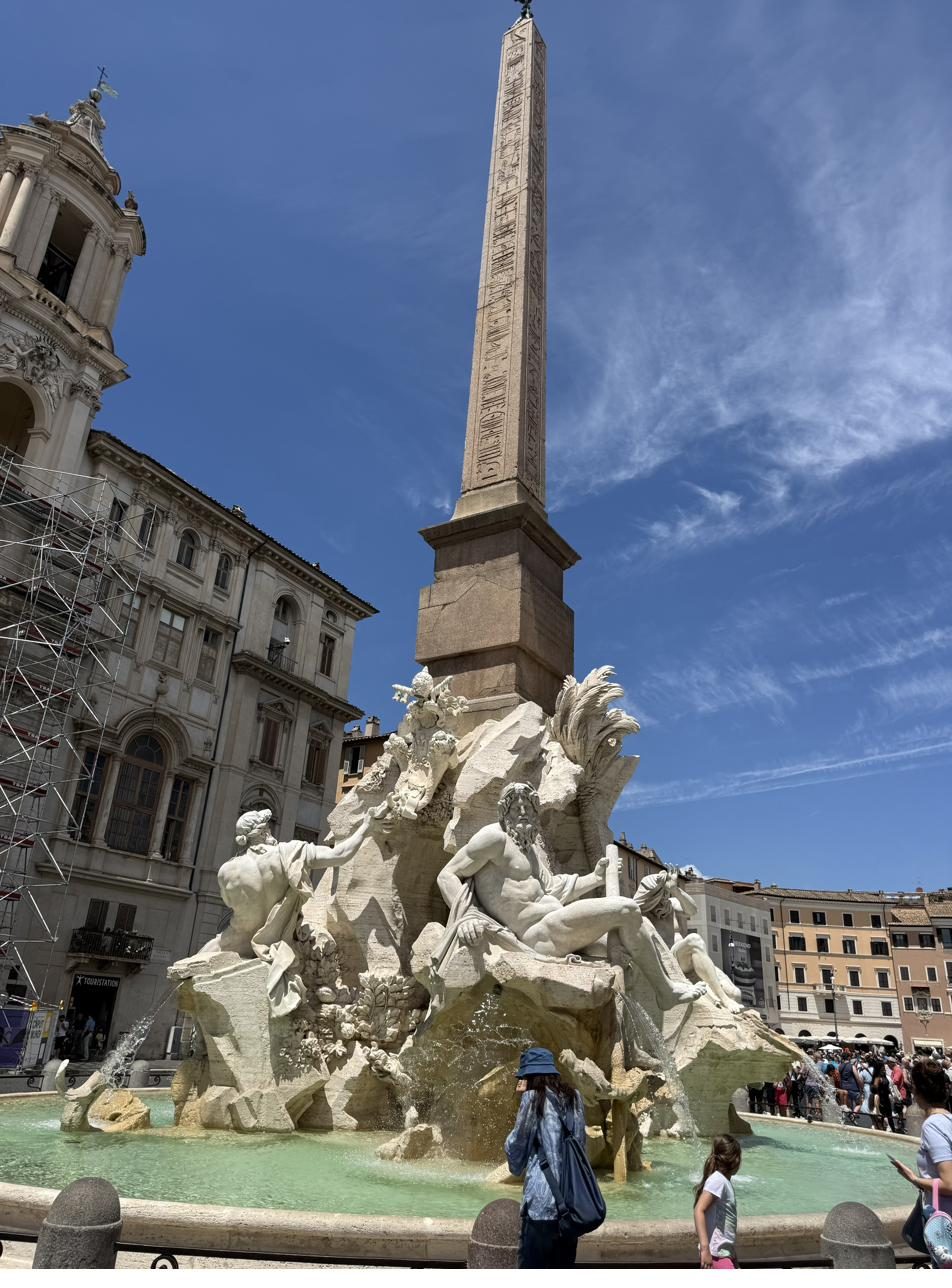
LocationCentre of Piazza Navona, Rome
UbicaciónCentro de la Piazza Navona, Roma
Bernini’s great Baroque fountain at the heart of Piazza Navona. From a hollowed travertine rock rise four colossal marble river gods personifying the Nile, Ganges, Danube and Río de la Plata — the great rivers of the four then-known continents — amid carved palms, rocks and animals (a lion, a horse, a serpent). Crowning the rock is an ancient Roman-Egyptian obelisk topped by a bronze dove with an olive branch, emblem of the Pamphilj pope who commissioned it. These views move around the fountain to show the river gods, the central papal arms, the rising obelisk, and the work in its setting before the church of Sant’Agnese in Agone.
La gran fuente barroca de Bernini en el corazón de la Piazza Navona. De una roca ahuecada de travertino se elevan cuatro colosales dioses fluviales de mármol que personifican el Nilo, el Ganges, el Danubio y el Río de la Plata — los grandes ríos de los cuatro continentes entonces conocidos — entre palmeras, rocas y animales tallados (un león, un caballo, una serpiente). Coronando la roca hay un antiguo obelisco egipcio de época romana rematado por una paloma de bronce con una rama de olivo, emblema del papa Pamphilj que la encargó. Estas vistas rodean la fuente para mostrar los dioses fluviales, el escudo papal central, el obelisco y la obra en su entorno ante la iglesia de Sant’Agnese in Agone.
The hieroglyphs were cut in Roman times, not in ancient Egypt, and the base plaques record that Pope Innocent X raised the obelisk and fountain. The lettering is not legible enough in these photographs to transcribe in full, so this is given as a summary rather than a word-for-word reading. The crowning bronze dove with an olive branch is the heraldic emblem of the Pamphilj family.
Los jeroglíficos se tallaron en época romana, no en el antiguo Egipto, y las placas de la base recuerdan que el papa Inocencio X erigió el obelisco y la fuente. Las letras no son lo bastante legibles en estas fotografías para transcribirlas por completo, así que esto se ofrece como resumen y no como lectura literal. La paloma de bronce con la rama de olivo que la corona es el emblema heráldico de la familia Pamphilj.
Designed and built by Bernini between 1648 and 1651 and unveiled on 12 June 1651 — about 375 years ago. The obelisk it carries is older still: a 1st-century AD obelisk made in Roman Egypt under the emperor Domitian, brought here and re-erected for the fountain.
Diseñada y construida por Bernini entre 1648 y 1651, e inaugurada el 12 de junio de 1651 — hace unos 375 años. El obelisco que sostiene es aún más antiguo: un obelisco del siglo I d.C. fabricado en el Egipto romano bajo el emperador Domiciano, traído aquí y vuelto a erigir para la fuente.
Designed by Gian Lorenzo Bernini (1598–1680) for Pope Innocent X. Bernini conceived the whole and supervised it, while specialists in his studio carved the four river gods: the Nile by Giacomo Antonio Fancelli, the Ganges by Claude Poussin, the Danube by Antonio Raggi, and the Río de la Plata by Francesco Baratta (1650–51).
Diseñada por Gian Lorenzo Bernini (1598–1680) para el papa Inocencio X. Bernini concibió el conjunto y lo supervisó, mientras que especialistas de su taller tallaron los cuatro dioses fluviales: el Nilo, de Giacomo Antonio Fancelli; el Ganges, de Claude Poussin; el Danubio, de Antonio Raggi; y el Río de la Plata, de Francesco Baratta (1650–51).
One of the supreme achievements of the Roman Baroque. The four rivers and continents proclaim the worldwide reach of the Church under the Pamphilj pope. It is famous for Bernini’s illusionistic daring — the heavy obelisk seems to balance on a rock pierced with open voids — and for figures that twist and strain as if moving like the rivers they personify. It anchors Piazza Navona, which preserves the shape of the ancient Stadium of Domitian, and faces Borromini’s Sant’Agnese in Agone — the source of the old legend that the Plata recoils in horror from the church, a story impossible in fact, since the church was built after the fountain.
Uno de los logros supremos del barroco romano. Los cuatro ríos y continentes proclaman el alcance mundial de la Iglesia bajo el papa Pamphilj. Es célebre por la audacia ilusionista de Bernini — el pesado obelisco parece sostenerse sobre una roca horadada de huecos — y por unas figuras que se retuercen y tensan como si se movieran igual que los ríos que personifican. Ancla la Piazza Navona, que conserva la forma del antiguo Estadio de Domiciano, y mira hacia la Sant’Agnese in Agone de Borromini — origen de la vieja leyenda de que el Plata se aparta horrorizado de la iglesia, historia imposible en realidad, pues la iglesia se construyó después de la fuente.
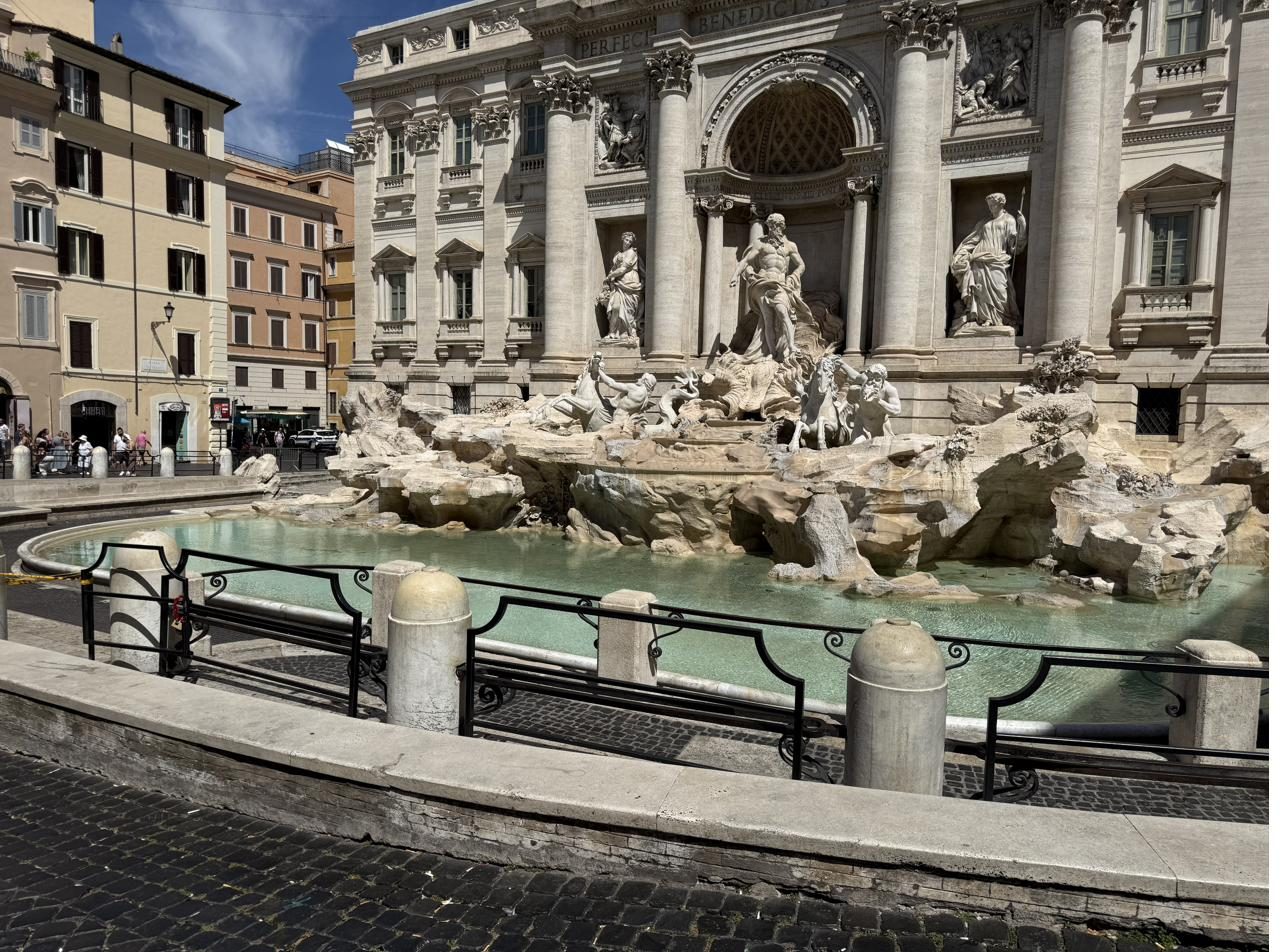
LocationPiazza di Trevi, Rome
UbicaciónPiazza di Trevi, Roma
The largest and most famous Baroque fountain in Rome, built against the rear facade of the Palazzo Poli like a great triumphal arch. At the centre the sea god Oceanus rides a shell-shaped chariot drawn by two sea horses, each led by a Triton — one horse rearing and wild, the other calm, for the changing moods of the sea. In niches to either side stand the allegories of Abundance and Health, and carved travertine rocks spill forward into a wide basin. These views move around the fountain to show the central group, the two side niches, and the rockwork meeting the square.
La fuente barroca más grande y famosa de Roma, construida contra la fachada posterior del Palazzo Poli como un gran arco de triunfo. En el centro, el dios del mar Océano avanza en un carro en forma de concha tirado por dos caballos marinos, cada uno guiado por un tritón — un caballo encabritado e indómito, el otro sereno, por los cambiantes estados del mar. En nichos a cada lado se alzan las alegorías de la Abundancia y la Salud, y rocas talladas de travertino se derraman hacia una amplia pila. Estas vistas rodean la fuente para mostrar el grupo central, los dos nichos laterales y la roca al encontrarse con la plaza.
“Pope Clement XII adorned with magnificent decoration the Aqua Virgo — commended for its abundance and healthfulness — in the year of the Lord 1735, the sixth year of his pontificate.” The Aqua Virgo is the ancient Roman aqueduct (19 BC) that still feeds the fountain; a second inscription on the attic names Pope Benedict XIV, under whom the work continued.
“El papa Clemente XII adornó con magnífica decoración el Aqua Virgo — alabada por su abundancia y salubridad — en el año del Señor de 1735, sexto de su pontificado.” El Aqua Virgo es el antiguo acueducto romano (19 a.C.) que todavía alimenta la fuente; una segunda inscripción del ático nombra al papa Benedicto XIV, bajo cuyo pontificado continuó la obra.
Designed by Nicola Salvi, who won Pope Clement XII’s competition and began building in 1732. After Salvi’s death in 1751 it was completed by Giuseppe Pannini and inaugurated by Pope Clement XIII on 22 May 1762 — about 260 years ago, after some 30 years of work. It stands roughly 26 m high and 49 m wide, and was restored in 1998–2000 and again in 2015.
Diseñada por Nicola Salvi, que ganó el concurso del papa Clemente XII y comenzó a construirla en 1732. Tras la muerte de Salvi en 1751 fue terminada por Giuseppe Pannini e inaugurada por el papa Clemente XIII el 22 de mayo de 1762 — hace unos 260 años, tras unos 30 años de trabajo. Mide unos 26 m de alto y 49 m de ancho, y fue restaurada en 1998–2000 y de nuevo en 2015.
Designed by the architect Nicola Salvi (1697–1751) and finished by Giuseppe Pannini. The central Oceanus, with the Tritons and sea horses, was carved by Pietro Bracci (1700–1773). The two allegorical statues, Abundance and Health, are by Filippo della Valle (1698–1768); other sculptors, among them Andrea Bergondi and Giovanni Grossi, carved the upper reliefs and decoration.
Diseñada por el arquitecto Nicola Salvi (1697–1751) y terminada por Giuseppe Pannini. El Océano central, con los tritones y los caballos marinos, fue tallado por Pietro Bracci (1700–1773). Las dos estatuas alegóricas, la Abundancia y la Salud, son de Filippo della Valle (1698–1768); otros escultores, entre ellos Andrea Bergondi y Giovanni Grossi, tallaron los relieves superiores y la decoración.
The supreme example of the Roman late-Baroque fountain and one of the most famous fountains in the world. It is the monumental display (the ‘mostra’) marking the end of the Aqua Virgo, an aqueduct in use since 19 BC. Its theme is the taming of water, and its great innovation is the fusion of palace facade, sculpture and ‘natural’ rock dissolving into the basin. Made world-famous by film and by the coin-tossing tradition — a coin tossed over the shoulder is said to ensure a return to Rome.
El ejemplo supremo de la fuente del barroco tardío romano y una de las más famosas del mundo. Es la ‘mostra’ monumental que marca el final del Aqua Virgo, un acueducto en uso desde el 19 a.C. Su tema es el dominio del agua, y su gran innovación es la fusión de la fachada del palacio, la escultura y la roca ‘natural’ que se disuelve en la pila. La hicieron mundialmente célebre el cine y la tradición de lanzar una moneda — una moneda arrojada por encima del hombro asegura, según se dice, el regreso a Roma.
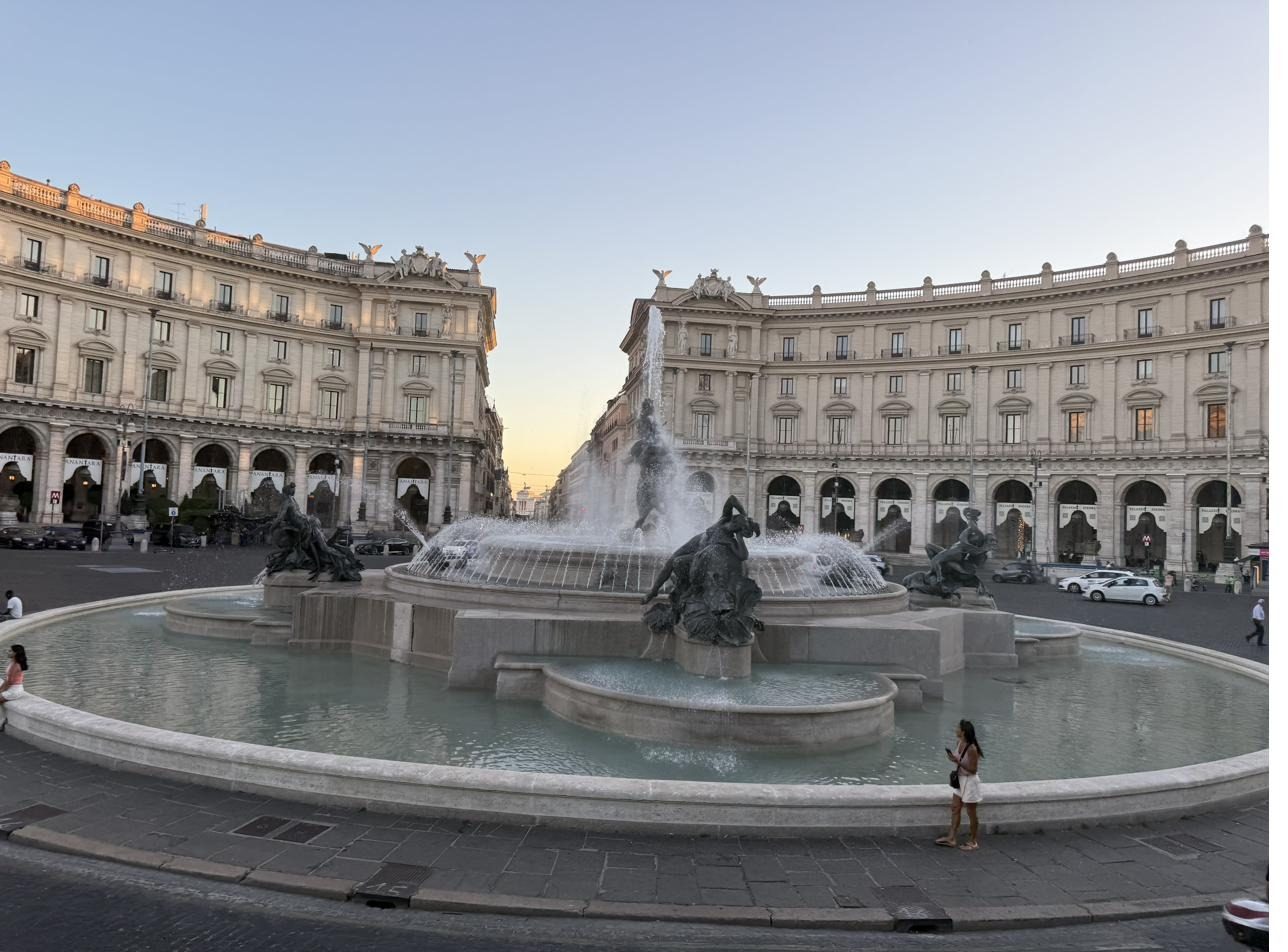
LocationCentre of Piazza della Repubblica, Rome
UbicaciónCentro de la Piazza della Repubblica, Roma
A grand turn-of-the-century fountain in a wide circular basin at the heart of Piazza della Repubblica. Four sensuous bronze Naiads (water-nymphs) recline around the rim, each on a different aquatic creature — a swan for the lakes, a water-monster for the rivers, a sea-horse for the oceans, and a dragon for the underground waters. At the centre, the sea-god Glaucus wrestles a dolphin, from whose mouth the tall jet springs. Because the fountain was photographed from across the square, several of these views are zoomed-in crops to bring out the figures. Behind curve the porticoed Esedra palaces that trace the line of the ancient Baths of Diocletian.
Una gran fuente de comienzos del siglo XX en una amplia pila circular, en el corazón de la Piazza della Repubblica. Cuatro sensuales náyades de bronce (ninfas del agua) se reclinan alrededor del borde, cada una sobre una criatura acuática distinta — un cisne para los lagos, un monstruo de agua para los ríos, un caballo marino para los océanos y un dragón para las aguas subterráneas. En el centro, el dios marino Glauco lucha con un delfín, de cuya boca brota el chorro central. Como la fuente se fotografió desde el otro lado de la plaza, varias de estas vistas son recortes ampliados para resaltar las figuras. Detrás se curvan los palacios porticados de la Esedra, que siguen la línea de las antiguas Termas de Diocleciano.
There is no text to translate on the monument itself. Worth noting in the setting: at dusk, down the Via Nazionale, the distant monuments of central Rome catch the last light, and the square — once called Piazza dell’Esedra — takes its curved shape directly from the great hall of the 3rd-century Baths of Diocletian.
No hay texto que traducir en el propio monumento. Vale la pena señalar el entorno: al anochecer, calle Via Nazionale abajo, los monumentos lejanos del centro de Roma captan la última luz, y la plaza — antes llamada Piazza dell’Esedra — toma su forma curva directamente de la gran sala de las Termas de Diocleciano, del siglo III.
The fountain basin was laid out by the architect Alessandro Guerrieri in 1888 (replacing an earlier arrangement first planned under Pope Pius IX around 1870 to celebrate the restored Acqua Marcia aqueduct). The four bronze Naiads were added and unveiled in 1901, and the central Glaucus group in 1912, with a re-inauguration in 1914 — so the sculpture is about 110–125 years old.
La pila de la fuente fue trazada por el arquitecto Alessandro Guerrieri en 1888 (en sustitución de una disposición anterior proyectada hacia 1870 bajo el papa Pío IX para celebrar la restauración del acueducto Acqua Marcia). Las cuatro náyades de bronce se añadieron e inauguraron en 1901, y el grupo central de Glauco en 1912, con una nueva inauguración en 1914 — de modo que la escultura tiene unos 110–125 años.
The bronze sculptures — the four Naiads and the central Glaucus — are by Mario Rutelli (1859–1941), a sculptor from Palermo and great-grandfather of a future mayor of Rome. The fountain’s architecture is by Alessandro Guerrieri; the surrounding Esedra palaces are by Gaetano Koch.
Las esculturas de bronce — las cuatro náyades y el Glauco central — son de Mario Rutelli (1859–1941), escultor de Palermo y bisabuelo de un futuro alcalde de Roma. La arquitectura de la fuente es de Alessandro Guerrieri; los palacios de la Esedra que la rodean son de Gaetano Koch.
One of Rome’s finest monuments in the Art Nouveau or ‘Liberty’ style, and a symbol of the secular, modern capital of newly unified Italy. The frank sensuality of the nude bronze Naiads caused a public scandal when they were unveiled in 1901 — for a time the figures were even hidden behind a wooden fence — before the city embraced them. The central Glaucus, mastering the dolphin, stands for humankind’s dominion over the forces of water.
Uno de los mejores monumentos de Roma en estilo Art Nouveau o ‘Liberty’, y un símbolo de la capital laica y moderna de la Italia recién unificada. La franca sensualidad de las náyades desnudas de bronce provocó un escándalo público cuando se descubrieron en 1901 — durante un tiempo las figuras llegaron a ocultarse tras una valla de madera — antes de que la ciudad las acogiera. El Glauco central, dominando al delfín, representa el dominio del ser humano sobre las fuerzas del agua.
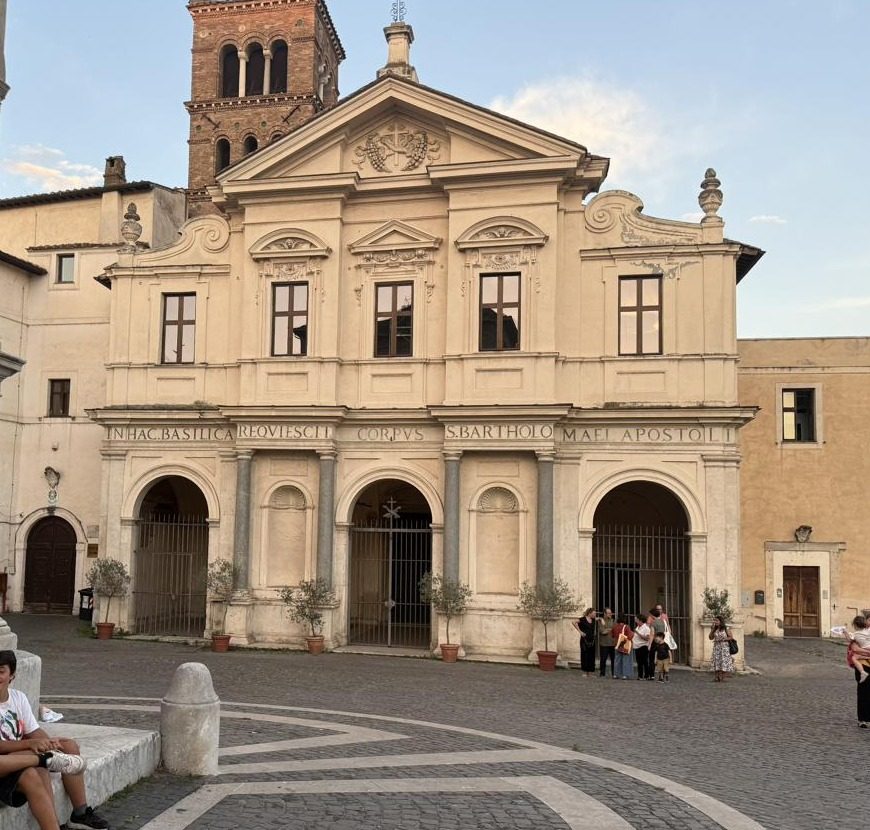
LocationIsola Tiberina (Tiber Island), Rome
UbicaciónIsola Tiberina (Isla Tiberina), Roma
A basilica on Tiber Island, easily mistaken for a plain Baroque church but in fact far older. Behind the 1624 facade — inscribed ‘In this basilica rests the body of St. Bartholomew the Apostle’ — rises a 12th-century Romanesque bell tower. The aisled interior, lined with ancient columns, has a carved gilded ceiling; on the steps of the raised chancel sits an 11th-century marble wellhead over an ancient spring, and a modern icon hangs behind the high altar. Today it is the memorial church of the ‘New Martyrs,’ its side chapels holding relics and mementos of 20th- and 21st-century Christians killed for their faith. Several of these views were cropped or zoomed because of distance and the strong interior light.
Una basílica en la Isla Tiberina, fácil de confundir con una sencilla iglesia barroca, pero en realidad mucho más antigua. Tras la fachada de 1624 — con la inscripción ‘En esta basílica reposa el cuerpo de San Bartolomé Apóstol’ — se alza un campanario románico del siglo XII. El interior, de naves separadas por columnas antiguas, tiene un techo tallado y dorado; en las gradas del presbiterio elevado se encuentra un brocal de mármol del siglo XI sobre un antiguo manantial, y detrás del altar mayor cuelga un icono moderno. Hoy es la iglesia memorial de los ‘Nuevos Mártires,’ y sus capillas laterales guardan reliquias y recuerdos de cristianos de los siglos XX y XXI asesinados por su fe. Varias de estas vistas se recortaron o ampliaron por la distancia y la fuerte luz interior.
“In this basilica rests the body of St. Bartholomew the Apostle.” The apostle’s relics lie beneath the high altar in an ancient porphyry basin. Bartholomew was martyred by being flayed alive, which is why he is shown in art with a knife — as on the carved wellhead inside.
“En esta basílica reposa el cuerpo de San Bartolomé Apóstol.” Las reliquias del apóstol se hallan bajo el altar mayor en una antigua pila de pórfido. Bartolomé fue martirizado siendo desollado vivo, por lo que en el arte se le representa con un cuchillo — como en el brocal tallado del interior.
Founded in 998 by Otto III, Holy Roman Emperor, over the ruins of the ancient Temple of Aesculapius, and completed about 1001. The Romanesque bell tower dates to around 1113. After a flood in 1557 the church was rebuilt, gaining its present Baroque facade in 1624. So it layers thousand-year-old foundations, a ~900-year-old tower, and a 400-year-old front. It has been the New Martyrs’ memorial since the 1990s.
Fundada en 998 por Otón III, emperador del Sacro Imperio, sobre las ruinas del antiguo Templo de Esculapio, y terminada hacia el año 1001. El campanario románico data de alrededor de 1113. Tras una inundación en 1557, la iglesia fue reconstruida y recibió su actual fachada barroca en 1624. Así superpone cimientos milenarios, una torre de unos 900 años y una fachada de 400. Es el memorial de los Nuevos Mártires desde la década de 1990.
Founded by the Emperor Otto III (998). The Baroque facade (1624) is by the architect Orazio Torriani; the carved coffered ceiling also dates to 1624, its central panels repainted in 1865. The 11th-century wellhead is by an unknown medieval carver. The modern Icon of the Witnesses of Faith and the martyrs’ memorial were created under the Community of Sant’Egidio, which has cared for the basilica since 1993. (The two side-chapel altarpieces — a Holy Family and a Madonna — are older devotional paintings; their authorship is not recorded on site.)
Fundada por el emperador Otón III (998). La fachada barroca (1624) es del arquitecto Orazio Torriani; el techo artesonado tallado también data de 1624, con sus paneles centrales repintados en 1865. El brocal del siglo XI es obra de un tallista medieval desconocido. El icono moderno de los Testigos de la Fe y el memorial de los mártires se crearon bajo la Comunidad de Sant’Egidio, que cuida la basílica desde 1993. (Los dos retablos de las capillas laterales — una Sagrada Familia y una Virgen — son pinturas devocionales más antiguas; su autoría no consta en el lugar.)
One of Rome’s most layered sacred places. Tiber Island has been linked with healing since 293 BC, when a temple to Aesculapius was founded here; the church rose directly on that temple, and the tradition continues in the Fatebenefratelli hospital across the square (whose founder, St. John of God, is honoured by the column outside). The basilica holds the relics of the apostle Bartholomew, and since the Jubilee of 2000 it has become Rome’s memorial to the ‘New Martyrs’ — Christians of every continent killed for their faith in modern times — turning an ancient church into a living memorial.
Uno de los lugares sagrados más estratificados de Roma. La Isla Tiberina se asocia con la sanación desde el 293 a.C., cuando se fundó aquí un templo a Esculapio; la iglesia se levantó justo sobre ese templo, y la tradición continúa en el hospital Fatebenefratelli al otro lado de la plaza (cuyo fundador, San Juan de Dios, honra la columna del exterior). La basílica guarda las reliquias del apóstol Bartolomé y, desde el Jubileo del año 2000, se ha convertido en el memorial romano de los ‘Nuevos Mártires’ — cristianos de todos los continentes asesinados por su fe en tiempos modernos — transformando una iglesia antigua en un memorial vivo.
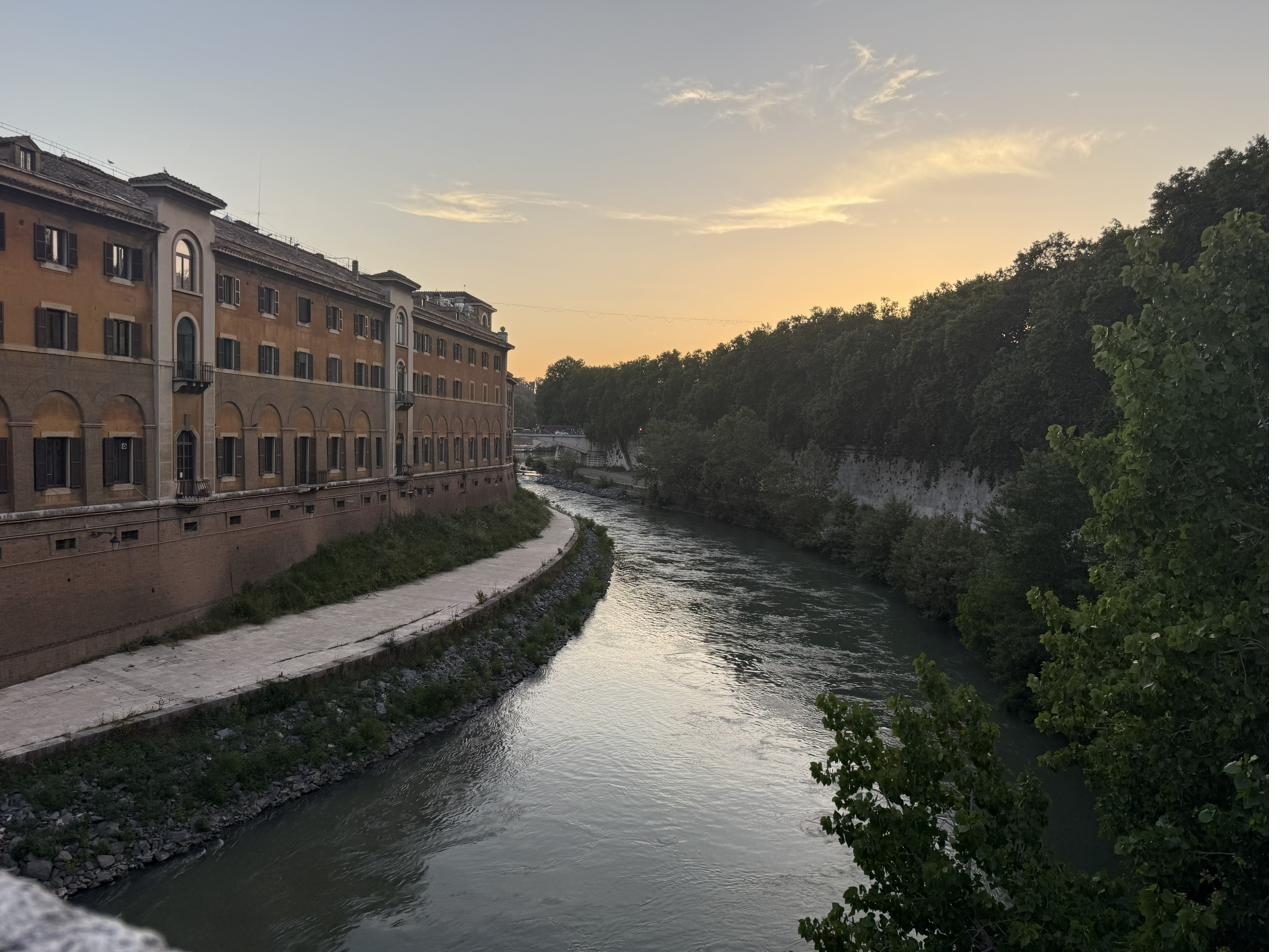
LocationTiber Island and its bridges, Rome
UbicaciónLa Isla Tiberina y sus puentes, Roma
Crossing into Trastevere by the island’s ancient pedestrian bridges, the river Tiber splits into two channels around a small, ship-shaped land mass — Tiber Island. These four sunset views look along each channel from the bridges: first one branch, where the Fatebenefratelli hospital lines the island, and then the other, with the island’s pointed downstream tip, the river’s weir, and the romantic ruined arch of the Ponte Rotto between them. It is one of the most atmospheric river crossings in the city.
Al cruzar hacia el Trastevere por los antiguos puentes peatonales de la isla, el río Tíber se divide en dos brazos alrededor de una pequeña porción de tierra con forma de barco — la Isla Tiberina. Estas cuatro vistas al atardecer recorren cada brazo desde los puentes: primero uno, donde el hospital Fatebenefratelli bordea la isla, y después el otro, con la punta aguas abajo de la isla, la presa del río y, entre ellos, el romántico arco en ruinas del Ponte Rotto. Es uno de los cruces fluviales más evocadores de la ciudad.
Nothing to translate here. Worth knowing: Ponte Fabricio is signed by its Roman builder in large carved letters on its arches, naming Lucius Fabricius, the official in charge of the roads in 62 BC.
Nada que traducir aquí. Conviene saber: el Ponte Fabricio lleva la firma de su constructor romano en grandes letras talladas en sus arcos, que nombran a Lucio Fabricio, el encargado de las vías en el año 62 a.C.
The crossings are deeply ancient. Ponte Fabricio, linking the island to the left bank, was built in 62 BC and is the oldest bridge in Rome still in use. Ponte Cestio, to the Trastevere side, dates to around 46 BC (largely rebuilt in 1888–92). The Ponte Rotto is the ruined survivor of the Pons Aemilius, Rome’s first stone bridge (2nd century BC). The island itself has been a place of healing since 291 BC; the tall embankment walls date from the 1870s–90s.
Los cruces son muy antiguos. El Ponte Fabricio, que une la isla con la orilla izquierda, se construyó en el 62 a.C. y es el puente más antiguo de Roma todavía en uso. El Ponte Cestio, hacia el lado del Trastevere, data de alrededor del 46 a.C. (reconstruido en gran parte en 1888–92). El Ponte Rotto es el resto en ruinas del Pons Aemilius, el primer puente de piedra de Roma (siglo II a.C.). La propia isla es lugar de sanación desde el 291 a.C.; los altos muros de contención datan de las décadas de 1870–90.
These are works of Roman engineering rather than single artists. Ponte Fabricio (62 BC) bears the name of Lucius Fabricius, the curator viarum who built it; Ponte Cestio is named for a member of the Cestius family. The Pons Aemilius (Ponte Rotto) was Rome’s earliest stone river-bridge.
Son obras de la ingeniería romana más que de un solo artista. El Ponte Fabricio (62 a.C.) lleva el nombre de Lucio Fabricio, el curator viarum que lo construyó; el Ponte Cestio toma su nombre de un miembro de la familia Cestia. El Pons Aemilius (Ponte Rotto) fue el primer puente de piedra sobre el río en Roma.
Tiber Island is one of Rome’s most storied places — a ship-shaped island linked with medicine since 291 BC, still home to a working hospital and the basilica of San Bartolomeo. Its bridges knit the city together: Ponte Fabricio, the oldest standing bridge in Rome, reaches from the old Jewish Ghetto and the Theatre of Marcellus, while Ponte Cestio carries you on into Trastevere. The broken arch of the Ponte Rotto, marooned midstream, is a favourite Roman image of a city that has always risen again after its floods.
La Isla Tiberina es uno de los lugares más legendarios de Roma — una isla con forma de barco ligada a la medicina desde el 291 a.C., que aún alberga un hospital en activo y la basílica de San Bartolomeo. Sus puentes cosen la ciudad: el Ponte Fabricio, el puente en pie más antiguo de Roma, llega desde el antiguo Gueto judío y el Teatro de Marcelo, mientras que el Ponte Cestio te lleva hacia el Trastevere. El arco roto del Ponte Rotto, aislado en medio del río, es una imagen romana predilecta de una ciudad que siempre ha vuelto a levantarse tras sus inundaciones.
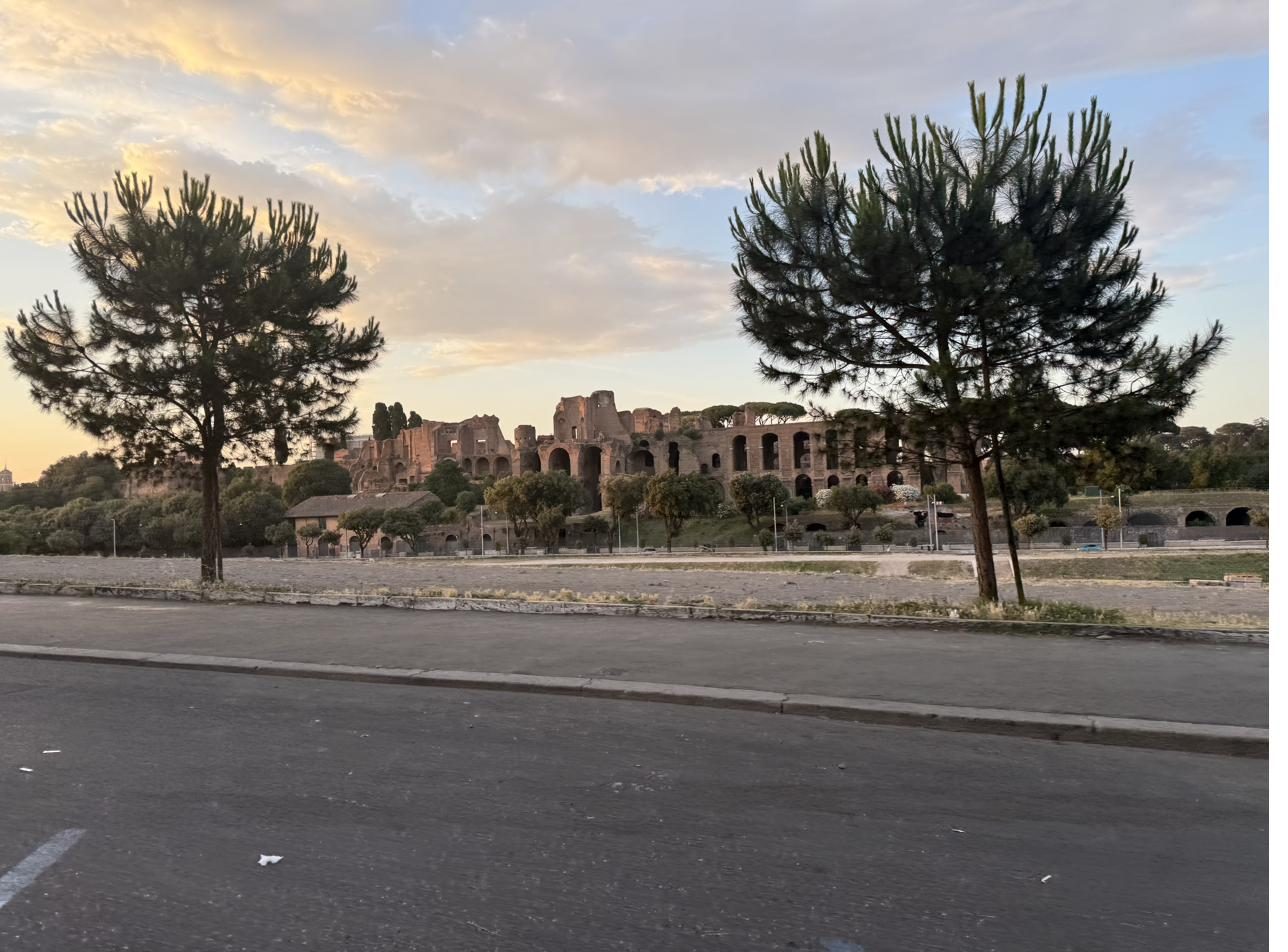
LocationCircus Maximus, Rome (looking northeast to the Palatine)
UbicaciónCirco Máximo, Roma (mirando al noreste hacia el Palatino)
Two evening views taken from a moving car across the Circus Maximus on 17 June. The broad flat field is the Circus Maximus itself, ancient Rome’s great chariot-racing track. Rising on the hill beyond is not a free-standing amphitheatre but the southern flank of the Palatine Hill, crowned by the ruins of the imperial palace — the curved facade of the Domus Augustana and the tall brick Severan Arches that the emperors raised out over the valley so they could watch the races below. Umbrella pines frame the scene in the golden evening light.
Dos vistas al atardecer tomadas desde un coche en marcha al cruzar el Circo Máximo el 17 de junio. El amplio campo llano es el propio Circo Máximo, la gran pista de carreras de carros de la antigua Roma. Lo que se alza en la colina del fondo no es un anfiteatro exento, sino la ladera sur del monte Palatino, coronada por las ruinas del palacio imperial — la fachada curva de la Domus Augustana y las altas arcadas de ladrillo severianas que los emperadores levantaron sobre el valle para contemplar las carreras abajo. Pinos piñoneros enmarcan la escena con la luz dorada del atardecer.
Nothing to translate. One note on identification: the long row of arches here is often mistaken for the Colosseum, but the Colosseum stands on flat ground at the far north end of this valley — it does not rise on the wooded hill across the Circus. What is on the hill is the emperors’ palace.
Nada que traducir. Una nota sobre la identificación: la larga hilera de arcos suele confundirse con el Coliseo, pero el Coliseo se alza en terreno llano en el extremo norte de este valle — no se levanta sobre la colina boscosa al otro lado del Circo. Lo que hay en la colina es el palacio de los emperadores.
The Circus Maximus was monumentalised over many centuries (its track goes back to the Roman kings, with grand rebuildings under Caesar, Augustus and Trajan). The palaces above date from the Empire: the Flavian Palace (Domus Flavia and Domus Augustana) was built for Domitian about AD 81–96, and the Severan Arches were added under Septimius Severus (AD 193–211). The ruins you see are therefore roughly 1,800–1,950 years old.
El Circo Máximo se monumentalizó a lo largo de muchos siglos (su pista se remonta a los reyes de Roma, con grandes reconstrucciones bajo César, Augusto y Trajano). Los palacios de arriba datan del Imperio: el Palacio Flavio (Domus Flavia y Domus Augustana) se construyó para Domiciano hacia los años 81–96 d.C., y las Arcadas Severianas se añadieron bajo Septimio Severo (193–211 d.C.). Las ruinas que se ven tienen, por tanto, unos 1.800–1.950 años.
Imperial Roman architecture rather than the work of one named artist. The Flavian Palace was designed for the emperor Domitian by his architect Rabirius (late 1st century AD); the Domus Severiana and its great arcades were built out over the hillside under the emperor Septimius Severus (early 3rd century AD). The Circus Maximus below was developed by many rulers across Rome’s history.
Arquitectura imperial romana más que obra de un solo artista con nombre. El Palacio Flavio fue diseñado para el emperador Domiciano por su arquitecto Rabirio (finales del siglo I d.C.); la Domus Severiana y sus grandes arcadas se construyeron sobre la ladera bajo el emperador Septimio Severo (principios del siglo III d.C.). El Circo Máximo de abajo fue desarrollado por muchos gobernantes a lo largo de la historia de Roma.
This is the classic view of the Palatine — the hill that is the legendary cradle of Rome and the very source of the word ‘palace.’ From these terraces the emperors looked down on the chariot races in the Circus Maximus, the largest entertainment venue of the ancient world. The pairing in these photographs — the empty racetrack below and the ruined palace above — captures the heart of imperial Rome in a single frame.
Esta es la vista clásica del Palatino — la colina que es la cuna legendaria de Roma y el origen mismo de la palabra ‘palacio.’ Desde estas terrazas los emperadores contemplaban las carreras de carros en el Circo Máximo, el mayor recinto de espectáculos del mundo antiguo. La combinación en estas fotografías — la pista vacía abajo y el palacio en ruinas arriba — resume el corazón de la Roma imperial en una sola imagen.
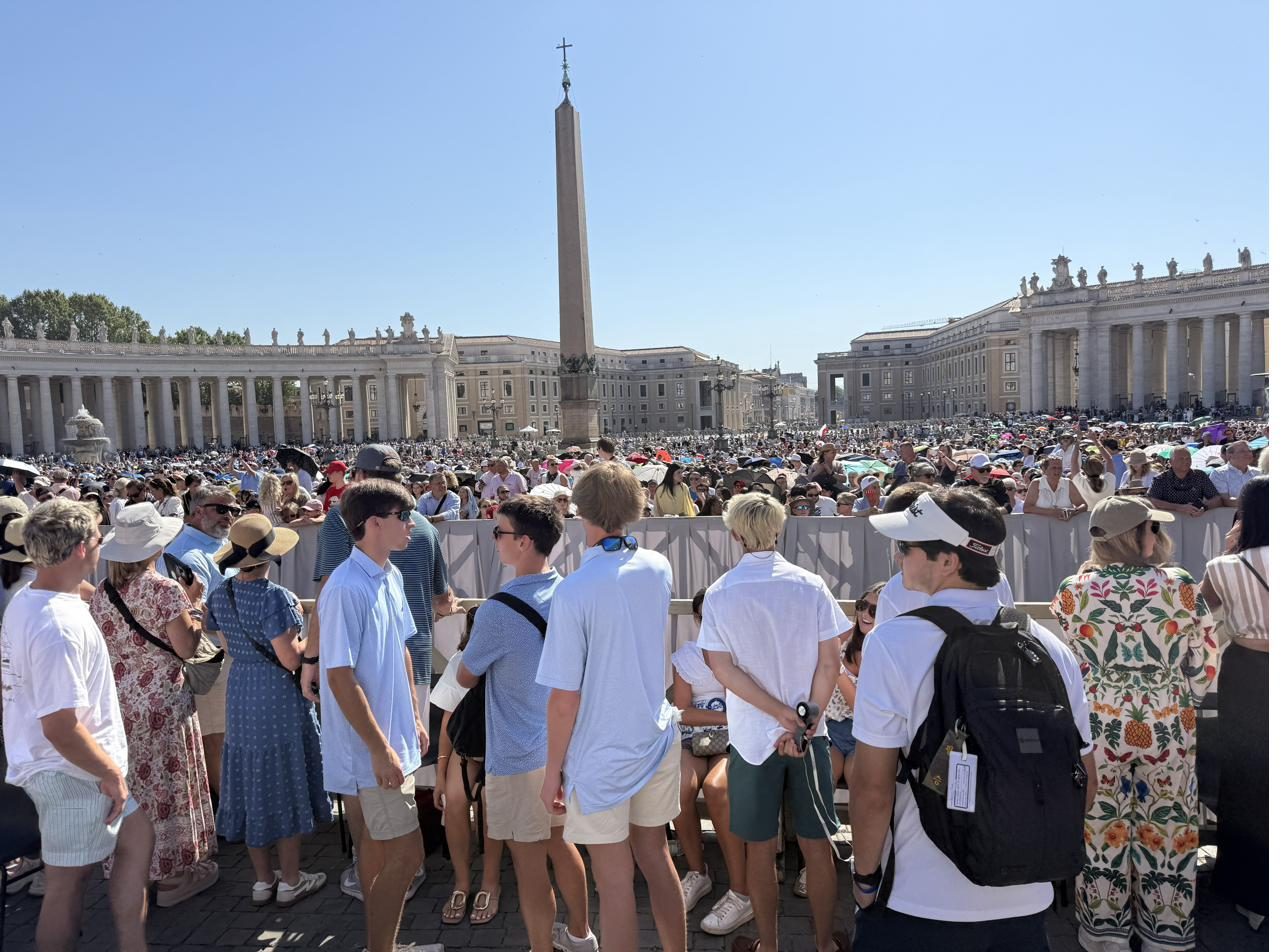
LocationSt. Peter’s Square, Vatican City (17 June 2026)
UbicaciónPlaza de San Pedro, Ciudad del Vaticano (17 de junio de 2026)
A record of Pope Leo XIV’s weekly General Audience in St. Peter’s Square on the morning of 17 June 2026. The General Audience (Udienza Generale) is normally held on Wednesday mornings: the Pope rides through the crowd in the open popemobile, then from a dais on the basilica steps gives a short teaching, greets pilgrim groups in many languages, and imparts his blessing, while large screens relay it to the far end of the square. These images capture the setting, the great crowd, the dais and accompanying clergy, the Pope’s arrival among the people, and two close views of Pope Leo himself.
Un registro de la Audiencia General semanal del papa León XIV en la Plaza de San Pedro la mañana del 17 de junio de 2026. La Audiencia General (Udienza Generale) suele celebrarse los miércoles por la mañana: el Papa recorre la multitud en el papamóvil abierto y luego, desde un estrado en las gradas de la basílica, ofrece una breve enseñanza, saluda a los grupos de peregrinos en muchos idiomas e imparte su bendición, mientras grandes pantallas lo retransmiten hasta el fondo de la plaza. Estas imágenes captan el escenario, la gran multitud, el estrado y el clero acompañante, la llegada del Papa entre la gente y dos vistas cercanas del propio León XIV.
“In honour of the Prince of the Apostles [St. Peter], Paul V Borghese, a Roman, Supreme Pontiff, in the year 1612, the seventh of his pontificate.” The inscription records the completion of the basilica facade under Pope Paul V; it has nothing to do with the present audience, but it frames the stage on which it takes place.
“En honor del Príncipe de los Apóstoles [San Pedro], Paulo V Borghese, romano, Sumo Pontífice, en el año 1612, séptimo de su pontificado.” La inscripción recuerda la conclusión de la fachada de la basílica bajo el papa Paulo V; no tiene relación con la audiencia actual, pero enmarca el escenario donde esta se celebra.
The event was on 17 June 2026. Its setting is much older: the basilica facade was completed by Carlo Maderno in 1612, and the great elliptical piazza with its colonnade was laid out by Gian Lorenzo Bernini between 1656 and 1667. At the centre stands an ancient Egyptian obelisk, brought to Rome in the 1st century AD and raised on this spot in 1586. The weekly audience, by contrast, is a living tradition that continues to this day.
El acto tuvo lugar el 17 de junio de 2026. Su escenario es mucho más antiguo: la fachada de la basílica fue concluida por Carlo Maderno en 1612, y la gran plaza elíptica con su columnata fue trazada por Gian Lorenzo Bernini entre 1656 y 1667. En el centro se alza un antiguo obelisco egipcio, traído a Roma en el siglo I d.C. y erigido en este lugar en 1586. La audiencia semanal, en cambio, es una tradición viva que continúa hasta hoy.
The central figure is Pope Leo XIV (born Robert Francis Prevost). The stage on which he appears is the work of two great architects: Gian Lorenzo Bernini, who designed the square and its sweeping colonnade (1656–67), and Carlo Maderno, who built the basilica facade (completed 1612). The white popemobile is a recent electric model bearing the papal coat of arms.
La figura central es el papa León XIV (nacido Robert Francis Prevost). El escenario en el que aparece es obra de dos grandes arquitectos: Gian Lorenzo Bernini, que diseñó la plaza y su amplia columnata (1656–67), y Carlo Maderno, que construyó la fachada de la basílica (concluida en 1612). El papamóvil blanco es un modelo eléctrico reciente que lleva el escudo papal.
Pope Leo XIV was elected on 8 May 2025 as the 267th pope, succeeding Pope Francis. Born in Chicago in 1955, he is the first pope born in the United States and the first from the Augustinian order; he spent some two decades as a missionary and then bishop in Peru (of which he is also a citizen) and led the Vatican’s office for the world’s bishops before his election. He took the name Leo in homage to Leo XIII, the pope of modern Catholic social teaching, signalling concern for workers and the poor in a new age of technological change and artificial intelligence. The weekly General Audience is his regular public meeting with pilgrims from around the world — the moment that turns this vast square into a place of teaching, greeting and blessing.
El papa León XIV fue elegido el 8 de mayo de 2025 como el 267.º papa, sucediendo al papa Francisco. Nacido en Chicago en 1955, es el primer papa nacido en los Estados Unidos y el primero de la orden agustina; pasó unas dos décadas como misionero y luego obispo en el Perú (del que también es ciudadano) y dirigió la oficina vaticana para los obispos del mundo antes de su elección. Tomó el nombre de León en homenaje a León XIII, el papa de la doctrina social moderna de la Iglesia, señalando su preocupación por los trabajadores y los pobres en una nueva era de cambio tecnológico e inteligencia artificial. La Audiencia General semanal es su encuentro público habitual con peregrinos de todo el mundo — el momento que convierte esta enorme plaza en un lugar de enseñanza, saludo y bendición.
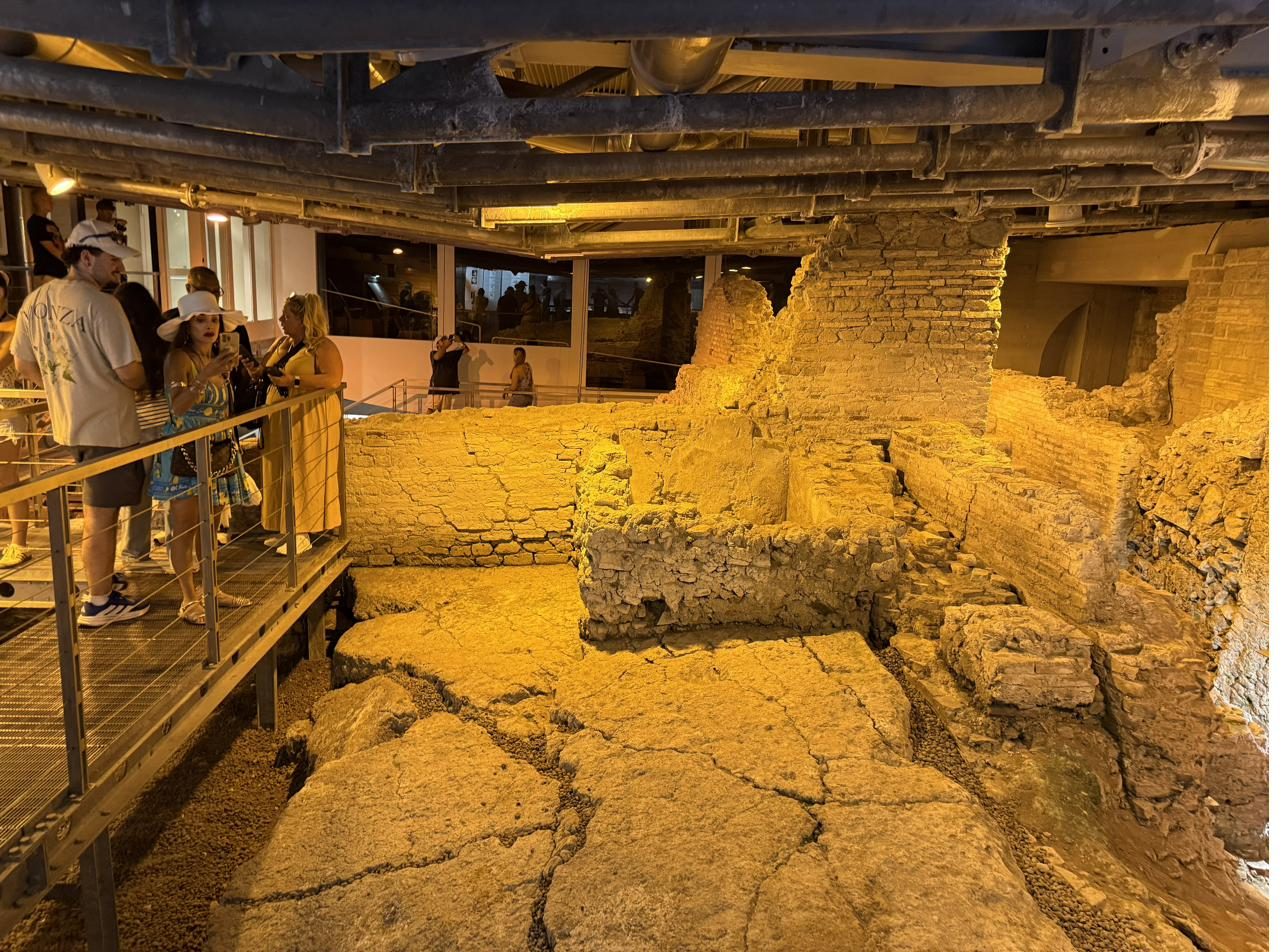
LocationUnderground archaeological area near the Trevi Fountain, Rome
UbicaciónÁrea arqueológica subterránea junto a la Fontana di Trevi, Roma
An underground archaeological site a few steps from the Trevi Fountain, found in 1999–2001 during the restoration of the former Cinema Trevi and now open about nine metres below today’s streets. The dig revealed part of an Imperial-era Roman apartment block (insula), later remodelled into a grander residence, and — most remarkably — a huge brick water tank, the castellum aquae (distribution tank) of the Aqua Virgo aqueduct: the very aqueduct that still feeds the Trevi Fountain above. Lit blue to evoke the water that once filled it, the site is known as the ‘City of Water.’ These views move from the excavated buildings to the water tank and chambers, and end with a selection of the coin hoard found here. The background below is drawn from the site’s own placards.
Un sitio arqueológico subterráneo a pocos pasos de la Fontana di Trevi, descubierto en 1999–2001 durante la restauración del antiguo Cinema Trevi y hoy visitable unos nueve metros por debajo de las calles actuales. La excavación reveló parte de un bloque de viviendas romano (insula) de época imperial, luego transformado en una residencia más señorial, y — lo más notable — un enorme depósito de agua de ladrillo, el castellum aquae (depósito de distribución) del acueducto Aqua Virgo: el mismo acueducto que todavía alimenta la Fontana di Trevi en la superficie. Iluminado de azul para evocar el agua que lo llenaba, el sitio se conoce como la ‘Ciudad del Agua.’ Estas vistas van de los edificios excavados al depósito y las cámaras de agua, y terminan con una selección del tesoro de monedas hallado aquí. La información de abajo procede de los carteles del propio sitio.
These are standard 4th-century coin legends: ‘Glory of the Romans,’ ‘Victory of the Emperors,’ ‘the Health / Security of the Republic,’ and vows (vota) for the emperor’s tenth and thirtieth years of rule. The hoard runs from the Constantinian dynasty through Theodosius and Arcadius, with one older bronze of the emperor Claudius still in circulation.
Son leyendas habituales de las monedas del siglo IV: ‘Gloria de los Romanos,’ ‘Victoria de los Emperadores,’ ‘la Salud / Seguridad de la República,’ y votos (vota) por los años décimo y trigésimo de reinado del emperador. El tesoro va de la dinastía constantiniana a Teodosio y Arcadio, con un bronce más antiguo del emperador Claudio aún en circulación.
The buildings are of the Imperial age: the south building had a public function from the 1st century AD and was transformed under the Emperor Hadrian (after 123 AD) into the castellum aquae, holding about 150,000 litres. The tank was abandoned around the 6th century, most likely after the Goths cut Rome’s aqueducts in 537 AD. The coin hoard spans the 4th century AD, and the site itself was rediscovered in 1999–2001.
Los edificios son de época imperial: el edificio sur tuvo una función pública desde el siglo I d.C. y fue transformado bajo el emperador Adriano (después del 123 d.C.) en el castellum aquae, con una capacidad de unos 150.000 litros. El depósito fue abandonado hacia el siglo VI, probablemente después de que los godos cortaran los acueductos de Roma en el 537 d.C. El tesoro de monedas abarca el siglo IV d.C., y el propio sitio fue redescubierto en 1999–2001.
This is archaeology rather than the work of one artist. The buildings are Roman Imperial construction in opus latericium (brickwork); the castellum belonged to the Aqua Virgo, the aqueduct completed by Agrippa in 19 BC. The site was excavated in 1999–2001 by Rome’s archaeological superintendency (supervised by Claudio Mocchegiani Carpano) during building works, and is now run as the museum ‘Vicus Caprarius – La Città dell’Acqua.’
Esto es arqueología más que obra de un solo artista. Los edificios son construcción romana imperial en opus latericium (ladrillo); el castellum pertenecía al Aqua Virgo, el acueducto concluido por Agripa en el 19 a.C. El sitio fue excavado en 1999–2001 por la superintendencia arqueológica de Roma (bajo la supervisión de Claudio Mocchegiani Carpano) durante unas obras, y hoy funciona como el museo ‘Vicus Caprarius – La Città dell’Acqua.’
A rare chance to stand inside ancient Rome beneath the modern city. Its great prize is the castellum aquae — the only distribution tank of the Aqua Virgo ever found, though ancient sources record as many as eighteen along the aqueduct’s course through the city. Because the Aqua Virgo still supplies the Trevi Fountain, this site connects directly to that monument: the water that astonishes visitors at the fountain runs through a network in use since 19 BC. The coin hoard, and the amphorae and lamps also found here, trace the daily life — and the Mediterranean trade in oil, wine and food — of the people who lived above these walls until the buildings were abandoned in the 5th–6th centuries.
Una rara oportunidad de adentrarse en la Roma antigua bajo la ciudad moderna. Su gran tesoro es el castellum aquae — el único depósito de distribución del Aqua Virgo jamás hallado, aunque las fuentes antiguas registran hasta dieciocho a lo largo del recorrido del acueducto por la ciudad. Como el Aqua Virgo todavía abastece la Fontana di Trevi, este sitio conecta directamente con ese monumento: el agua que asombra a los visitantes en la fuente circula por una red en uso desde el 19 a.C. El tesoro de monedas, y las ánforas y lámparas también halladas aquí, reflejan la vida cotidiana — y el comercio mediterráneo de aceite, vino y alimentos — de quienes vivieron sobre estos muros hasta que los edificios se abandonaron en los siglos V–VI.
LocationRight bank of the Tiber, near the Vatican, Rome
UbicaciónOrilla derecha del Tíber, junto al Vaticano, Roma
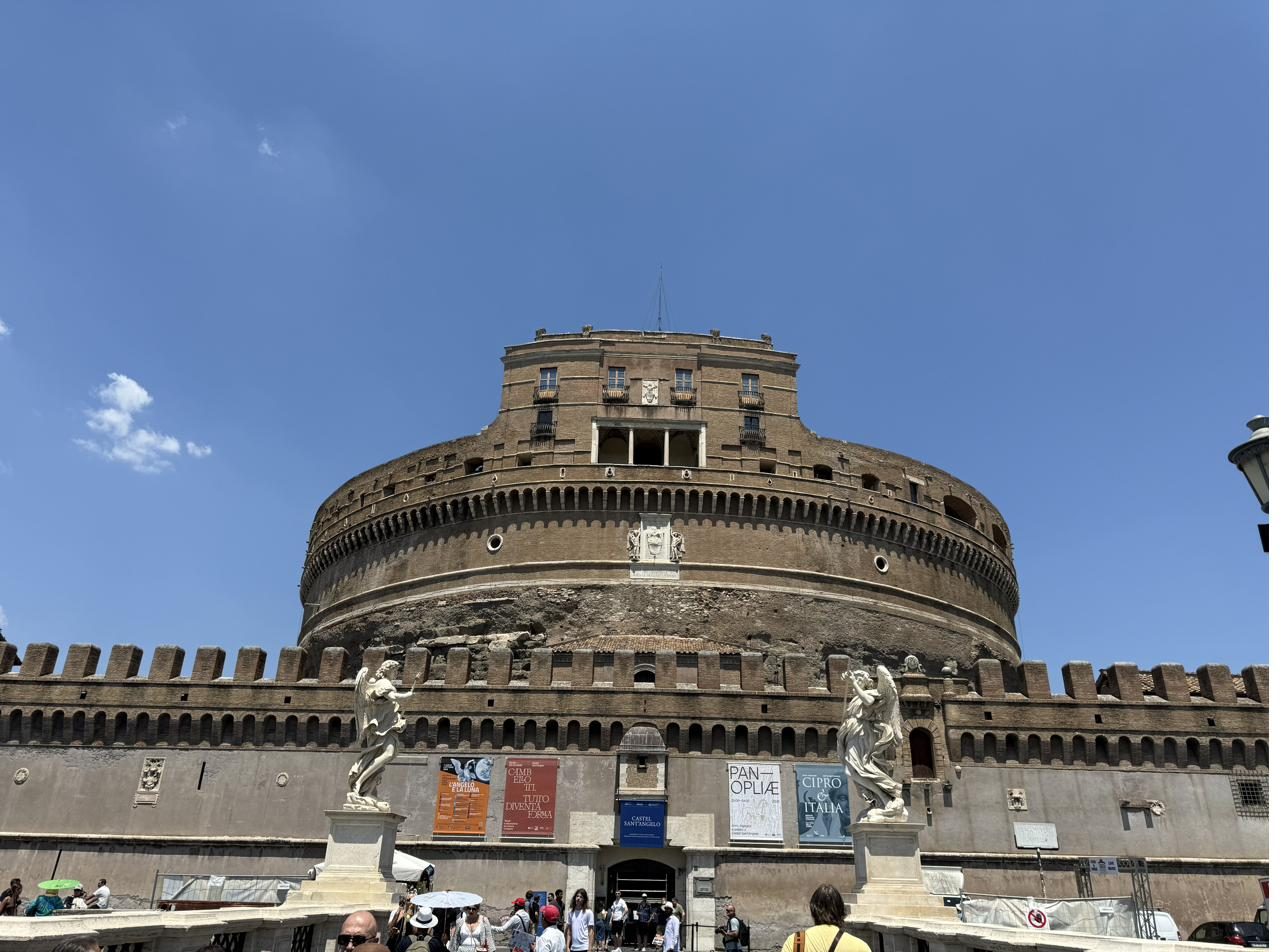
A colossal cylindrical monument on the Tiber’s right bank that has been, in turn, an emperor’s tomb, a fortress, a papal refuge, a prison and now a museum. It began as the Mausoleum of Hadrian; in the Middle Ages it was crowned with a bronze angel and renamed for it. These views move from the outside in: the great drum and the statue-lined bridge, then the ancient spiral ramp and the bare Roman burial core, the richly frescoed papal apartments above, and finally the bronze archangel on the summit. The background below is drawn from the castle’s own placards and verified sources.
Un colosal monumento cilíndrico en la orilla derecha del Tíber que ha sido, sucesivamente, tumba de un emperador, fortaleza, refugio papal, prisión y hoy museo. Comenzó como el Mausoleo de Adriano; en la Edad Media fue coronado con un ángel de bronce y rebautizado por él. Estas vistas van de fuera hacia dentro: el gran tambor y el puente jalonado de estatuas, luego la antigua rampa helicoidal y el núcleo funerario romano desnudo, los aposentos papales ricamente decorados con frescos y, por último, el arcángel de bronce en la cima. La información de abajo procede de los carteles del propio castillo y de fuentes verificadas.
The building’s Roman name was the Mausoleum of Hadrian (the ‘Mole Adriana’). Its present name, ‘Castle of the Holy Angel,’ comes from the angel on its roof and the legend attached to it (see Significance).
El nombre romano del edificio era Mausoleo de Adriano (la ‘Mole Adriana’). Su nombre actual, ‘Castillo del Santo Ángel,’ procede del ángel de su tejado y de la leyenda asociada a él (véase Significado).
Built between 123 and 139 AD by the Emperor Hadrian (architect Demetrianus) and completed in 139 — a year after Hadrian’s death — by Antoninus Pius, so the core is about 1,890 years old and stands roughly 50 metres tall. The spiral ramp and burial core are original Roman work; the papal apartments are 16th-century; the bronze angel dates to 1753; and the building became Italy’s national museum here in 1901.
Construido entre los años 123 y 139 d.C. por el emperador Adriano (arquitecto Demetriano) y terminado en el 139 — un año después de la muerte de Adriano — por Antonino Pío, de modo que el núcleo tiene unos 1.890 años y mide cerca de 50 metros de altura. La rampa helicoidal y el núcleo funerario son obra romana original; los aposentos papales son del siglo XVI; el ángel de bronce data de 1753; y el edificio se convirtió aquí en el museo nacional de Italia en 1901.
Imperial Roman architecture, built for Hadrian. The papal apartments were frescoed in the 16th century — the Sala Paolina by Perino del Vaga and his workshop for Pope Paul III. The bronze Archangel Michael (1753) is by the Flemish sculptor Peter Anton von Verschaffelt, replacing earlier statues, including a marble one of 1536 by Raffaello da Montelupo. The angels lining the bridge were designed by Gian Lorenzo Bernini and carved by his pupils (1668).
Arquitectura imperial romana, construida para Adriano. Los aposentos papales se decoraron con frescos en el siglo XVI — la Sala Paolina, por Perino del Vaga y su taller para el papa Paulo III. El Arcángel Miguel de bronce (1753) es del escultor flamenco Peter Anton von Verschaffelt, en sustitución de estatuas anteriores, entre ellas una de mármol de 1536 de Raffaello da Montelupo. Los ángeles que jalonan el puente fueron diseñados por Gian Lorenzo Bernini y tallados por sus discípulos (1668).
One of Rome’s great survivors — Hadrian’s tomb turned papal stronghold. Its name comes from 590 AD, when (by tradition) Pope Gregory the Great, leading a procession against the plague, saw the Archangel Michael sheathing his sword atop the mausoleum, taken as a sign the plague would end. Linked to the Vatican by the Passetto di Borgo — a fortified corridor built in 1277 — it sheltered popes in danger, most famously Clement VII during the Sack of Rome in 1527. Mausoleum, fortress, prison, treasury and refuge, it compresses nearly two thousand years of Roman history into a single round tower.
Uno de los grandes supervivientes de Roma — la tumba de Adriano convertida en bastión papal. Su nombre viene del año 590 d.C., cuando (según la tradición) el papa Gregorio Magno, encabezando una procesión contra la peste, vio al Arcángel Miguel envainando su espada sobre el mausoleo, lo que se interpretó como señal del fin de la peste. Unido al Vaticano por el Passetto di Borgo — un corredor fortificado construido en 1277 — dio refugio a papas en peligro, sobre todo a Clemente VII durante el Saco de Roma de 1527. Mausoleo, fortaleza, prisión, tesoro y refugio, condensa casi dos mil años de historia romana en una sola torre redonda.
LocationThe terraces of Castel Sant’Angelo, Rome
UbicaciónLas terrazas del Castel Sant’Angelo, Roma
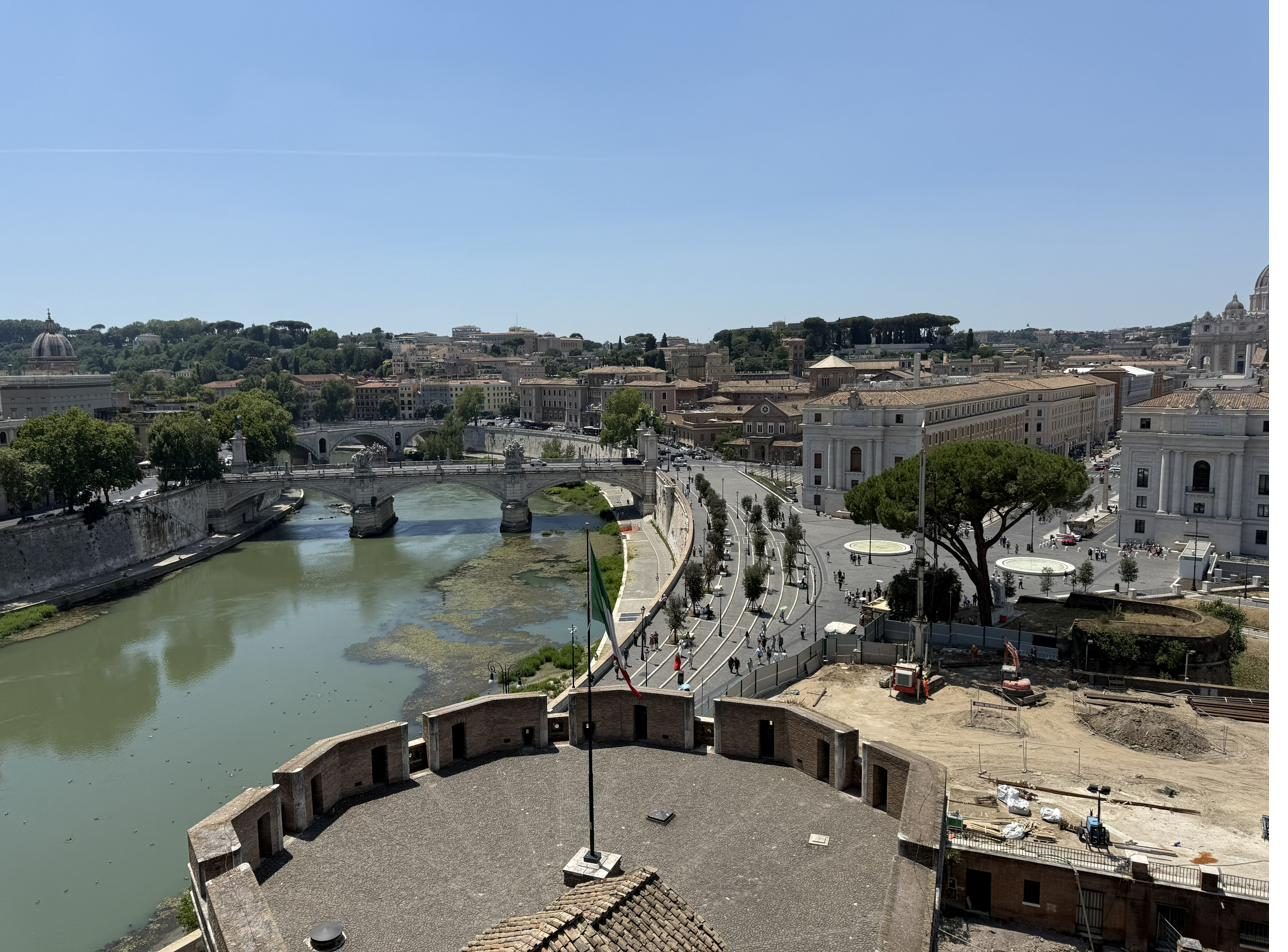
From the castle’s ramparts and rooftop terrace — about fifty metres up — the city opens out in every direction. These four views look across the Tiber and its bridges toward St. Peter’s, along the Passetto di Borgo that runs to the Vatican, out over the castle’s own gun-bastions to the southern hills, and down onto the umbrella pines of the gardens below. They were chosen from many overlapping photographs to show distinct vistas rather than repeat the same sweep.
Desde las murallas y la terraza del castillo — a unos cincuenta metros de altura — la ciudad se abre en todas direcciones. Estas cuatro vistas miran a través del Tíber y sus puentes hacia San Pedro, a lo largo del Passetto di Borgo que va al Vaticano, por encima de los bastiones artilleros del castillo hacia las colinas del sur, y hacia abajo sobre los pinos piñoneros de los jardines. Se eligieron entre muchas fotografías superpuestas para mostrar vistas distintas en lugar de repetir el mismo panorama.
Nothing to translate. A quick orientation: the dome that dominates the western skyline is Michelangelo’s dome of St. Peter’s, and the long arched wall reaching toward it is the Passetto di Borgo, the popes’ covered escape route to the Vatican.
Nada que traducir. Una breve orientación: la cúpula que domina el horizonte occidental es la cúpula de San Pedro de Miguel Ángel, y el largo muro con arcos que se dirige hacia ella es el Passetto di Borgo, la ruta de huida cubierta de los papas hacia el Vaticano.
A terrace has crowned this building since antiquity, when the mausoleum already stood some 50 metres high. The panorama takes in monuments of every era at once — the ancient river crossings, the Renaissance dome of St. Peter’s (completed in 1590), the medieval Passetto (1277), and the 19th-century embankments and bridges along the Tiber.
Una terraza corona este edificio desde la antigüedad, cuando el mausoleo ya alcanzaba unos 50 metros de altura. El panorama abarca a la vez monumentos de todas las épocas — los antiguos cruces del río, la cúpula renacentista de San Pedro (concluida en 1590), el medieval Passetto (1277) y los muros de contención y puentes del siglo XIX a lo largo del Tíber.
Not an artwork but a vantage point. Among the landmarks in view, the dome of St. Peter’s is the work of Michelangelo (completed by Giacomo della Porta in 1590), and the Passetto di Borgo was built for Pope Nicholas III in 1277.
No es una obra de arte, sino un mirador. Entre los hitos a la vista, la cúpula de San Pedro es obra de Miguel Ángel (concluida por Giacomo della Porta en 1590), y el Passetto di Borgo se construyó para el papa Nicolás III en 1277.
For centuries this was the highest secure vantage over the city and the approach to the Vatican — exactly why the popes valued both the castle and the Passetto that linked it to St. Peter’s. Today it gives one of Rome’s most famous panoramas, sweeping from St. Peter’s across the river to the hills, and it is especially celebrated at sunset.
Durante siglos este fue el punto de vigilancia seguro más alto sobre la ciudad y el acceso al Vaticano — justo por lo que los papas valoraban tanto el castillo como el Passetto que lo unía a San Pedro. Hoy ofrece uno de los panoramas más famosos de Roma, que barre desde San Pedro, cruza el río y llega hasta las colinas, y es especialmente célebre al atardecer.
LocationPiazza Venezia, Rome
UbicaciónPiazza Venezia, Roma
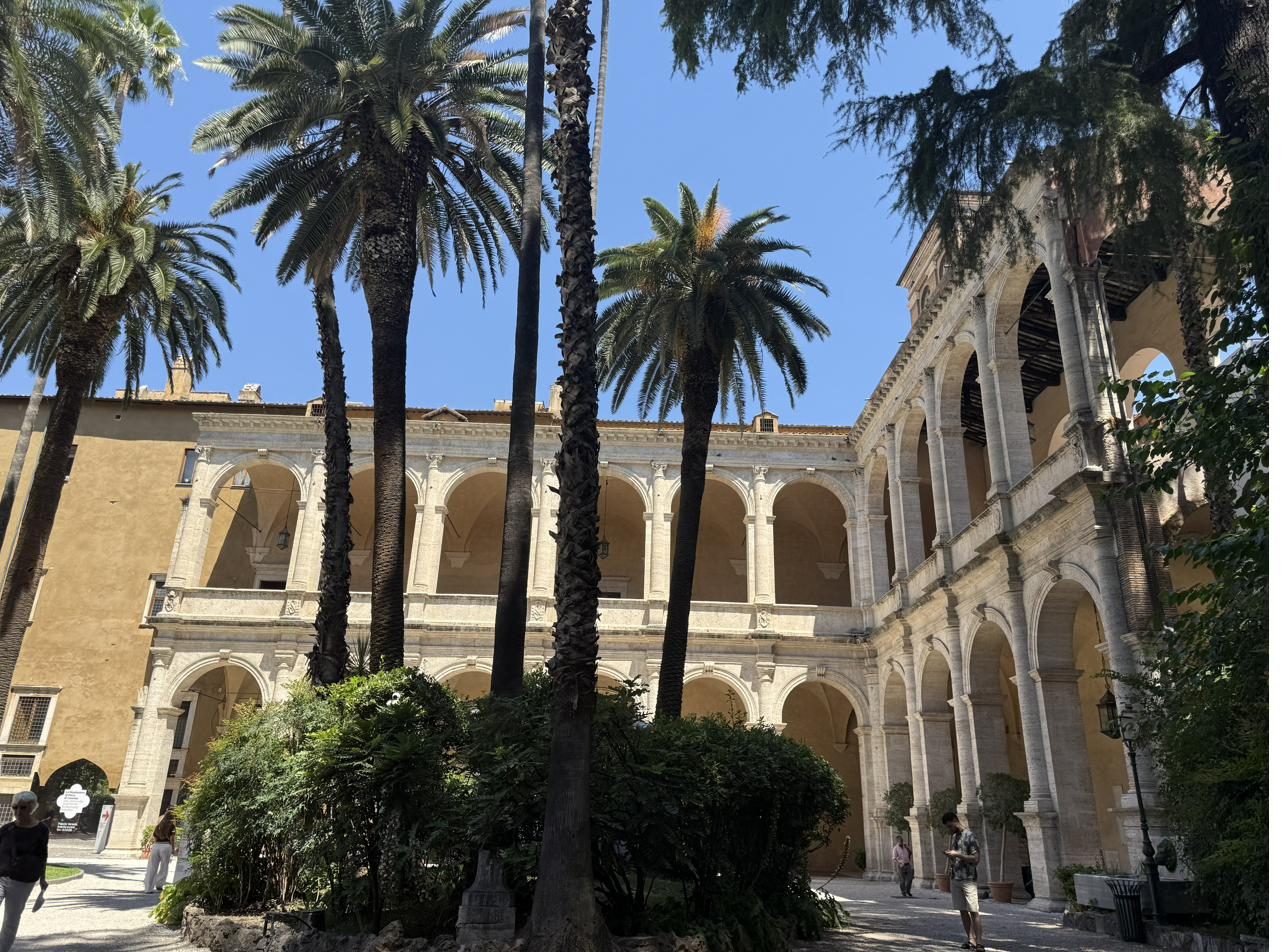
One of the first great Renaissance palaces in Rome, and today a national museum of art from the Middle Ages to the Baroque. Behind its severe, fortress-like facade lie a garden courtyard ringed by elegant arcades and a sequence of grand halls hung with masterpieces. These views pair the architecture with a handful of the collection’s highlights — a gold-ground panel from the 1420s, Giorgione’s enigmatic double portrait, a Baroque mythological tondo, and a suit of Renaissance armour. The background below is drawn from the museum’s own placards.
Uno de los primeros grandes palacios renacentistas de Roma y hoy un museo nacional de arte desde la Edad Media hasta el Barroco. Tras su fachada severa, casi de fortaleza, se esconden un patio ajardinado rodeado de elegantes arcadas y una sucesión de grandes salas con obras maestras. Estas vistas combinan la arquitectura con algunas de las joyas de la colección — una tabla de fondo dorado de la década de 1420, el enigmático doble retrato de Giorgione, un tondo mitológico barroco y una armadura renacentista. La información de abajo procede de los carteles del propio museo.
There is nothing here to translate, but the name carries its own history: from 1564 the building was the Venetian embassy, which gave both the palace and the square their name. In the 20th century its balcony over Piazza Venezia became infamous as the place from which Mussolini addressed the crowds.
No hay aquí nada que traducir, pero el nombre encierra su propia historia: desde 1564 el edificio fue la embajada veneciana, lo que dio nombre tanto al palacio como a la plaza. En el siglo XX, su balcón sobre la Piazza Venezia se hizo tristemente célebre como el lugar desde el que Mussolini se dirigía a las multitudes.
Built from 1455 for the Venetian cardinal Pietro Barbo, who — once he became Pope Paul II in 1464 — enlarged it, making it one of the earliest Renaissance palaces in Rome. It was given to the Republic of Venice as its embassy in 1564, passed to Austria in 1797, and returned to Italy in 1916. The artworks shown span roughly 1420 (Mariotto di Cristofano) to about 1665 (Carpioni).
Construido a partir de 1455 para el cardenal veneciano Pietro Barbo que — una vez convertido en el papa Paulo II en 1464 — lo amplió, haciéndolo uno de los primeros palacios renacentistas de Roma. Fue cedido a la República de Venecia como embajada en 1564, pasó a Austria en 1797 y regresó a Italia en 1916. Las obras mostradas abarcan desde hacia 1420 (Mariotto di Cristofano) hasta alrededor de 1665 (Carpioni).
The palace was begun for Cardinal Pietro Barbo (Pope Paul II), with later work by his relative Marco Barbo and Cardinal Lorenzo Cibo. Among the paintings shown are works by Mariotto di Cristofano (1395?–1457), the great Venetian master Giorgione (1477/8–1510), and Giulio Carpioni (1613–1678). The etched armour is 16th-century work; its maker is not recorded on the label shown.
El palacio se comenzó para el cardenal Pietro Barbo (papa Paulo II), con obras posteriores de su pariente Marco Barbo y del cardenal Lorenzo Cibo. Entre las pinturas mostradas hay obras de Mariotto di Cristofano (1395?–1457), del gran maestro veneciano Giorgione (1477/8–1510) y de Giulio Carpioni (1613–1678). La armadura grabada es obra del siglo XVI; su autor no consta en la cartela mostrada.
A palace that mirrors Rome’s history. As a cardinal’s and then a pope’s residence it helped introduce Renaissance architecture to the city; as the Venetian (and later Austrian) embassy it gave the building and the square their name; and in the 20th century it became the headquarters of Mussolini’s government, whose balcony over Piazza Venezia is one of the most charged sites of modern Italian history. Today it safeguards a rich collection — from gold-ground altarpieces and Giorgione’s poetry of mood to Baroque mythologies and arms and armour.
Un palacio que refleja la historia de Roma. Como residencia de un cardenal y luego de un papa, ayudó a introducir la arquitectura renacentista en la ciudad; como embajada veneciana (y después austriaca) dio nombre al edificio y a la plaza; y en el siglo XX se convirtió en la sede del gobierno de Mussolini, cuyo balcón sobre la Piazza Venezia es uno de los lugares más cargados de la historia moderna de Italia. Hoy custodia una rica colección — desde retablos de fondo dorado y la poesía de los estados de ánimo de Giorgione hasta mitologías barrocas y armas y armaduras.
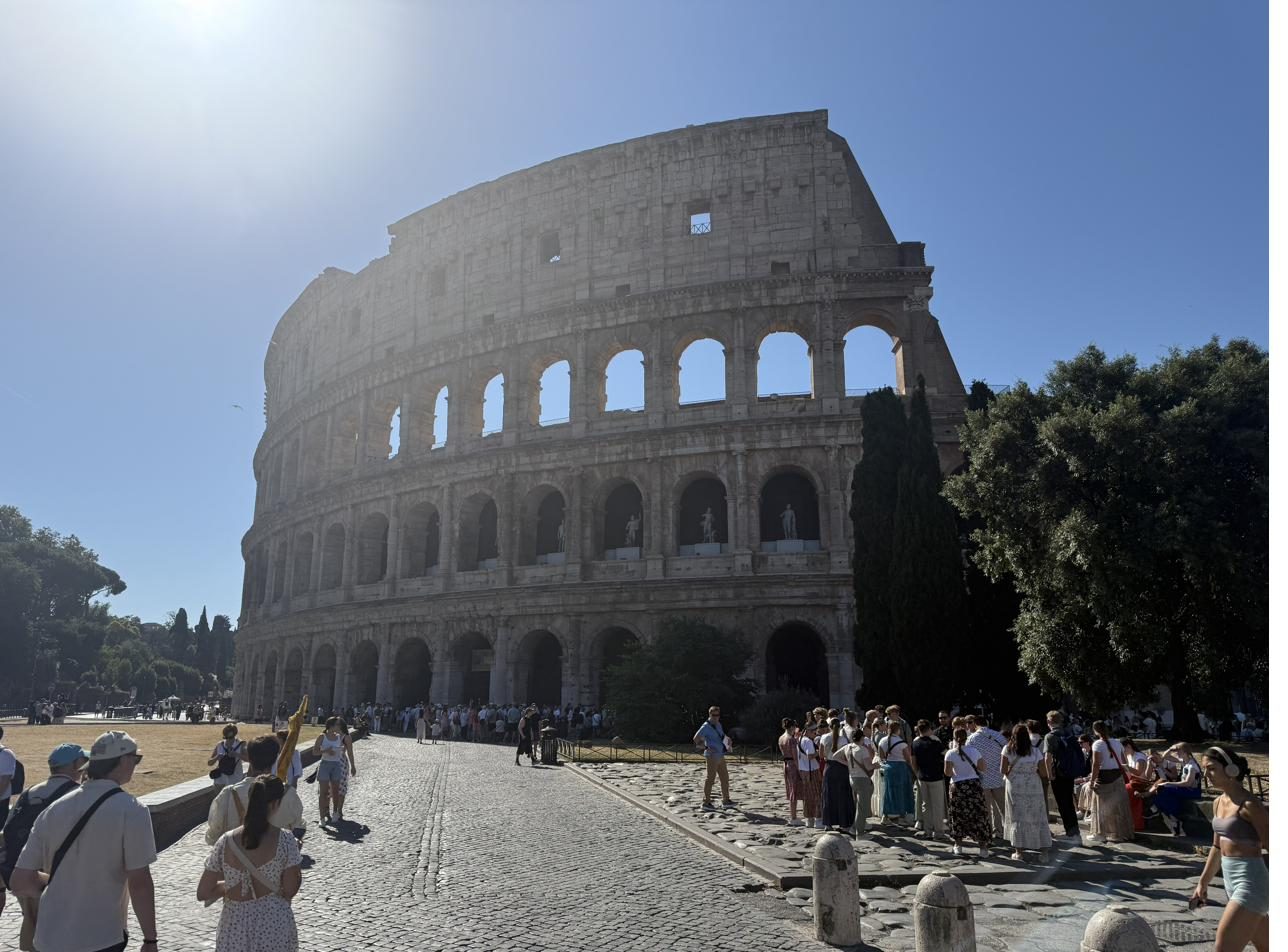
LocationPiazza del Colosseo, Rome
UbicaciónPiazza del Colosseo, Roma
The largest amphitheatre ever built, raised by the Flavian emperors as a gift to the Roman people on the drained site of Nero’s private lake. Its elliptical wall of arches enclosed tiered seating for some 50,000 spectators, who came for gladiatorial combats, wild-beast hunts and grand spectacles. These views show the three-tiered facade, the radial walls and vaults that carried the seating, the arena where a modern cross now recalls later Christian devotion, and the vast interior with its reconstructed wooden floor. A companion panel looks at the engineering and the underground hypogeum.
El anfiteatro más grande jamás construido, levantado por los emperadores flavios como regalo al pueblo romano sobre el lago privado de Nerón, ya desecado. Su muro elíptico de arcos encerraba gradas escalonadas para unos 50.000 espectadores, que acudían a los combates de gladiadores, las cacerías de fieras y los grandes espectáculos. Estas vistas muestran la fachada de tres pisos, los muros radiales y las bóvedas que sostenían las gradas, la arena donde una cruz moderna recuerda la devoción cristiana posterior, y el vasto interior con su suelo de madera reconstruido. Un panel complementario examina la ingeniería y el hipogeo subterráneo.
Its Roman name was the Amphitheatrum Flavium (Flavian Amphitheatre); the name ‘Colosseum’ is medieval, probably taken from the Colossus of Nero, a giant bronze statue that once stood nearby.
Su nombre romano era Amphitheatrum Flavium (Anfiteatro Flavio); el nombre ‘Coliseo’ es medieval, probablemente tomado del Coloso de Nerón, una estatua de bronce gigante que se alzaba cerca.
Begun under the Emperor Vespasian about 70–72 AD — funded by the spoils of the sack of Jerusalem in 70 AD, on the site of the lake of Nero’s Domus Aurea — and inaugurated by his son Titus in 80 AD with a hundred days of games; further work followed under Domitian. It stands roughly 50 metres tall and is about 1,950 years old.
Comenzado bajo el emperador Vespasiano hacia los años 70–72 d.C. — financiado con el botín del saqueo de Jerusalén del año 70 d.C., sobre el lago de la Domus Aurea de Nerón — e inaugurado por su hijo Tito en el 80 d.C. con cien días de juegos; las obras continuaron bajo Domiciano. Mide cerca de 50 metros de altura y tiene unos 1.950 años.
Imperial Roman architecture of the Flavian dynasty — the emperors Vespasian, Titus and Domitian. It was built of travertine (quarried at Tivoli), tuff and brick-faced concrete, the great blocks once tied together with iron clamps. The names of its architects are not recorded.
Arquitectura imperial romana de la dinastía flavia — los emperadores Vespasiano, Tito y Domiciano. Se construyó con travertino (extraído en Tívoli), toba y hormigón revestido de ladrillo, con los grandes bloques unidos en su día mediante grapas de hierro. Los nombres de sus arquitectos no se han conservado.
The Colosseum is the supreme symbol of Imperial Rome and the largest amphitheatre ever built. It was also a marvel of crowd engineering: some 80 arched entrances let tens of thousands of people find their seats — and leave — quickly. Across the centuries it served as fortress, quarry and Christian shrine, and it survives today as the enduring emblem of the city.
El Coliseo es el símbolo supremo de la Roma imperial y el anfiteatro más grande jamás construido. Fue también un prodigio de ingeniería de masas: unas 80 entradas con arco permitían que decenas de miles de personas encontraran su sitio — y salieran — con rapidez. A lo largo de los siglos sirvió de fortaleza, cantera y santuario cristiano, y hoy perdura como el emblema imperecedero de la ciudad.
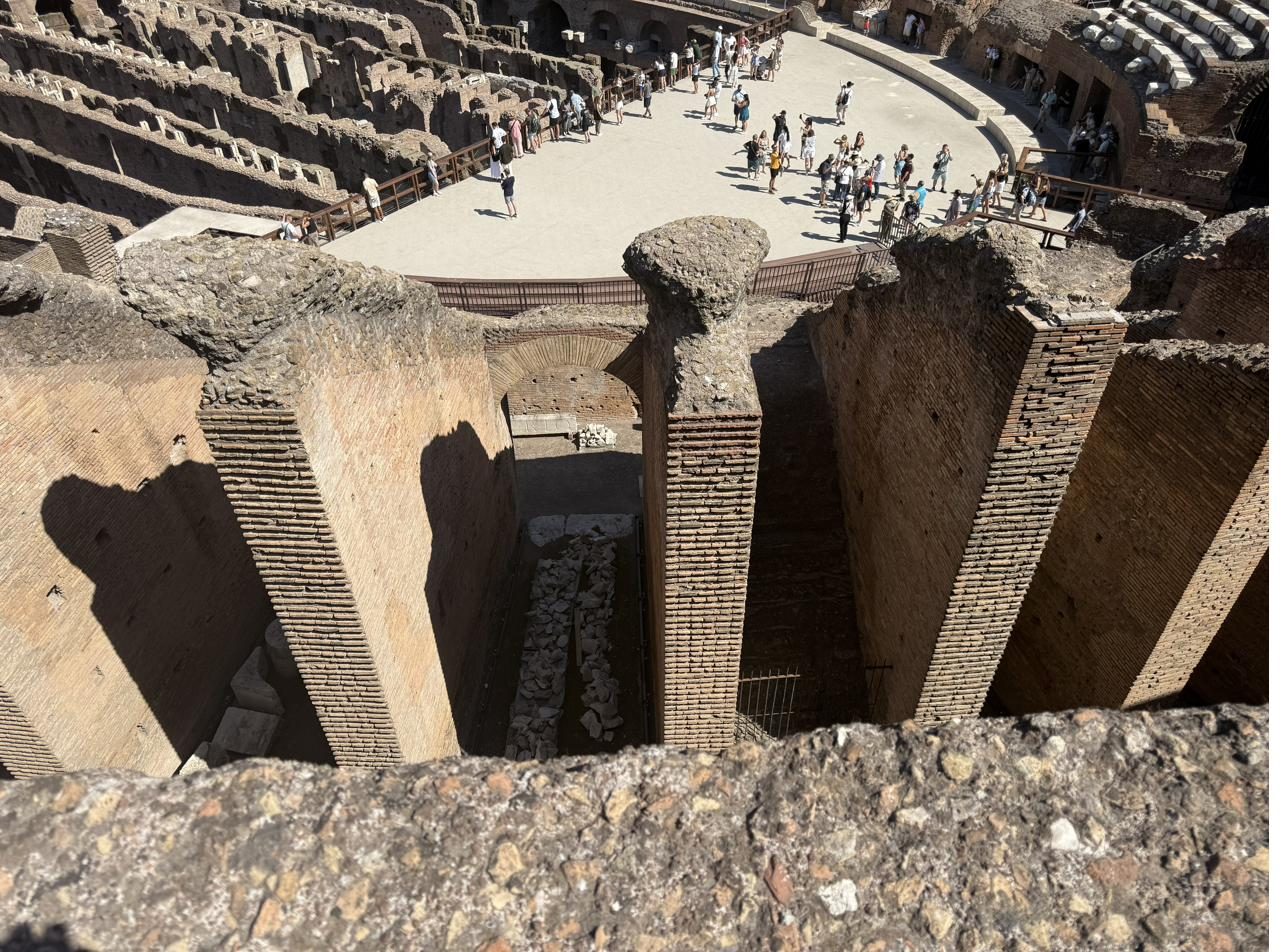
LocationBeneath the arena, the Colosseum, Rome
UbicaciónBajo la arena, el Coliseo, Roma
With the wooden arena floor gone, the Colosseum’s most ingenious feature is laid bare: the hypogeum, a two-level underground labyrinth of brick walls, passages and machine-rooms. Out of sight below the floor, lifts and trapdoors worked by winches and counterweights raised gladiators, scenery and wild animals straight into the arena. These views look down into the maze of piers and channels, show the reconstructed wooden floor that once hid it, and pick out the holes where iron clamps once bound the travertine blocks.
Sin el suelo de madera de la arena, queda al descubierto el elemento más ingenioso del Coliseo: el hipogeo, un laberinto subterráneo de dos niveles formado por muros de ladrillo, pasajes y salas de máquinas. Oculto bajo el suelo, montacargas y trampillas accionados por tornos y contrapesos elevaban a los gladiadores, los decorados y las fieras directamente a la arena. Estas vistas miran hacia el laberinto de pilares y canales, muestran el suelo de madera reconstruido que en su día lo ocultaba, y destacan los huecos donde las grapas de hierro unían los bloques de travertino.
Those clamps were prised out and melted down in the Middle Ages, which is why the stone looks pitted today. The holes are a record of how the Romans locked the great blocks together — largely without mortar between them.
Esas grapas fueron arrancadas y fundidas en la Edad Media, por lo que hoy la piedra aparece picada. Los huecos son un testimonio de cómo los romanos trababan entre sí los grandes bloques — en gran parte sin mortero entre ellos.
The hypogeum was added and elaborated under the Emperor Domitian (reigned 81–96 AD), after the amphitheatre’s inauguration in 80 AD, and it remained in use for the games for centuries afterwards.
El hipogeo se añadió y desarrolló bajo el emperador Domiciano (reinó 81–96 d.C.), después de la inauguración del anfiteatro en el 80 d.C., y siguió en uso para los juegos durante siglos.
Roman engineering of the Flavian period. The structure combined travertine piers, tuff and brick-faced concrete; the underground machinery — dozens of lifts on pulleys and counterweights, with trapdoors opening into the arena — was driven by human muscle. The velarium, a vast retractable awning for shade, was worked from the top of the walls by sailors of the imperial fleet.
Ingeniería romana de época flavia. La estructura combinaba pilares de travertino, toba y hormigón revestido de ladrillo; la maquinaria subterránea — decenas de montacargas con poleas y contrapesos, con trampillas que se abrían a la arena — se movía con fuerza humana. El velarium, un enorme toldo retráctil para dar sombra, se manejaba desde lo alto de los muros por marineros de la flota imperial.
The hypogeum is one of the ancient world’s great pieces of stagecraft engineering. By hiding the machinery below a wooden floor spread with sand, the Romans could make beasts and fighters appear as if from nowhere, turning the amphitheatre into an enormous theatrical machine. It is the clearest surviving illustration of how Roman builders married raw structural power — arches, vaults, concrete and iron — to showmanship and spectacle.
El hipogeo es una de las grandes obras de ingeniería escénica del mundo antiguo. Al ocultar la maquinaria bajo un suelo de madera cubierto de arena, los romanos podían hacer que fieras y luchadores aparecieran como de la nada, convirtiendo el anfiteatro en una enorme máquina teatral. Es la ilustración más clara que se conserva de cómo los constructores romanos unieron la pura potencia estructural — arcos, bóvedas, hormigón y hierro — al espectáculo.
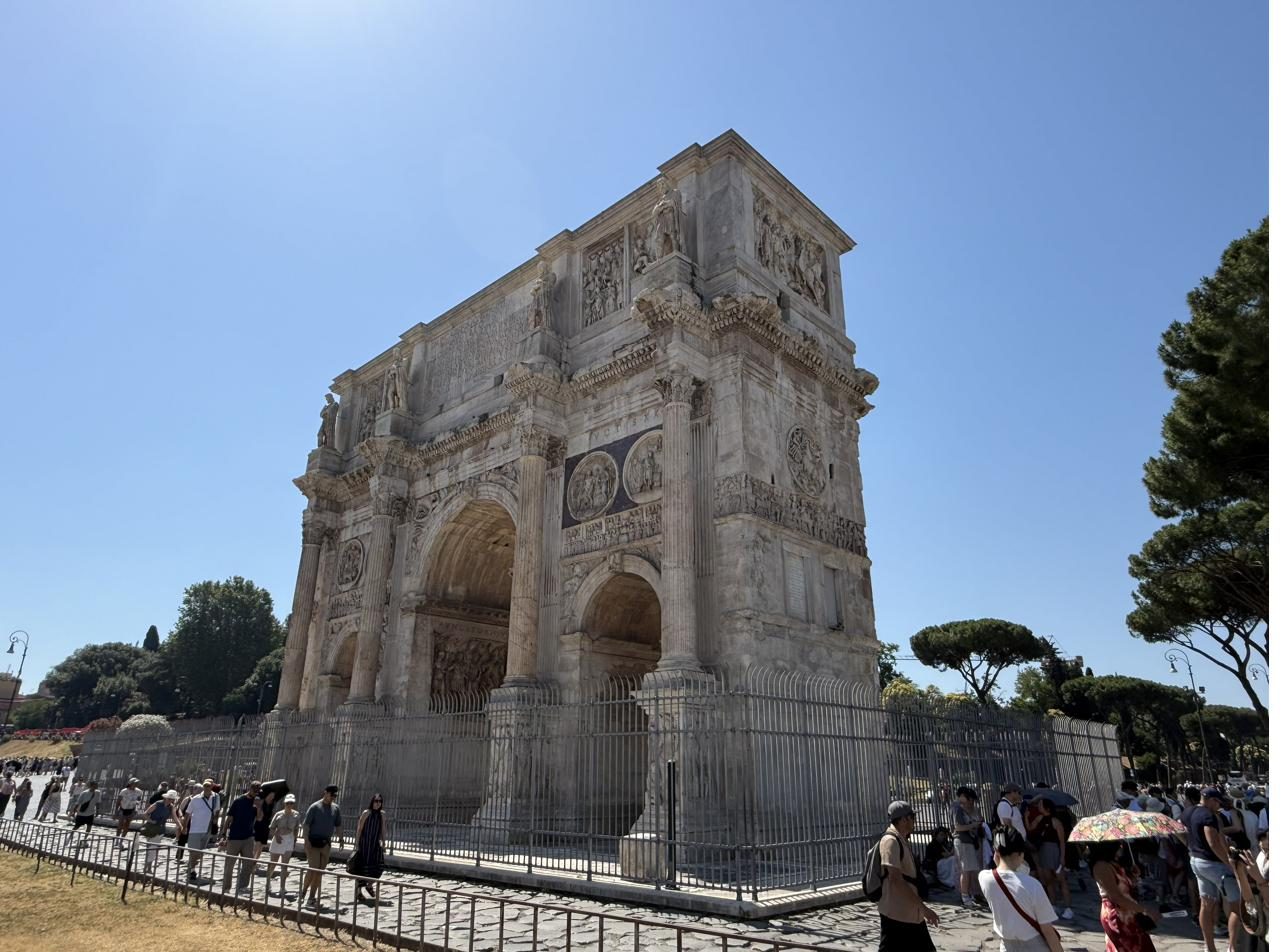
LocationBetween the Colosseum and the Palatine, Rome
UbicaciónEntre el Coliseo y el Palatino, Roma
A triple triumphal arch standing between the Colosseum and the Palatine, the largest to survive from ancient Rome. The Senate raised it to celebrate the emperor Constantine’s victory over his rival Maxentius and the tenth year of his reign. Famously, much of its sculpture is spolia — reliefs and statues taken from monuments of earlier ‘good emperors’ — set alongside newly carved Constantinian friezes, making the arch both a victory monument and a turning point in late-Roman art.
Un triple arco triunfal situado entre el Coliseo y el Palatino, el más grande que se conserva de la Roma antigua. El Senado lo levantó para celebrar la victoria del emperador Constantino sobre su rival Majencio y el décimo año de su reinado. Célebremente, gran parte de su escultura es spolia — relieves y estatuas tomados de monumentos de ‘buenos emperadores’ anteriores — junto a frisos constantinianos de nueva factura, lo que hace del arco a la vez un monumento de victoria y un punto de inflexión en el arte tardorromano.
“To the Emperor Caesar Flavius Constantinus, the Greatest, Pious and Blessed Augustus: because, by the prompting of the divinity and by his own greatness of mind, he with his army avenged the state with just arms, at a single stroke, upon the tyrant and his whole faction, the Senate and People of Rome dedicated this arch, distinguished by triumphs.” The phrase ‘instinctu divinitatis’ — ‘by divine inspiration’ — names no particular god, capturing the religious ambiguity of Constantine’s age.
“Al Emperador César Flavio Constantino, el Máximo, Pío y Bienaventurado Augusto: porque, por inspiración de la divinidad y por la grandeza de su espíritu, con su ejército vengó al Estado con armas justas, de un solo golpe, contra el tirano y toda su facción, el Senado y el Pueblo de Roma dedicaron este arco, distinguido por sus triunfos.” La expresión ‘instinctu divinitatis’ — ‘por inspiración divina’ — no nombra a ningún dios en concreto, lo que refleja la ambigüedad religiosa de la época de Constantino.
Dedicated on 25 July 315 AD, celebrating Constantine’s victory over Maxentius at the Battle of the Milvian Bridge (28 October 312) and his decennalia, the tenth year of his rule. It is about 25 metres wide and 21 metres high. Much of the reused sculpture is older still, taken from 2nd-century monuments of Trajan, Hadrian and Marcus Aurelius.
Dedicado el 25 de julio del 315 d.C., en celebración de la victoria de Constantino sobre Majencio en la batalla del Puente Milvio (28 de octubre del 312) y de sus decennalia, el décimo año de su reinado. Mide unos 25 metros de ancho y 21 de alto. Buena parte de la escultura reutilizada es aún más antigua, tomada de monumentos del siglo II de Trajano, Adriano y Marco Aurelio.
Built by order of the Roman Senate. Much of the relief is spolia reused from monuments of the emperors Trajan, Hadrian and Marcus Aurelius — the prisoner statues on the attic are Trajanic Dacians, the round medallions Hadrianic. The newly carved Constantinian friezes (the Battle of the Milvian Bridge, the distribution of largesse) are in a flatter, more frontal style that marks the shift toward late-antique and medieval art.
Construido por orden del Senado romano. Gran parte del relieve es spolia reutilizada de monumentos de los emperadores Trajano, Adriano y Marco Aurelio — las estatuas de prisioneros del ático son dacios de época de Trajano, los medallones redondos de época de Adriano. Los frisos constantinianos de nueva factura (la batalla del Puente Milvio, el reparto de donativos) están en un estilo más plano y frontal que marca el paso hacia el arte tardoantiguo y medieval.
The arch is both a celebration and a statement. By wrapping Constantine in sculpture borrowed from Rome’s most admired earlier emperors, it tied the new ruler to a golden age and legitimised his power after years of civil war. The deliberately vague ‘divine inspiration’ of its inscription stands on the threshold between pagan Rome and the Christian empire Constantine would foster, and the arch became the model from which later triumphal arches — down to modern ones — descend.
El arco es a la vez una celebración y una declaración. Al envolver a Constantino en esculturas tomadas de los emperadores anteriores más admirados de Roma, vinculó al nuevo gobernante con una edad de oro y legitimó su poder tras años de guerra civil. La deliberadamente vaga ‘inspiración divina’ de su inscripción se sitúa en el umbral entre la Roma pagana y el imperio cristiano que Constantino fomentaría, y el arco se convirtió en el modelo del que descienden los arcos triunfales posteriores — hasta los modernos.
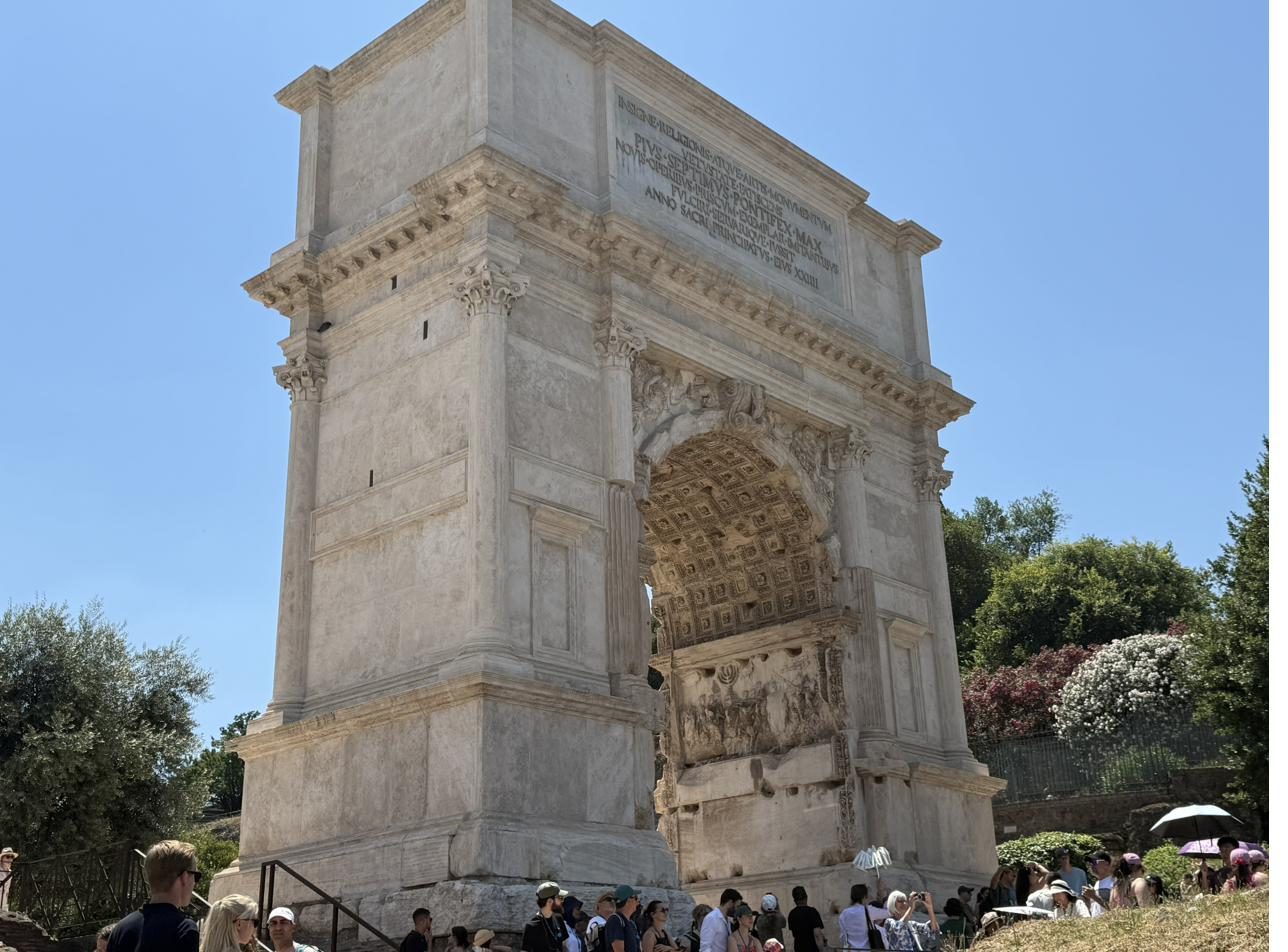
LocationOn the Via Sacra, at the entrance to the Roman Forum, Rome
UbicaciónEn la Via Sacra, a la entrada del Foro Romano, Roma
The oldest surviving triumphal arch in Rome, raised at the high point of the Via Sacra where it enters the Forum. Domitian built it in memory of his brother, the emperor Titus, and of the Flavian victory in the Jewish War. Inside the single passage, two famous relief panels face each other — the spoils of Jerusalem carried in triumph, and Titus in his chariot — while the vault shows the dead emperor being carried up to the gods.
El arco triunfal más antiguo que se conserva en Roma, levantado en el punto más alto de la Via Sacra, donde esta entra en el Foro. Domiciano lo construyó en memoria de su hermano, el emperador Tito, y de la victoria flavia en la Guerra Judía. Dentro del único vano, dos célebres relieves se enfrentan — el botín de Jerusalén llevado en triunfo y Tito en su carro — mientras que la bóveda muestra al emperador difunto siendo llevado a los dioses.
“The Senate and People of Rome, to the deified Titus Vespasian Augustus, son of the deified Vespasian.” Calling Titus ‘divine’ (Divo) shows the arch was put up after his death, once he had been formally deified.
“El Senado y el Pueblo de Roma, al deificado Tito Vespasiano Augusto, hijo del deificado Vespasiano.” Llamar a Tito ‘divino’ (Divo) indica que el arco se erigió tras su muerte, una vez que había sido formalmente deificado.
Erected about 81–82 AD, soon after Titus’s death in 81, by his brother and successor Domitian; it commemorates the capture of Jerusalem in 70 AD. The marble arch was repaired and partly rebuilt under Pope Pius VII in 1821, which is why some of the stonework looks newer than the rest.
Erigido hacia los años 81–82 d.C., poco después de la muerte de Tito en el 81, por su hermano y sucesor Domiciano; conmemora la toma de Jerusalén en el 70 d.C. El arco de mármol fue reparado y parcialmente reconstruido bajo el papa Pío VII en 1821, por lo que parte de la sillería parece más nueva que el resto.
Imperial Roman architecture of the Flavian dynasty, built under Domitian; the sculptor is unknown. The reliefs of the spoils of Jerusalem — which include the seven-branched Temple menorah, the silver trumpets and the showbread table — and of the triumph of Titus are among the most celebrated of all Roman reliefs. The 19th-century restoration was directed by the architect Giuseppe Valadier.
Arquitectura imperial romana de la dinastía flavia, construida bajo Domiciano; se desconoce el escultor. Los relieves del botín de Jerusalén — que incluyen el candelabro de siete brazos (la menorá) del Templo, las trompetas de plata y la mesa de los panes — y del triunfo de Tito están entre los más célebres de todo el arte romano. La restauración del siglo XIX la dirigió el arquitecto Giuseppe Valadier.
The Arch of Titus is the prototype of the Roman triumphal arch and the direct ancestor of the Arch of Constantine and of later monuments down to the Arc de Triomphe. Its spoils relief is the most important surviving image of the Temple treasures of Jerusalem being carried through Rome, and for that reason the arch holds deep significance in Jewish history as well as Roman.
El Arco de Tito es el prototipo del arco triunfal romano y el antepasado directo del Arco de Constantino y de monumentos posteriores hasta el Arco del Triunfo de París. Su relieve del botín es la imagen más importante que se conserva de los tesoros del Templo de Jerusalén llevados por Roma y, por ello, el arco encierra un profundo significado tanto en la historia judía como en la romana.
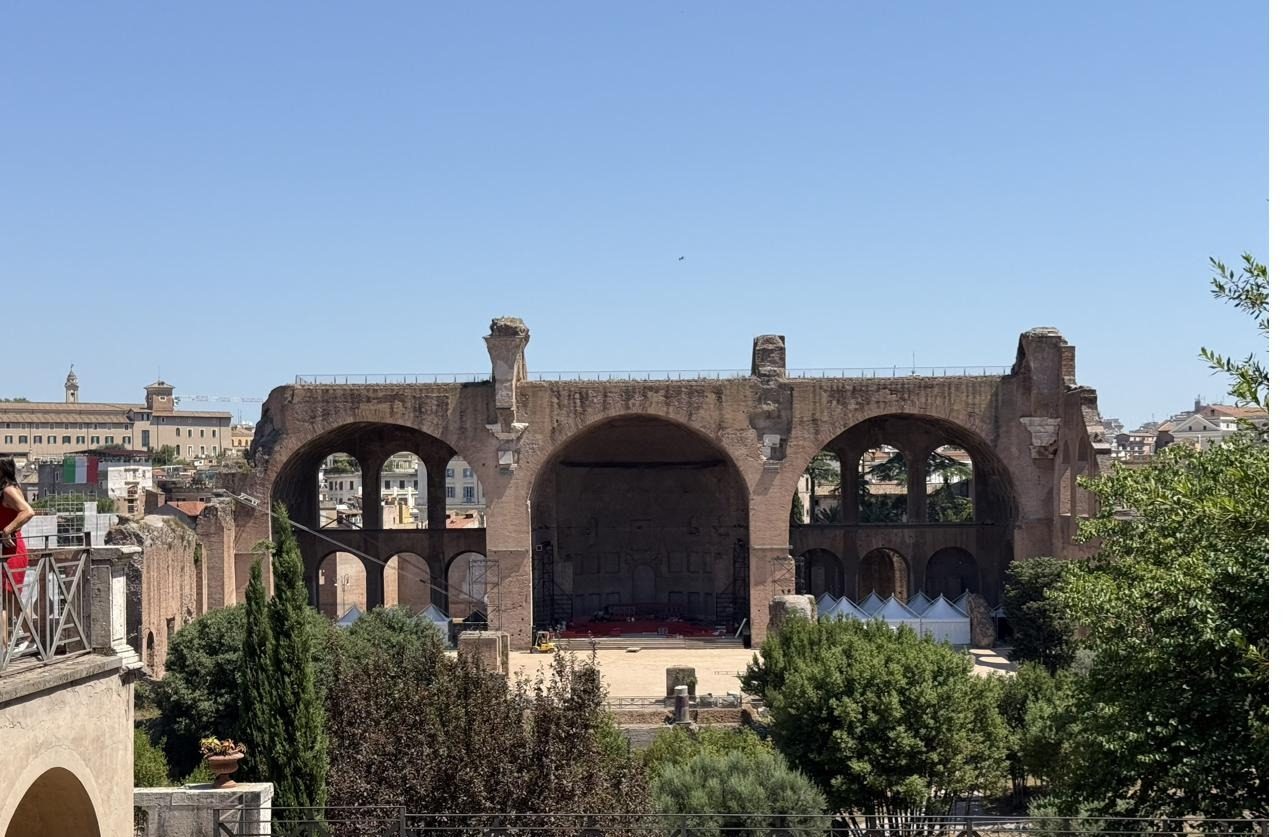
LocationAt the eastern edge of the Roman Forum, on the Velia, Rome
UbicaciónEn el extremo oriental del Foro Romano, sobre la Velia, Roma
Two colossal late-Roman buildings stand where the Forum meets the Colosseum valley. The Basilica of Maxentius — the largest building in the Forum — was a vast law court and civic hall whose surviving north aisle still rises in three giant coffered vaults. Beside it stretched the Temple of Venus and Rome, the largest temple in the ancient city, designed by the emperor Hadrian. Both reached their final form in the age of Maxentius and Constantine, the rivals who fought at the Milvian Bridge.
Dos colosales edificios tardorromanos se alzan donde el Foro se une al valle del Coliseo. La Basílica de Majencio — el edificio más grande del Foro — fue una vasta sala de justicia y edificio cívico cuya nave norte conservada aún se eleva en tres gigantescas bóvedas con casetones. Junto a ella se extendía el Templo de Venus y Roma, el templo más grande de la ciudad antigua, diseñado por el emperador Adriano. Ambos alcanzaron su forma final en la época de Majencio y Constantino, los rivales que se enfrentaron en el Puente Milvio.
The neighbouring Temple of Venus and Rome was dedicated to two goddesses at once: Venus Felix (‘Venus the Bringer of Good Fortune’), facing the Colosseum, and Roma Aeterna (‘Eternal Rome’), facing the Forum — a pairing that turns the city’s name, ROMA, into AMOR, ‘love.’
El vecino Templo de Venus y Roma estaba dedicado a dos diosas a la vez: Venus Felix (‘Venus la que trae la buena fortuna’), de cara al Coliseo, y Roma Aeterna (‘Roma Eterna’), de cara al Foro — un emparejamiento que convierte el nombre de la ciudad, ROMA, en AMOR.
The Temple of Venus and Rome was designed by Hadrian, consecrated in 121 AD and finished around 135–141. The basilica was begun by Maxentius about 306–308 AD and completed by Constantine by about 313, after his victory at the Milvian Bridge in 312. The temple was damaged by fire in 307 and rebuilt by Maxentius, who replaced its wooden roof with the concrete coffered vaults whose remains survive.
El Templo de Venus y Roma fue diseñado por Adriano, consagrado en el 121 d.C. y terminado hacia 135–141. La basílica fue comenzada por Majencio hacia 306–308 d.C. y completada por Constantino hacia el 313, tras su victoria en el Puente Milvio en 312. El templo sufrió un incendio en 307 y fue reconstruido por Majencio, que sustituyó su techo de madera por las bóvedas de hormigón con casetones cuyos restos se conservan.
The temple was designed by the emperor Hadrian himself — unusually for a Roman building, the architect is named. The basilica is the work of the emperors Maxentius and Constantine; built of brick-faced concrete, its three groin vaults rose about 39 metres on four great piers, lit by huge windows and lined with marble. Its deeply coffered vaults, modelled on the Pantheon’s dome, would later inspire Renaissance architects.
El templo fue diseñado por el propio emperador Adriano — algo inusual en un edificio romano, el arquitecto tiene nombre. La basílica es obra de los emperadores Majencio y Constantino; construida con hormigón revestido de ladrillo, sus tres bóvedas de arista se alzaban unos 39 metros sobre cuatro grandes pilares, iluminadas por enormes ventanales y revestidas de mármol. Sus bóvedas profundamente decoradas con casetones, inspiradas en la cúpula del Panteón, inspirarían más tarde a los arquitectos renacentistas.
The Basilica of Maxentius shows Roman concrete engineering at its most ambitious — vast vaulted spaces that pointed the way to the great churches of later ages; Bramante and others studied it when designing the new St. Peter’s. Together, the two buildings frame the moment when the pagan classical city gave way to the Christian empire: the basilica was the last great secular hall raised in the Forum, and Constantine, who completed it, would soon make Christianity the empire’s favoured faith.
La Basílica de Majencio muestra la ingeniería romana del hormigón en su versión más ambiciosa — vastos espacios abovedados que anticiparon las grandes iglesias de épocas posteriores; Bramante y otros la estudiaron al diseñar la nueva San Pedro. Juntos, los dos edificios enmarcan el momento en que la ciudad clásica pagana dio paso al imperio cristiano: la basílica fue la última gran sala laica levantada en el Foro, y Constantino, que la terminó, pronto haría del cristianismo la fe favorecida del imperio.
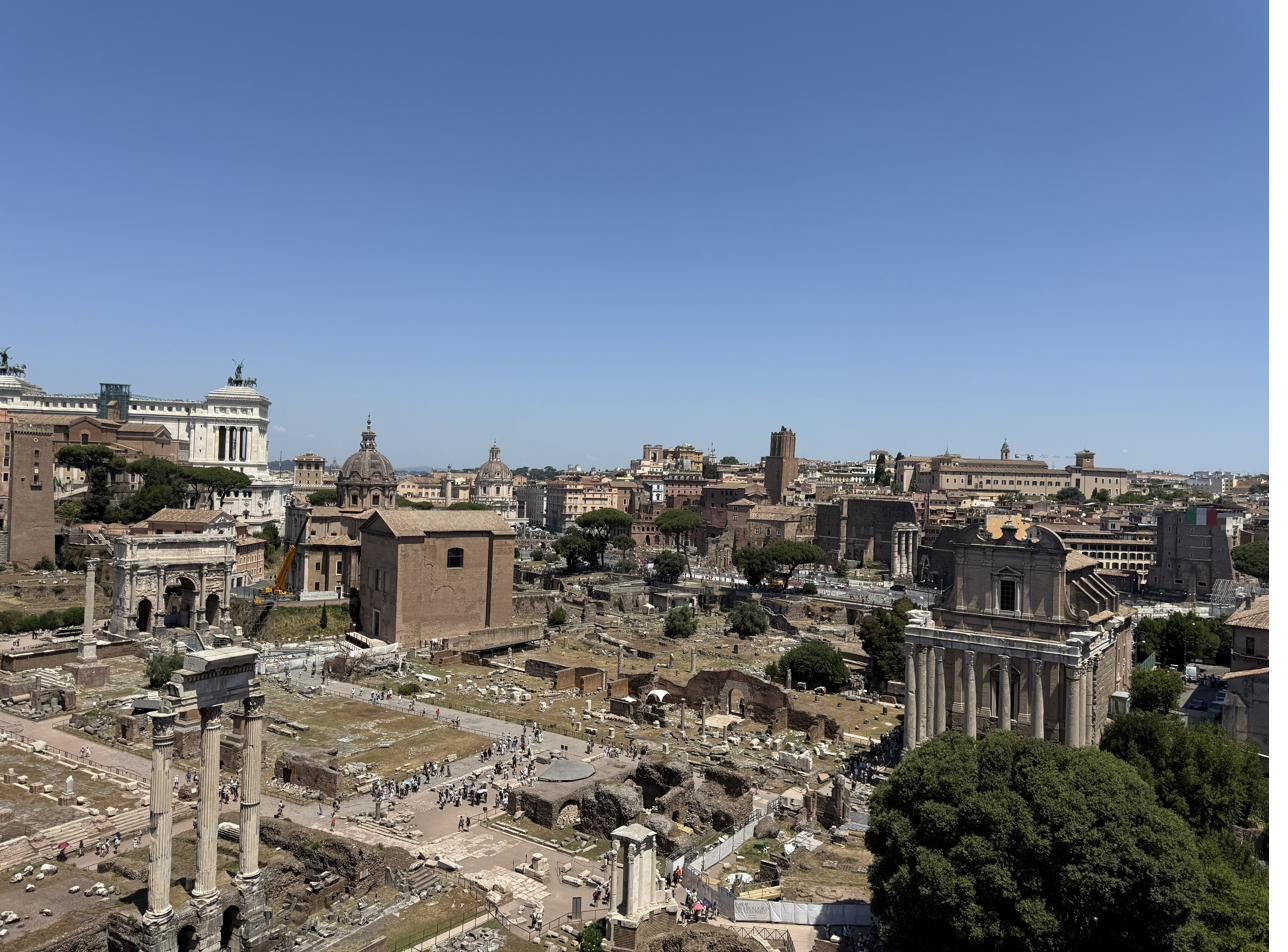
LocationBetween the Palatine and Capitoline hills, Rome
UbicaciónEntre los montes Palatino y Capitolino, Roma
For more than a thousand years this valley between the Palatine and Capitoline hills was the heart of Rome — its marketplace, law courts, senate house and temples, and the stage for triumphs, funerals and public life. From the Palatine above, the whole sweep comes into view: a dense field of temples, basilicas, arches and columns. These three views read the Forum from west to east, naming the chief landmarks as they appear.
Durante más de mil años este valle entre los montes Palatino y Capitolino fue el corazón de Roma — su mercado, sus tribunales, su sede del senado y sus templos, y el escenario de triunfos, funerales y vida pública. Desde el Palatino, arriba, se abarca todo el conjunto: un denso campo de templos, basílicas, arcos y columnas. Estas tres vistas recorren el Foro de oeste a este, nombrando los principales hitos a medida que aparecen.
The Latin word forum simply meant an open public square. This one, the Forum Romanum, was so central that it needed no other name — it was ‘the Forum,’ the model from which every other takes its name.
La palabra latina forum significaba simplemente una plaza pública abierta. Este, el Forum Romanum, era tan central que no necesitaba otro nombre — era ‘el Foro,’ el modelo del que todos los demás toman su nombre.
The Forum grew from a drained marsh into Rome’s civic centre from about the 7th century BC, and stayed in use through the Republic and Empire — well over a thousand years. The structures in view range from the Republican period to late antiquity: the Temple of Antoninus and Faustina (141 AD), the Arch of Septimius Severus (203 AD), the Basilica of Maxentius (about 313 AD), and — the very last monument raised here — the Column of Phocas (608 AD).
El Foro creció desde una ciénaga desecada hasta convertirse en el centro cívico de Roma desde hacia el siglo VII a.C., y siguió en uso durante la República y el Imperio — mucho más de mil años. Las estructuras a la vista van del periodo republicano a la antigüedad tardía: el Templo de Antonino y Faustina (141 d.C.), el Arco de Septimio Severo (203 d.C.), la Basílica de Majencio (hacia 313 d.C.) y — el último monumento erigido aquí — la Columna de Focas (608 d.C.).
A long succession of Romans built here across the centuries — kings, Republican magistrates and emperors alike. The individual temples, arches and halls are looked at more closely in the panels that follow.
Una larga sucesión de romanos construyó aquí a lo largo de los siglos — reyes, magistrados republicanos y emperadores por igual. Los templos, arcos y salas concretos se examinan más de cerca en los paneles siguientes.
The Roman Forum was the symbolic centre of the Roman world — where elections were held, laws proclaimed, gods worshipped, the dead eulogised (Julius Caesar among them) and victories paraded. Within the city, all roads led here: the Golden Milestone that measured the empire’s distances stood in this square. To look down on it from the Palatine is to see the civic heart of an empire laid bare.
El Foro Romano fue el centro simbólico del mundo romano — donde se celebraban elecciones, se proclamaban leyes, se adoraba a los dioses, se elogiaba a los muertos (Julio César entre ellos) y se desfilaban las victorias. Dentro de la ciudad, todos los caminos llevaban aquí: el Miliario de Oro que medía las distancias del imperio se alzaba en esta plaza. Contemplarlo desde el Palatino es ver al descubierto el corazón cívico de un imperio.
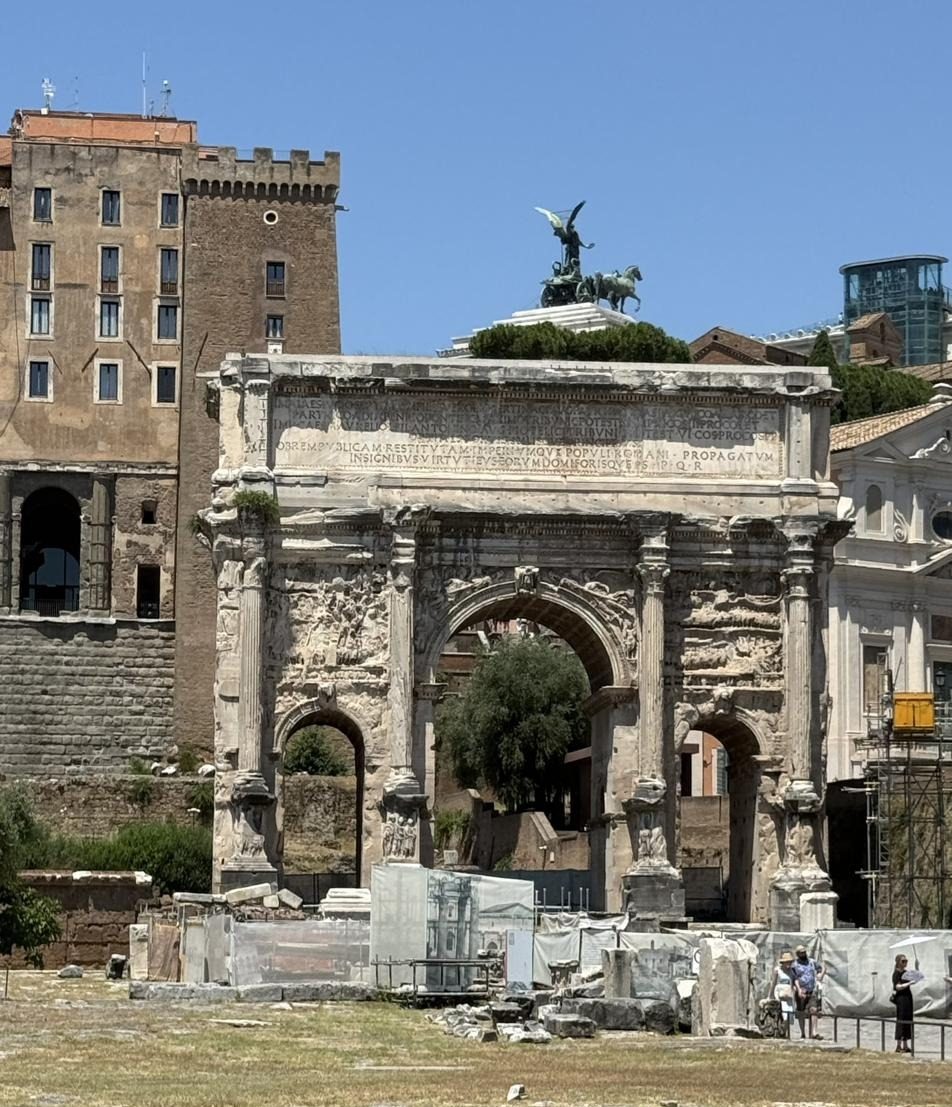
LocationAlong the Via Sacra, the Roman Forum, Rome
UbicaciónA lo largo de la Via Sacra, el Foro Romano, Roma
A closer look at some of the individual buildings that crowd the Forum floor. At the west end stands the triple Arch of Septimius Severus; nearby rise the three slender columns of the Temple of Castor and Pollux. Along the Via Sacra are the great columns of the Temple of Antoninus and Faustina — later turned into a church — and the round Temple of Romulus, which still keeps its original bronze doors. Among these monuments once stood the altar where Julius Caesar was cremated.
Una mirada más de cerca a algunos de los edificios que se agolpan en el suelo del Foro. En el extremo oeste se alza el triple Arco de Septimio Severo; cerca se elevan las tres esbeltas columnas del Templo de Cástor y Pólux. A lo largo de la Via Sacra están las grandes columnas del Templo de Antonino y Faustina — convertido después en iglesia — y el redondo Templo de Rómulo, que aún conserva sus puertas de bronce originales. Entre estos monumentos se alzaba en su día el altar donde fue incinerado Julio César.
“…they laid Caesar’s body in the Forum… and heaped upon it tables, benches and what other wood was there… they lit the fire, and all the people stood by the pyre through the night. On that spot an altar was first raised; now there stands the temple of Caesar himself, in which he is honoured as a god.”
“…depositaron el cuerpo de César en el Foro… y amontonaron encima mesas, bancos y cuanta otra madera había allí… prendieron el fuego, y todo el pueblo veló junto a la pira durante la noche. En aquel lugar se erigió primero un altar; ahora se alza el templo del propio César, en el que es honrado como un dios.”
These buildings span eight centuries of the Forum’s life. The Temple of Castor and Pollux was first vowed in 484 BC (the surviving columns belong to a rebuilding dedicated in 6 AD); the Temple of Antoninus and Faustina dates to 141 AD; the Arch of Septimius Severus to 203 AD; and the round Temple of Romulus to about 307 AD.
Estos edificios abarcan ocho siglos de vida del Foro. El Templo de Cástor y Pólux se prometió por primera vez en el 484 a.C. (las columnas que se conservan pertenecen a una reconstrucción dedicada en el 6 d.C.); el Templo de Antonino y Faustina data del 141 d.C.; el Arco de Septimio Severo del 203 d.C.; y el redondo Templo de Rómulo de hacia el 307 d.C.
Their builders range across the centuries: the Temple of Antoninus and Faustina was raised by the emperor Antoninus Pius for his deified wife; the Arch of Septimius Severus by the Senate for the Severan emperors; the Temple of Romulus by Maxentius. Several survived by being turned into churches — which is why the Temple of Antoninus and Faustina wears a Baroque facade between its ancient columns, and the Temple of Romulus still keeps its 1,700-year-old bronze doors.
Sus constructores abarcan los siglos: el Templo de Antonino y Faustina lo levantó el emperador Antonino Pío para su esposa deificada; el Arco de Septimio Severo, el Senado para los emperadores severos; el Templo de Rómulo, Majencio. Varios sobrevivieron al convertirse en iglesias — por eso el Templo de Antonino y Faustina luce una fachada barroca entre sus columnas antiguas, y el Templo de Rómulo aún conserva sus puertas de bronce de hace 1.700 años.
Together these monuments show how the Forum gathered layer upon layer of memory. Victories were carved in marble, gods and deified emperors were housed in temples, and the most charged spot of all was the altar where, in 44 BC, the Roman people cremated the murdered Julius Caesar and where his temple later rose. That so many survive at all is largely thanks to the early Church, which adopted them — turning pagan temples into chapels and so sparing them the quarrying that consumed most of ancient Rome.
Juntos, estos monumentos muestran cómo el Foro fue acumulando capa sobre capa de memoria. Las victorias se tallaban en mármol, los dioses y los emperadores deificados se alojaban en templos, y el lugar más cargado de todos era el altar donde, en el 44 a.C., el pueblo romano incineró al asesinado Julio César y donde más tarde se alzó su templo. Que tantos sobrevivan se debe en gran parte a la Iglesia primitiva, que los adoptó — convirtiendo los templos paganos en capillas y librándolos así del expolio que consumió la mayor parte de la Roma antigua.
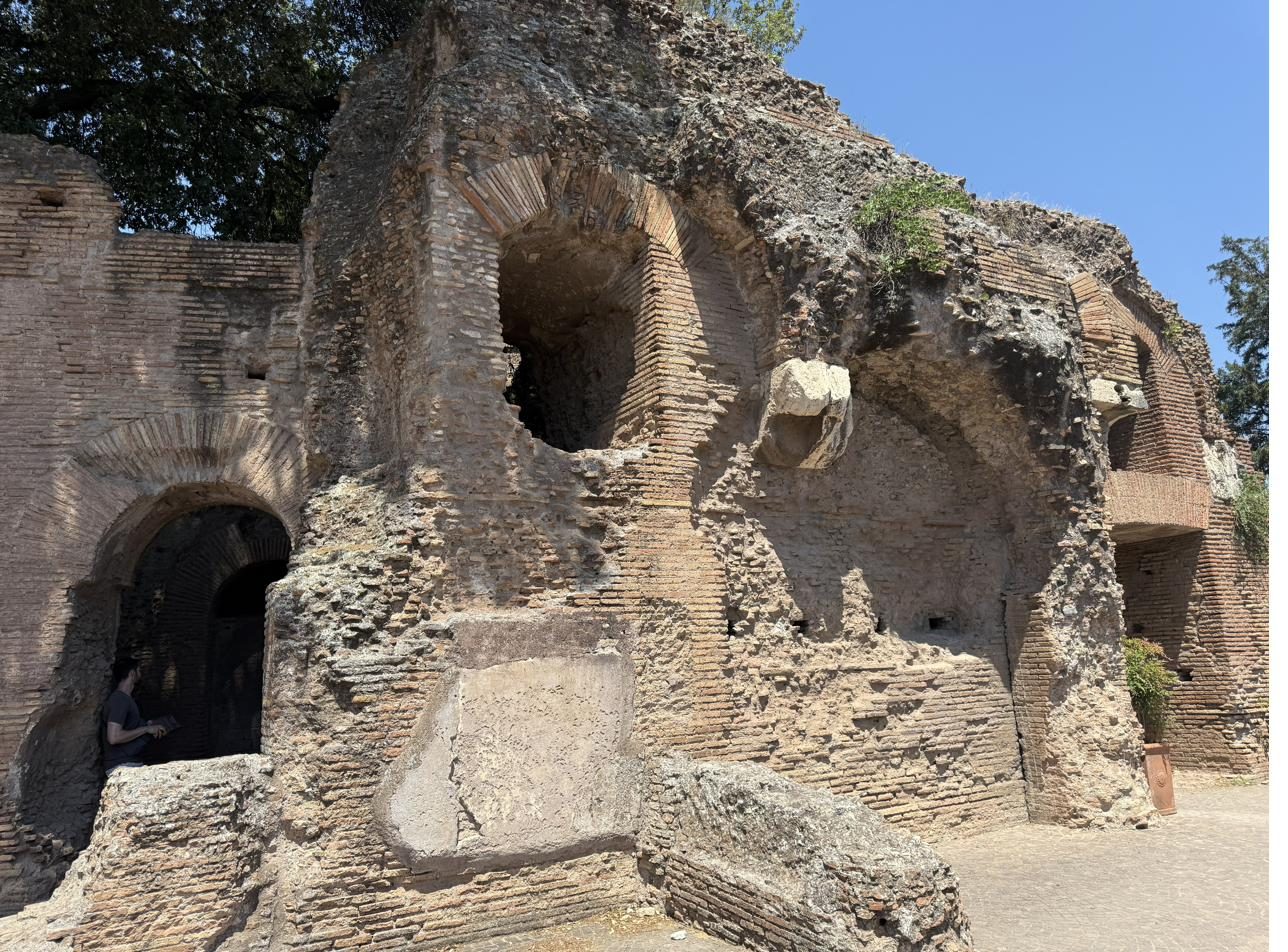
LocationThe Palatine Hill, above the Roman Forum, Rome
UbicaciónEl monte Palatino, sobre el Foro Romano, Roma
The centremost of Rome’s seven hills, and the most storied. Legend made it the spot where Romulus founded the city; history made it the home of the emperors — so completely that the hill’s Latin name, Palatium, became our word ‘palace.’ These views climb among the ruins of the imperial palace and the Renaissance gardens later laid over them: the brick-and-concrete chambers of the Domus, a great vaulted passage beneath the palace platform, and the elegant pavilions and cypresses of the Farnese Gardens.
El más céntrico de los siete montes de Roma, y el más legendario. La leyenda lo hizo el lugar donde Rómulo fundó la ciudad; la historia lo convirtió en el hogar de los emperadores — hasta tal punto que el nombre latino de la colina, Palatium, se convirtió en nuestra palabra ‘palacio.’ Estas vistas suben entre las ruinas del palacio imperial y los jardines renacentistas trazados después sobre ellas: las salas de ladrillo y hormigón de la Domus, un gran pasaje abovedado bajo la plataforma del palacio, y los elegantes pabellones y cipreses de los Jardines Farnesianos.
In other words, every ‘palace’ in Europe is, at root, named after this one hill — the place where Roman emperors lived so grandly that their address became a word.
Dicho de otro modo, todo ‘palacio’ de Europa lleva, en el fondo, el nombre de esta única colina — el lugar donde los emperadores romanos vivieron con tal grandeza que su dirección se convirtió en una palabra.
The Palatine has been lived on for some 3,000 years — from Iron-Age huts (traditionally linked to Romulus) through the aristocratic houses of the Republic. From Augustus onward it became the emperors’ hill; the great palace whose ruins dominate it was built by Domitian (81–92 AD) and extended by Septimius Severus around 200 AD. The Renaissance Farnese Gardens were laid out over the ruins in the 16th century.
El Palatino lleva habitado unos 3.000 años — desde cabañas de la Edad del Hierro (tradicionalmente vinculadas a Rómulo) hasta las casas aristocráticas de la República. Desde Augusto se convirtió en la colina de los emperadores; el gran palacio cuyas ruinas la dominan lo construyó Domiciano (81–92 d.C.) y lo amplió Septimio Severo hacia el 200 d.C. Los renacentistas Jardines Farnesianos se trazaron sobre las ruinas en el siglo XVI.
The vast imperial palace — the Domus Flavia (the public state rooms) and the Domus Augustana (the emperor’s private quarters), with its sunken garden ‘stadium’ — was the work of Domitian’s architect Rabirius, one of the few Roman architects whose name survives. Septimius Severus later extended the complex southward on huge brick substructures overlooking the Circus Maximus. The garden pavilions belong to the Farnese Gardens (Orti Farnesiani), created for Cardinal Alessandro Farnese in the 1500s — among the first botanical gardens in Europe.
El vasto palacio imperial — la Domus Flavia (las salas públicas de estado) y la Domus Augustana (los aposentos privados del emperador), con su jardín hundido en forma de ‘estadio’ — fue obra del arquitecto de Domiciano, Rabirio, uno de los pocos arquitectos romanos cuyo nombre se conserva. Septimio Severo amplió después el complejo hacia el sur sobre enormes subestructuras de ladrillo que dominan el Circo Máximo. Los pabellones del jardín pertenecen a los Jardines Farnesianos (Orti Farnesiani), creados para el cardenal Alessandro Farnese en el siglo XVI — entre los primeros jardines botánicos de Europa.
For three centuries this hill was the seat of the Roman emperors, the command-centre of the Mediterranean world — and its name passed into half the languages of Europe as the word for any great house. Layered over the imperial ruins, the Farnese Gardens turned the hill into a Renaissance idyll of terraces and cypresses. To walk it today is to move through three thousand years at once: the legendary cradle of Rome, the palace of its emperors, and a Renaissance garden, all on the same ground.
Durante tres siglos esta colina fue la sede de los emperadores romanos, el centro de mando del mundo mediterráneo — y su nombre pasó a la mitad de las lenguas de Europa como la palabra para cualquier gran casa. Superpuestos a las ruinas imperiales, los Jardines Farnesianos convirtieron la colina en un idilio renacentista de terrazas y cipreses. Recorrerla hoy es atravesar tres mil años a la vez: la cuna legendaria de Roma, el palacio de sus emperadores y un jardín renacentista, todo sobre el mismo suelo.
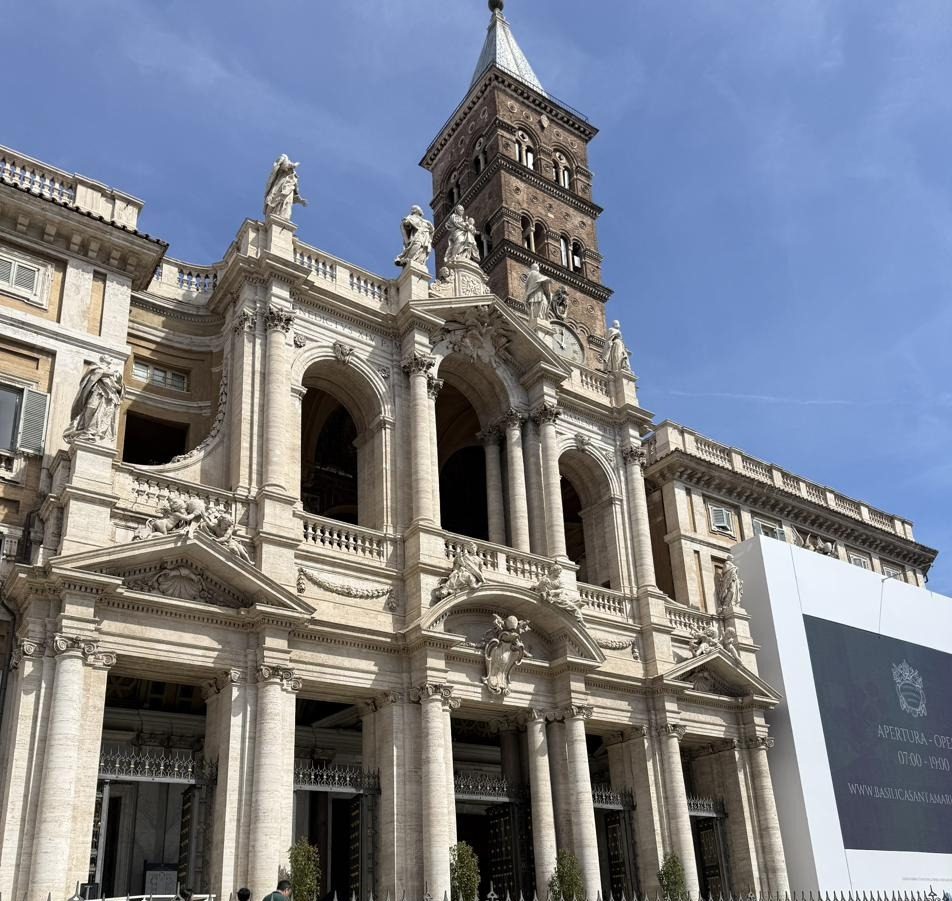
LocationPiazza di Santa Maria Maggiore, Esquiline Hill, Rome
UbicaciónPiazza di Santa Maria Maggiore, monte Esquilino, Roma
The oldest church in the Western world dedicated to the Virgin Mary, and one of Rome’s four great papal basilicas. Founded in the 5th century, it still keeps its early-Christian basilica plan — a long nave divided by forty ancient columns — beneath a gilded Renaissance ceiling and behind a grand Baroque facade. These views show that facade and its medieval bell tower, the famous coffered ceiling, one of the two monumental domed chapels, and Bernini’s statue of a royal benefactor in the portico.
La iglesia más antigua del mundo occidental dedicada a la Virgen María, y una de las cuatro grandes basílicas papales de Roma. Fundada en el siglo V, conserva aún su planta de basílica paleocristiana — una larga nave dividida por cuarenta columnas antiguas — bajo un techo renacentista dorado y tras una majestuosa fachada barroca. Estas vistas muestran esa fachada y su campanario medieval, el célebre techo de casetones, una de las dos monumentales capillas con cúpula, y la estatua de Bernini de un benefactor real en el pórtico.
“To Philip IV, Catholic King of the Spains … the Chapter and Canons raised this monument in gratitude, in the year 1692.” Philip IV had granted the basilica a perpetual yearly gift, and the grateful clergy honoured him with Bernini’s statue.
“A Felipe IV, Rey Católico de las Españas … el Cabildo y los Canónigos erigieron este monumento en agradecimiento, en el año 1692.” Felipe IV había concedido a la basílica una donación anual perpetua, y el clero agradecido lo honró con la estatua de Bernini.
Founded in the 5th century: tradition tells of a miraculous August snowfall in 358 that marked out the site, but the basilica was built after the Council of Ephesus (431) by Pope Sixtus III and consecrated in 434. The gilded ceiling is of the 15th–16th century; the present facade was added by Ferdinando Fuga in 1741–43; the campanile dates to 1377.
Fundada en el siglo V: la tradición habla de una milagrosa nevada de agosto en el 358 que señaló el sitio, pero la basílica se construyó tras el Concilio de Éfeso (431) por el papa Sixto III y se consagró en el 434. El techo dorado es de los siglos XV–XVI; la fachada actual la añadió Ferdinando Fuga en 1741–43; el campanario data de 1377.
A thousand years of artists. The Baroque facade is by Ferdinando Fuga (under Pope Benedict XIV); the gilded coffered ceiling was designed by Giuliano da Sangallo; the apse mosaic of the Coronation of the Virgin is by Jacopo Torriti (1295). The basilica is also the burial place of the great sculptor Gian Lorenzo Bernini, whose statue of Philip IV stands in the portico (cast by Girolamo Lucenti, 1692).
Mil años de artistas. La fachada barroca es de Ferdinando Fuga (bajo el papa Benedicto XIV); el techo dorado de casetones lo diseñó Giuliano da Sangallo; el mosaico del ábside con la Coronación de la Virgen es de Jacopo Torriti (1295). La basílica es también el lugar de enterramiento del gran escultor Gian Lorenzo Bernini, cuya estatua de Felipe IV se alza en el pórtico (fundida por Girolamo Lucenti, 1692).
Santa Maria Maggiore is the foremost shrine of the Virgin Mary in the Western Church and the best-preserved of Rome’s great early basilicas, still showing its 5th-century mosaics — the oldest Marian images in the West. Legend says its golden ceiling was gilded with the first gold brought back from the Americas, a gift of Ferdinand and Isabella to Pope Alexander VI. In April 2025 it became the burial place of Pope Francis, who chose to be laid to rest here near the icon of the Virgin he venerated.
Santa Maria Maggiore es el principal santuario de la Virgen María en la Iglesia occidental y la mejor conservada de las grandes basílicas antiguas de Roma, que aún muestra sus mosaicos del siglo V — las imágenes marianas más antiguas de Occidente. La leyenda dice que su techo dorado se doró con el primer oro traído de las Américas, regalo de Fernando e Isabel al papa Alejandro VI. En abril de 2025 se convirtió en el lugar de sepultura del papa Francisco, que eligió descansar aquí junto al icono de la Virgen que veneraba.
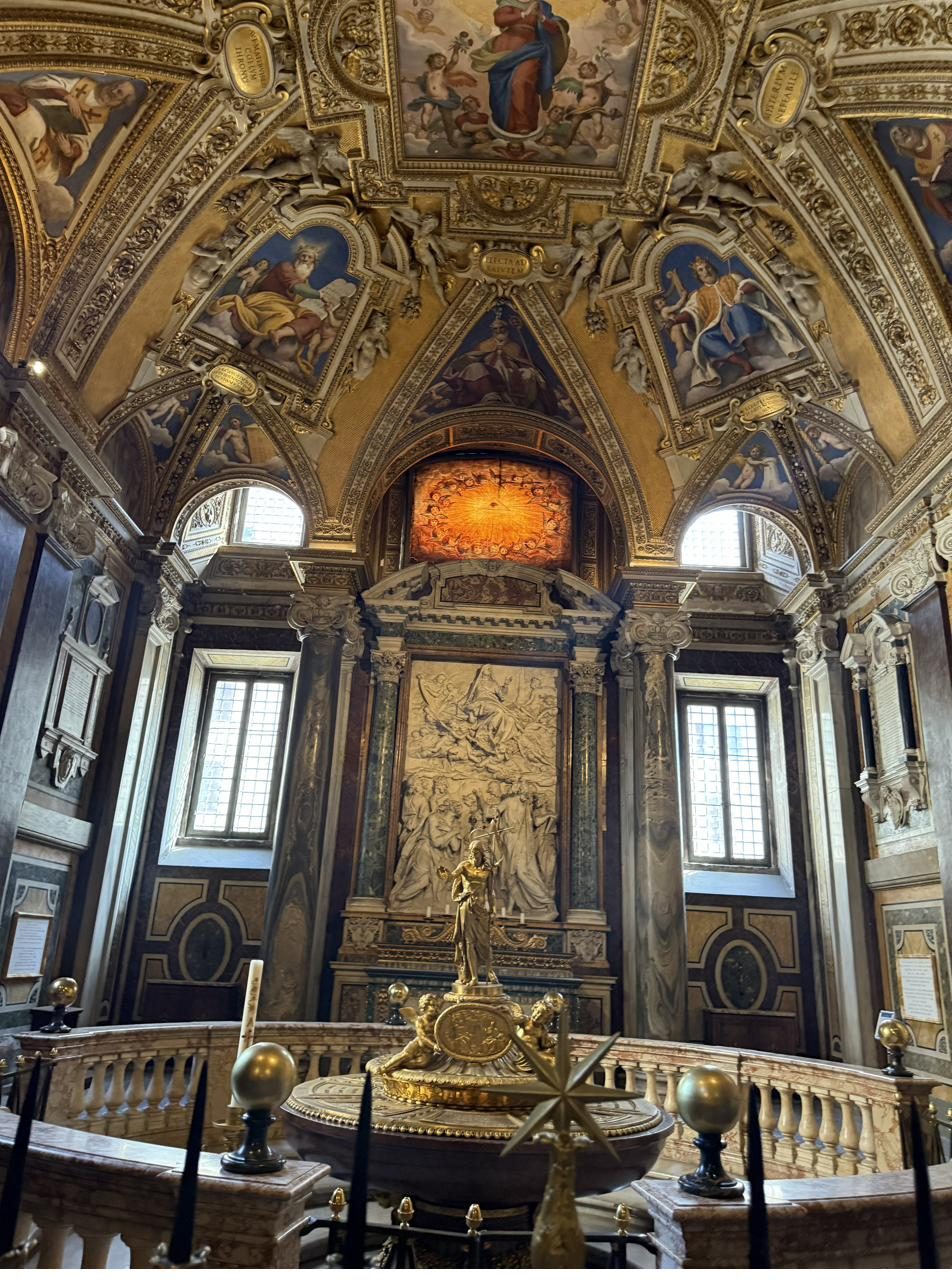
LocationInside the Basilica di Santa Maria Maggiore, Rome
UbicaciónEn el interior de la Basílica de Santa Maria Maggiore, Roma
Beyond the nave, the basilica opens into a series of richly decorated chapels and a grand baptistery. These views gather some of them: the baptistery with its marble font and a relief by Pietro Bernini; the bronze Holy Door that is unsealed only in Jubilee years; a side-chapel altar framed by marble angels; and a Marian chapel where pilgrims still light candles before the Madonna.
Más allá de la nave, la basílica se abre en una serie de capillas ricamente decoradas y un gran baptisterio. Estas vistas reúnen algunas de ellas: el baptisterio con su pila de mármol y un relieve de Pietro Bernini; la Puerta Santa de bronce que solo se abre en los años jubilares; el altar de una capilla lateral enmarcado por ángeles de mármol; y una capilla mariana donde los peregrinos aún encienden velas ante la Virgen.
“Pope Pius XII, in 1949, the eleventh year of his sacred reign.” A Holy Door is walled up between Jubilees and ceremonially opened by the pope to begin each Holy Year; this inscription marks the Jubilee proclaimed in 1949.
“El papa Pío XII, en 1949, el undécimo año de su sagrado reinado.” Una Puerta Santa permanece tapiada entre jubileos y la abre ceremonialmente el papa para iniciar cada Año Santo; esta inscripción señala el Jubileo proclamado en 1949.
The chapels span several centuries of the basilica’s long life. The baptismal font is the work of Giuseppe Valadier (early 19th century); the Assumption relief behind it is by Pietro Bernini, father of Gian Lorenzo. The two monumental domed chapels off the nave — the Sistine Chapel of Pope Sixtus V and the Pauline (Borghese) Chapel of Pope Paul V — date from around 1585 and 1611.
Las capillas abarcan varios siglos de la larga vida de la basílica. La pila bautismal es obra de Giuseppe Valadier (principios del siglo XIX); el relieve de la Asunción que hay detrás es de Pietro Bernini, padre de Gian Lorenzo. Las dos monumentales capillas con cúpula que dan a la nave — la Capilla Sixtina del papa Sixto V y la Capilla Paulina (Borghese) del papa Paulo V — datan de hacia 1585 y 1611.
The font is by Giuseppe Valadier; the marble Assumption relief by Pietro Bernini. The basilica’s greatest treasures lie in the two domed chapels: the Sistine Chapel holds Arnolfo di Cambio’s marble Nativity (1291) and the relic of the Holy Crib of Bethlehem, while the Pauline (Borghese) Chapel enshrines the Salus Populi Romani — the ancient, deeply venerated icon of the Virgin traditionally attributed to St Luke. The makers of the side-chapel paintings shown here are not recorded on site.
La pila es de Giuseppe Valadier; el relieve de mármol de la Asunción, de Pietro Bernini. Los mayores tesoros de la basílica están en las dos capillas con cúpula: la Capilla Sixtina guarda la Natividad de mármol de Arnolfo di Cambio (1291) y la reliquia de la Sagrada Cuna de Belén, mientras que la Capilla Paulina (Borghese) custodia la Salus Populi Romani — el antiguo y muy venerado icono de la Virgen tradicionalmente atribuido a san Lucas. Los autores de los cuadros de las capillas laterales que se muestran aquí no constan en el lugar.
If the nave tells the basilica’s ancient story, the chapels tell its living one. Pilgrims still come to light candles before the Madonna and to pray at the Salus Populi Romani, the icon that Roman tradition credits with protecting the city. The Holy Door, opened once a generation, marks Santa Maria Maggiore as one of the four basilicas of the Roman Jubilee — a place where, century after century, the devotion that built the church continues.
Si la nave cuenta la historia antigua de la basílica, las capillas cuentan la viva. Los peregrinos siguen viniendo a encender velas ante la Virgen y a rezar ante la Salus Populi Romani, el icono al que la tradición romana atribuye la protección de la ciudad. La Puerta Santa, abierta una vez por generación, señala a Santa Maria Maggiore como una de las cuatro basílicas del Jubileo romano — un lugar donde, siglo tras siglo, continúa la devoción que construyó la iglesia.
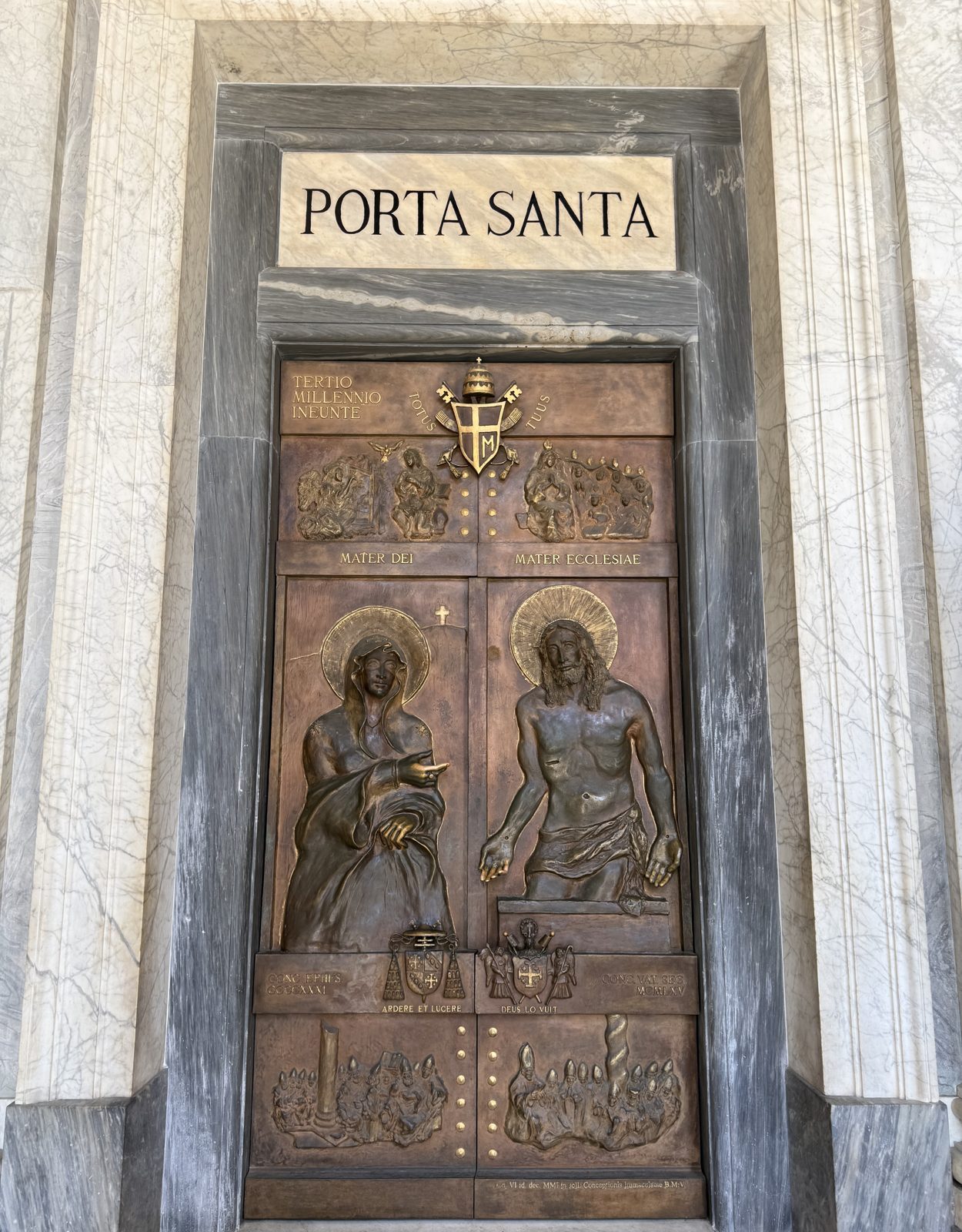
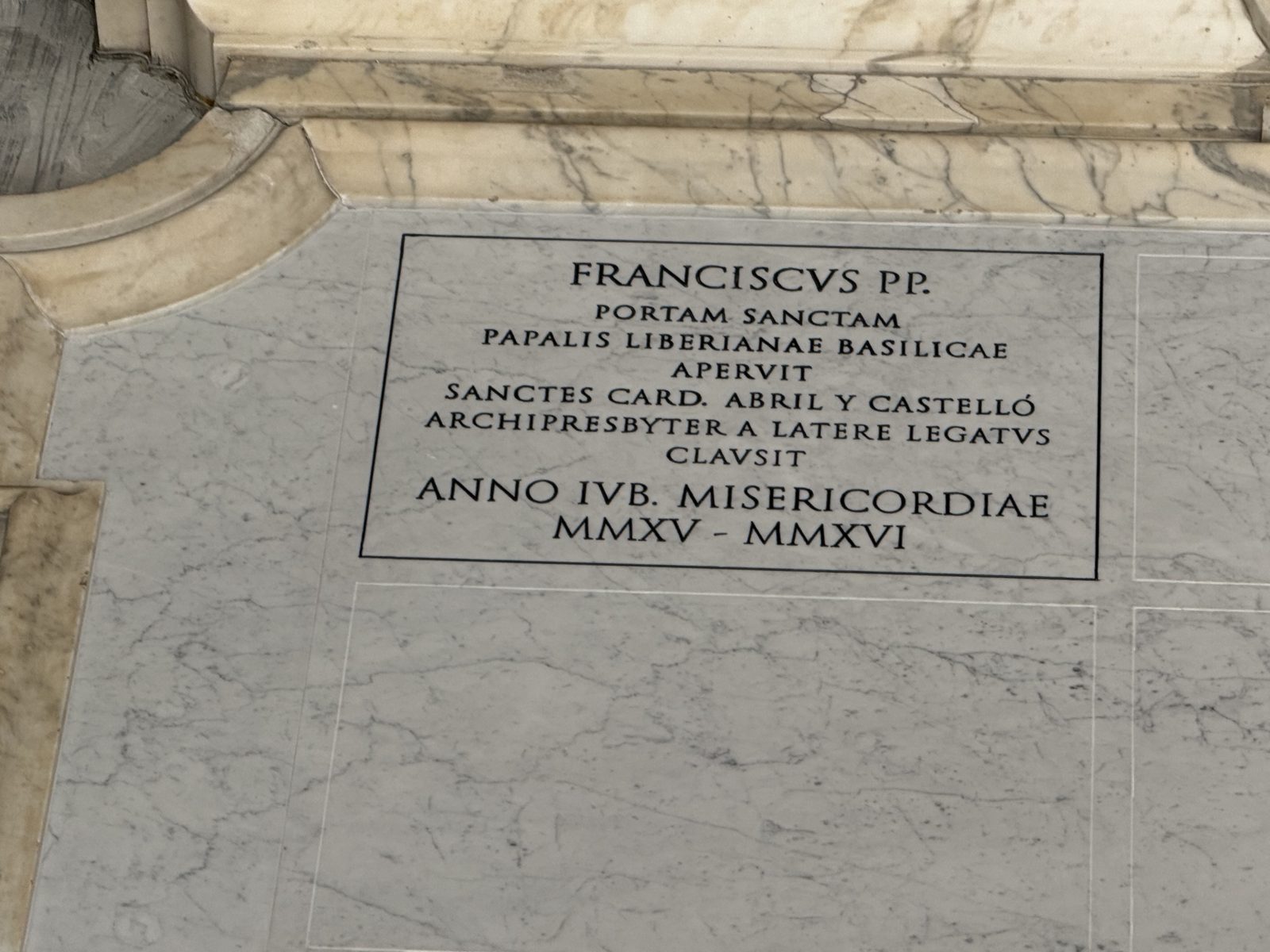
LocationSanta Maria Maggiore, Rome
UbicaciónSanta María la Mayor, Roma
The basilica's bronze Holy Door, carved with the words PORTA SANTA and two saints in relief, with the marble plaque set beside it recording its most recent opening.
La Puerta Santa de bronce de la basílica, grabada con las palabras PORTA SANTA y dos santos en relieve, con la placa de mármol junto a ella que registra su apertura más reciente.
“Holy Door.” / “Pope Francis opened the Holy Door of the Papal Liberian Basilica; Cardinal Abril y Castelló, Archpriest and Legate, closed it — in the Jubilee Year of Mercy, 2015–2016.”
“Puerta Santa.” / “El papa Francisco abrió la Puerta Santa de la Basílica Papal Liberiana; el cardenal Abril y Castelló, arcipreste y legado, la cerró — en el Año Jubilar de la Misericordia, 2015–2016.”
The plaque records the Jubilee of Mercy of 2015–2016. A Holy Door is opened only in Jubilee years; Santa Maria Maggiore is one of Rome's four papal basilicas, each of which has one.
La placa registra el Jubileo de la Misericordia de 2015–2016. Una Puerta Santa se abre solo en los años jubilares; Santa María la Mayor es una de las cuatro basílicas papales de Roma, cada una con la suya.
Commissioned by the basilica's Chapter; the inscription names Pope Francis, who opened the door, and Cardinal Santos Abril y Castelló, the archpriest who closed it.
Encargada por el Cabildo de la basílica; la inscripción nombra al papa Francisco, que abrió la puerta, y al cardenal Santos Abril y Castelló, el arcipreste que la cerró.
Passing through a Holy Door during a Jubilee is one of the central acts of a Roman pilgrimage. This basilica was especially dear to Pope Francis, who was buried here in 2025.
Cruzar una Puerta Santa durante un Jubileo es uno de los actos centrales de una peregrinación romana. Esta basílica fue muy querida por el papa Francisco, sepultado aquí en 2025.
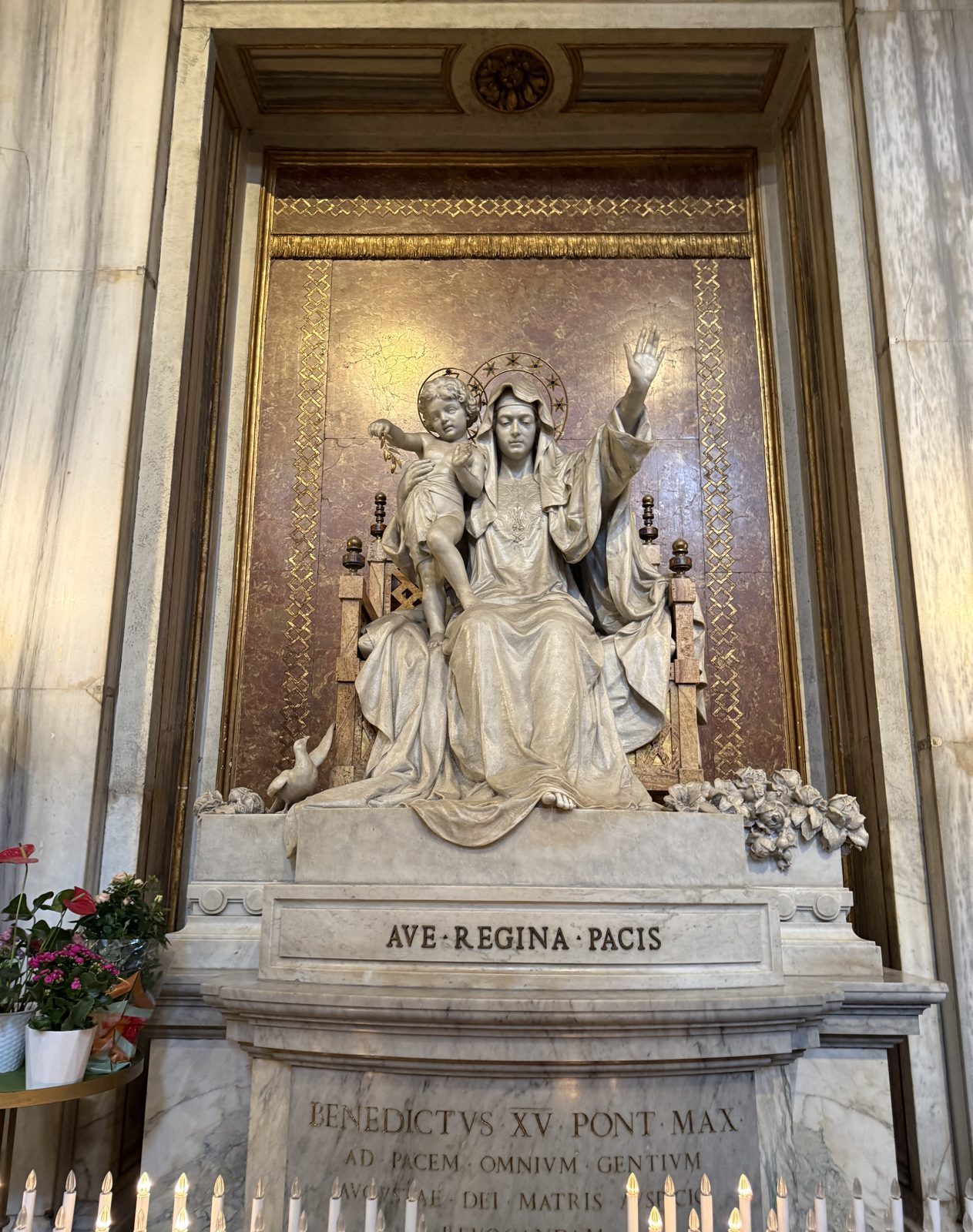
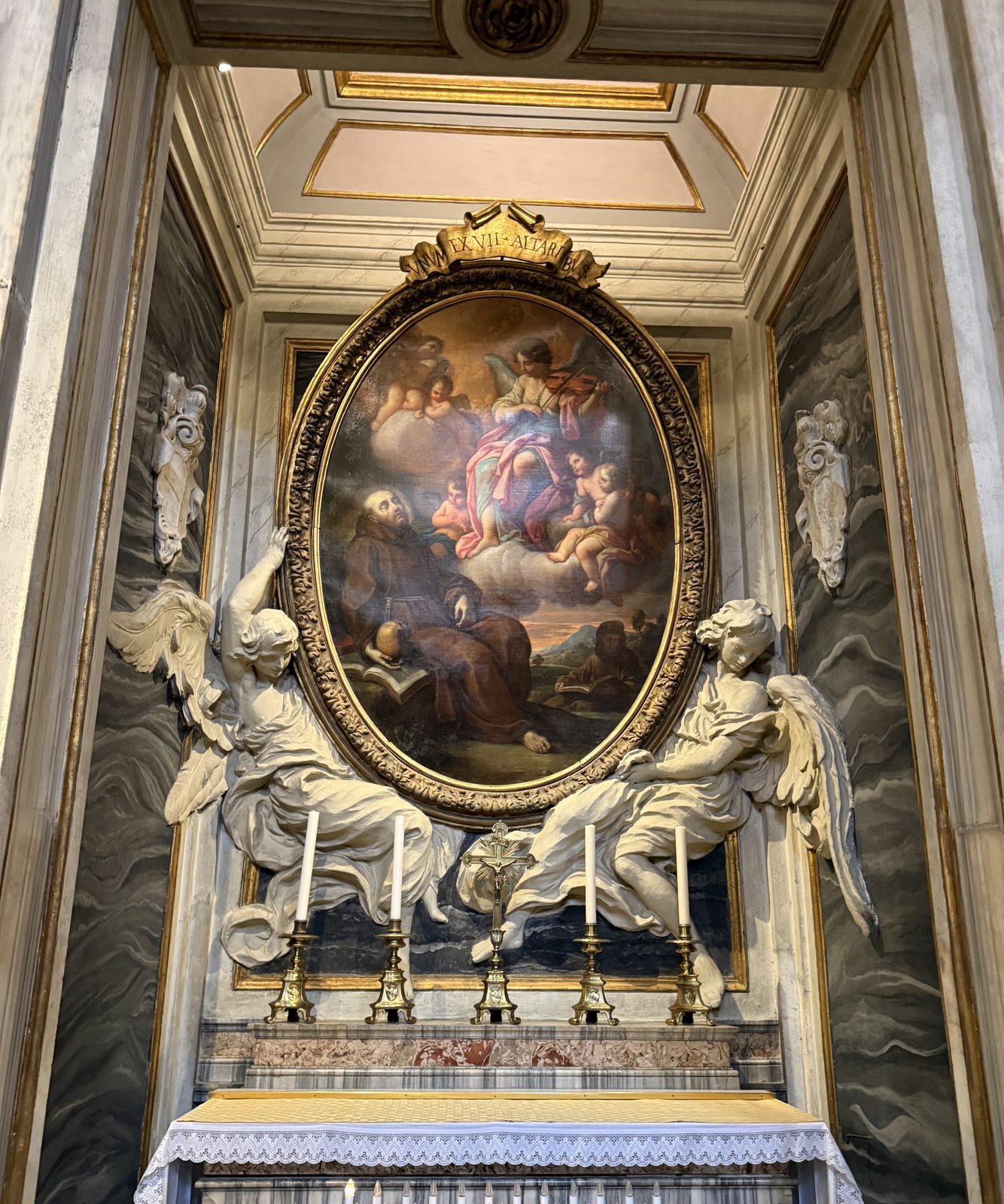
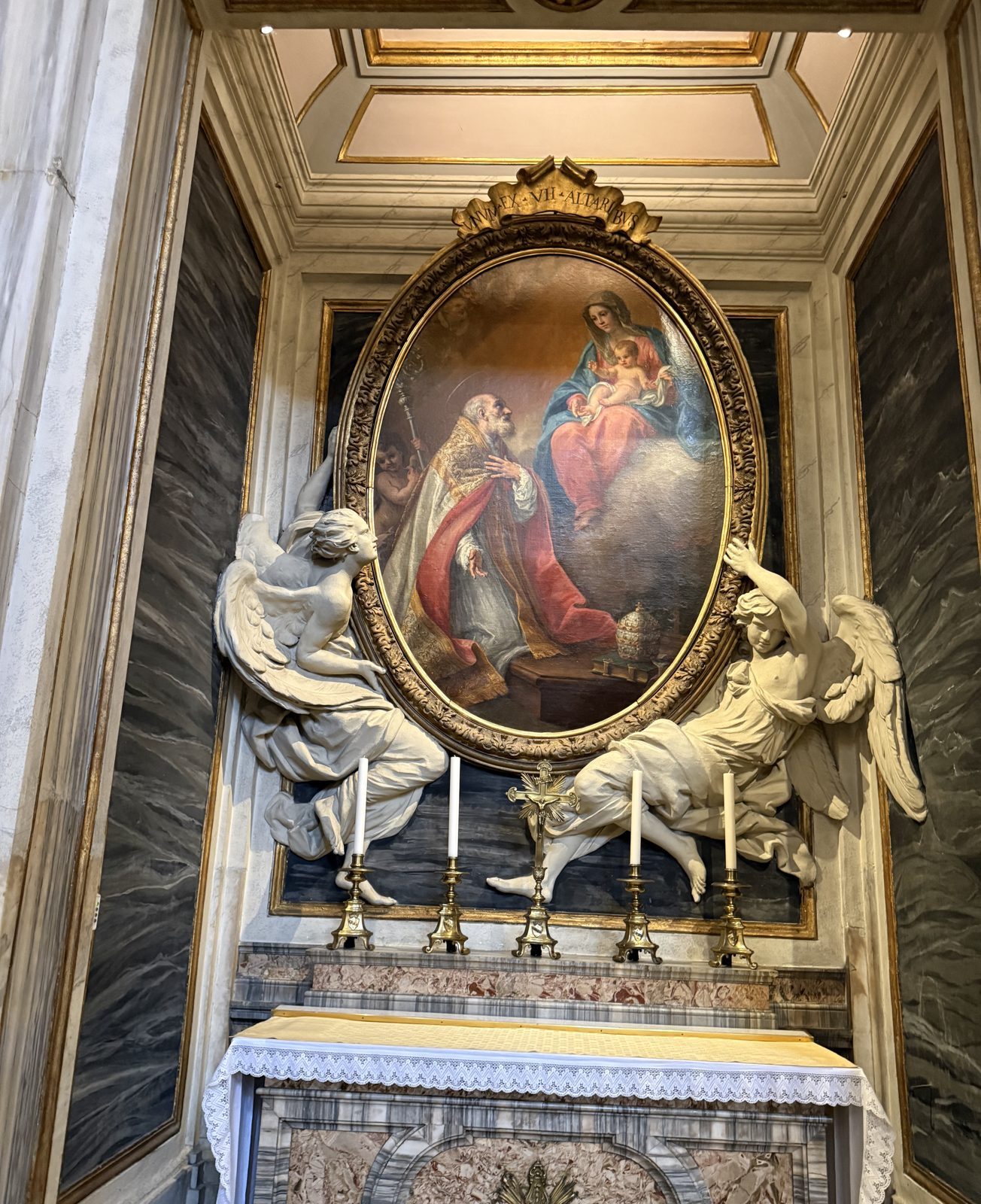
LocationLeft aisle, Santa Maria Maggiore, Rome
UbicaciónNave izquierda, Santa María la Mayor, Roma
The marble Regina Pacis — the Virgin and Child enthroned as Queen of Peace — together with two matching side altars, each an oval altarpiece (one a Franciscan saint in a heavenly vision, the other a Madonna) framed by a pair of large Baroque marble angels.
La Regina Pacis de mármol — la Virgen con el Niño entronizada como Reina de la Paz — junto con dos altares laterales a juego, cada uno con un retablo ovalado (uno un santo franciscano en una visión celestial, el otro una Virgen) enmarcado por una pareja de grandes ángeles barrocos de mármol.
“Hail, Queen of Peace.” / “Benedict XV, Supreme Pontiff.”
“Salve, Reina de la Paz.” / “Benedicto XV, Sumo Pontífice.”
The Regina Pacis dates to about 1918; the two oval altarpieces and their flanking angels are Baroque works of the 17th–18th centuries.
La Regina Pacis data de alrededor de 1918; los dos retablos ovalados y sus ángeles son obras barrocas de los siglos XVII–XVIII.
The Regina Pacis is by Guido Galli (1890–1944), commissioned by Pope Benedict XV as a prayer for peace during the First World War. The two oval altarpiece paintings and their marble angels are described here by subject — their authors are not recorded in the sources we could verify.
La Regina Pacis es de Guido Galli (1890–1944), encargada por el papa Benedicto XV como oración por la paz durante la Primera Guerra Mundial. Las dos pinturas ovaladas y sus ángeles de mármol se describen aquí por su tema — sus autores no constan en las fuentes que pudimos verificar.
Galli's statue is one of Rome's most direct artistic pleas for peace, made at the height of the Great War; the flanking aisle altars show the Berniniesque taste for sculpted angels that pervades the basilica.
La estatua de Galli es una de las súplicas artísticas por la paz más directas de Roma, hecha en plena Gran Guerra; los altares laterales muestran el gusto berniniano por los ángeles esculpidos que recorre la basílica.
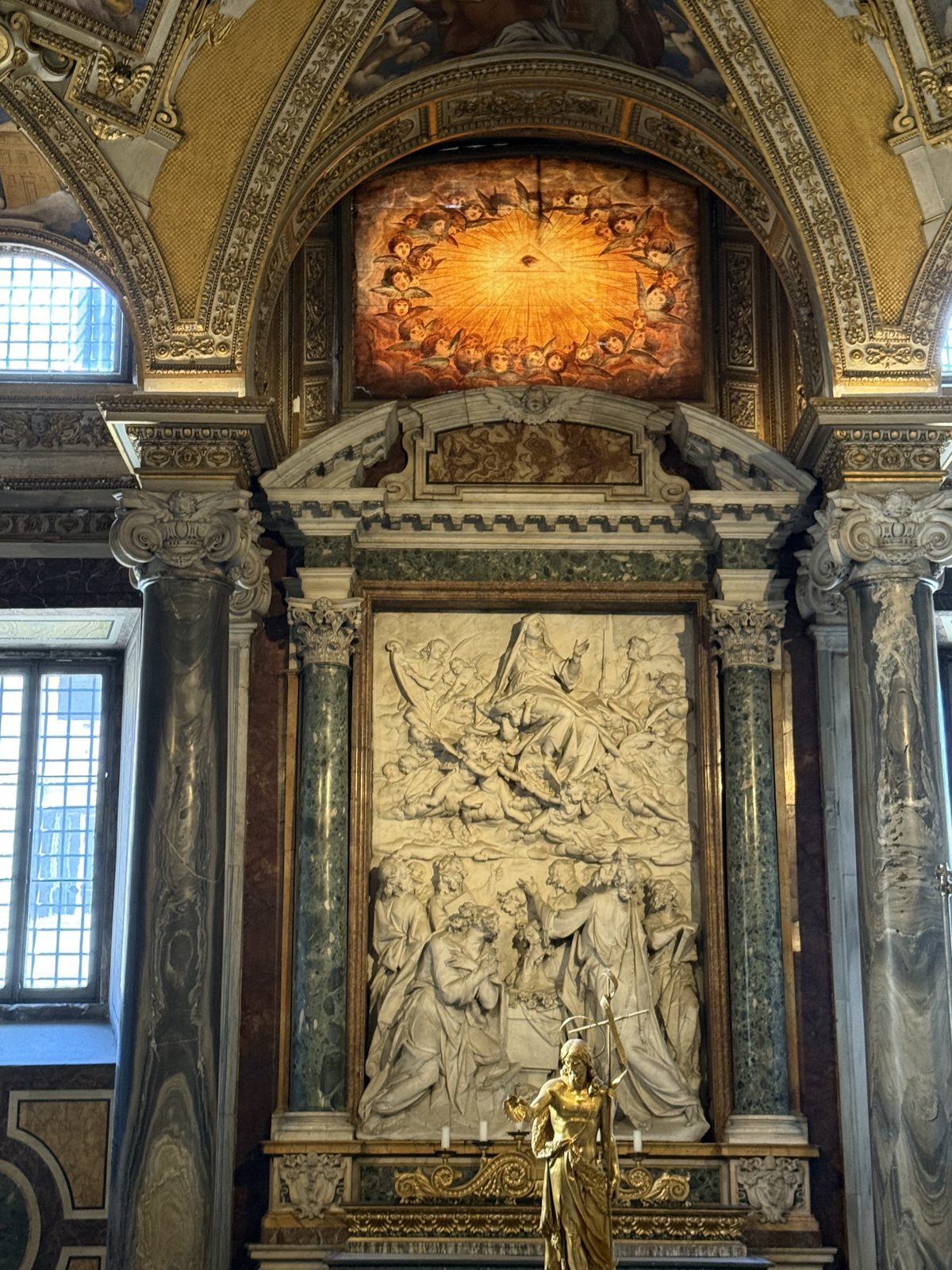
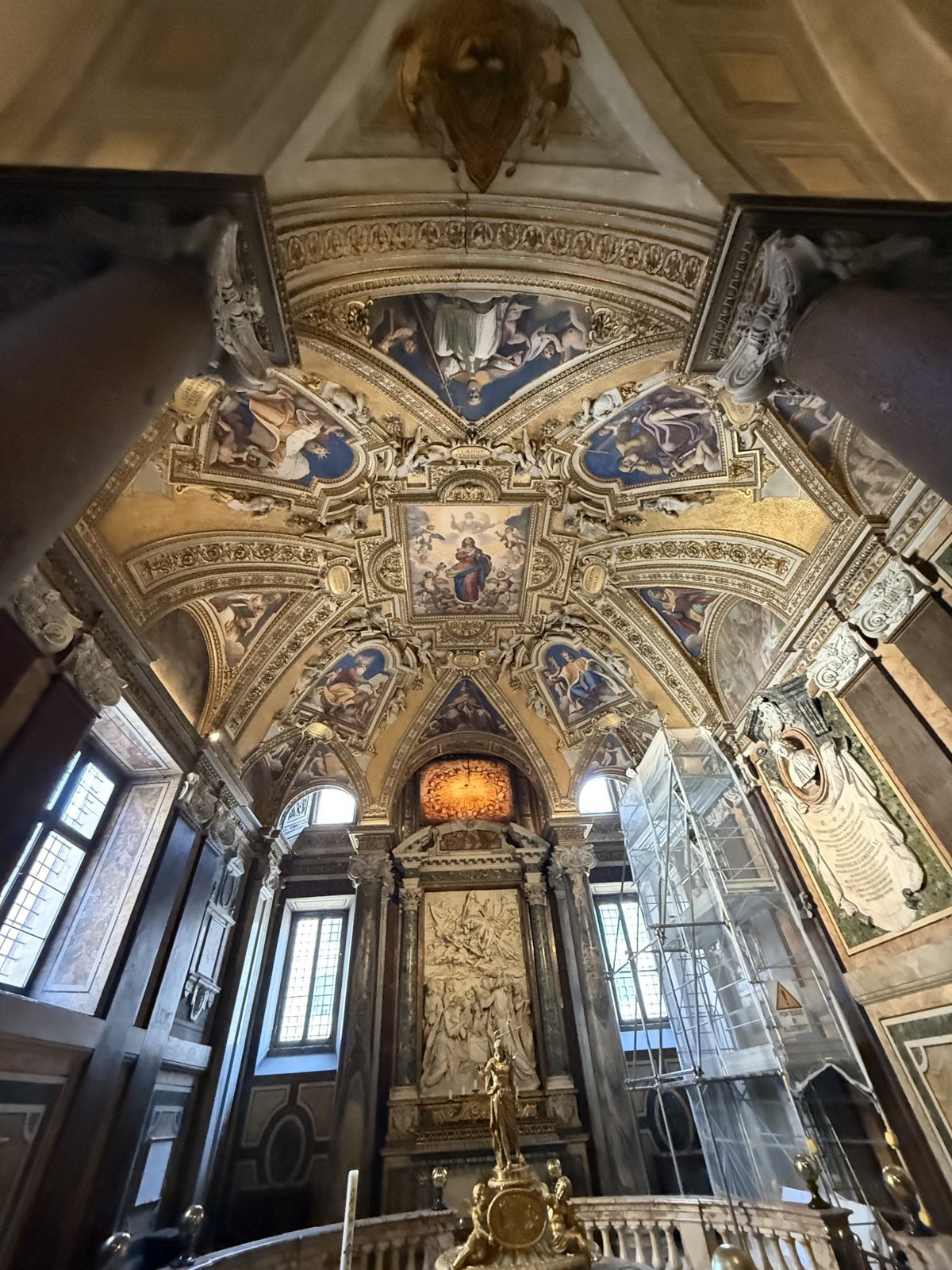
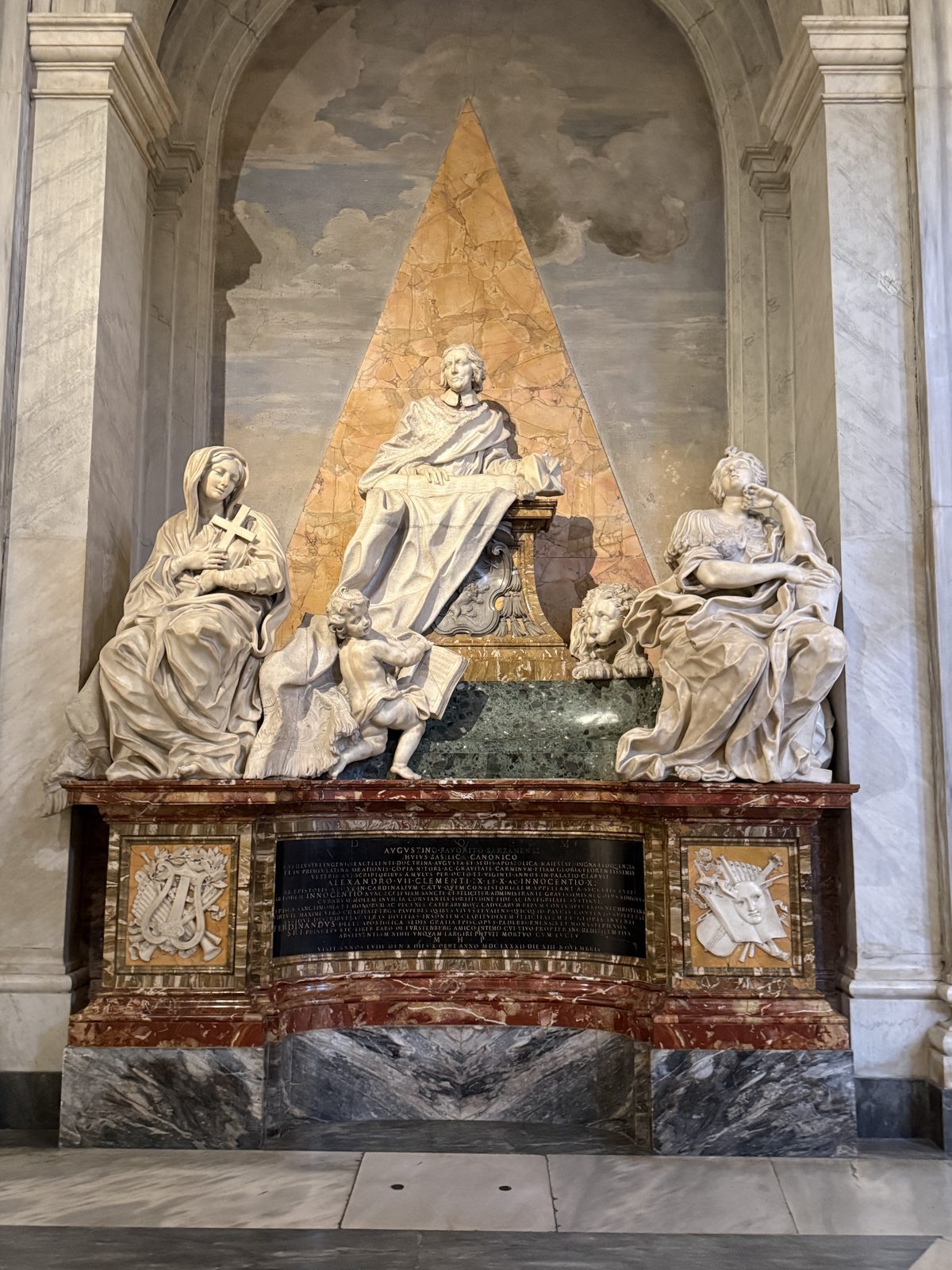
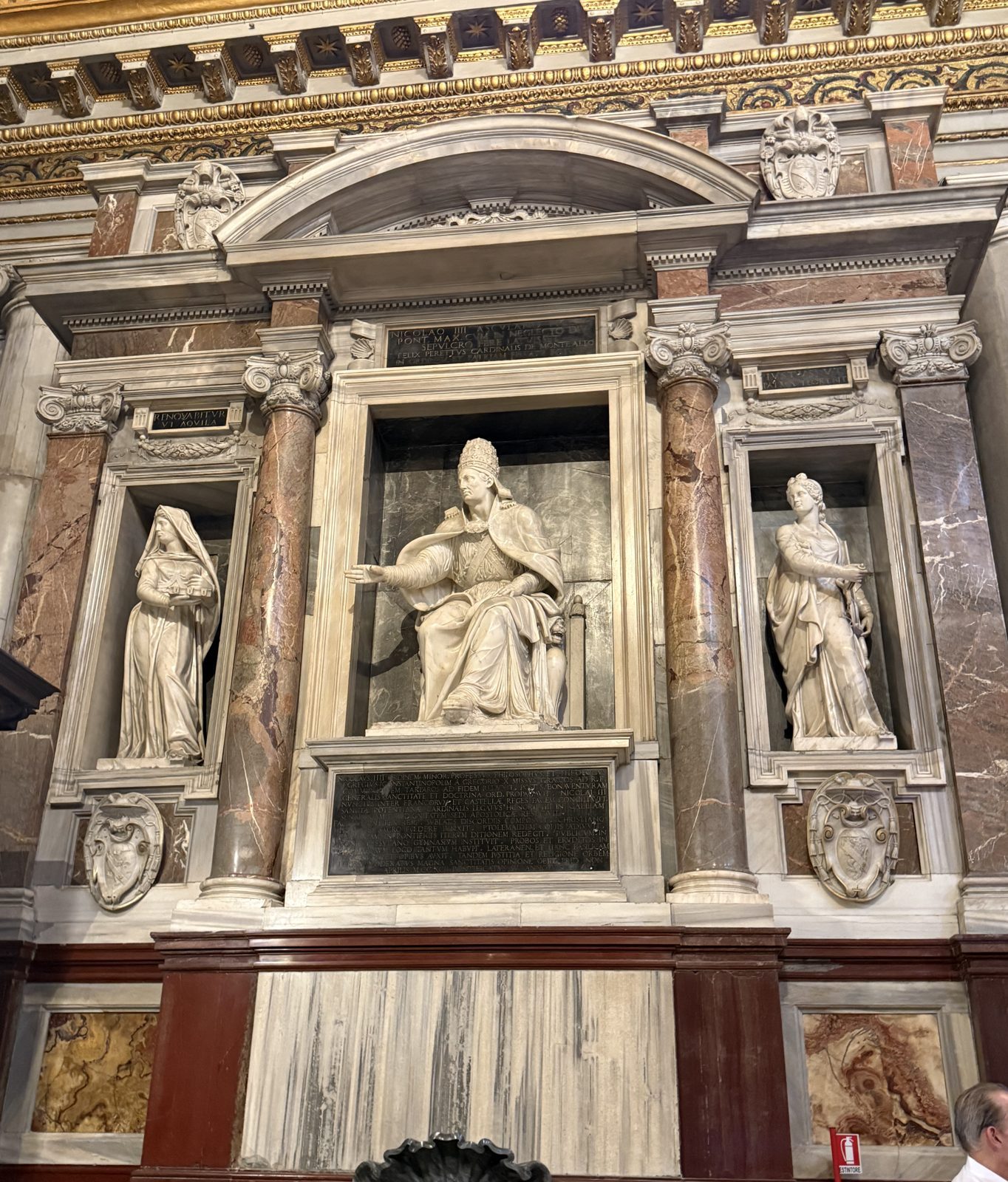
LocationTransept chapels, Santa Maria Maggiore, Rome
UbicaciónCapillas del transepto, Santa María la Mayor, Roma
Views inside the basilica's two great domed chapels, which face each other across the transept: a richly gilded chapel altar, a frescoed dome, and two grand papal funerary monuments with kneeling popes, allegorical figures and sarcophagi.
Vistas del interior de las dos grandes capillas con cúpula de la basílica, enfrentadas a través del transepto: un altar ricamente dorado, una cúpula con frescos y dos grandes monumentos funerarios papales con papas arrodillados, figuras alegóricas y sarcófagos.
The Sistine Chapel was built 1585–1589; the Pauline (Borghese) Chapel 1606–1613.
La Capilla Sixtina se construyó en 1585–1589; la Capilla Paulina (Borghese) en 1606–1613.
The Sistine Chapel was designed by Domenico Fontana for Pope Sixtus V and holds the tombs of Sixtus V and Pius V (its gilded bronze tabernacle of 1590 is by Lodovico del Duca, on four angels by Sebastiano Torrigiani). The Pauline Chapel was designed by Flaminio Ponzio for Pope Paul V, holds the venerated Salus Populi Romani icon, and contains the tombs of Paul V and Clement VIII, both sculpted by Silla da Viggiù. The specific tomb and dome shown here belong to these two chapels; we have kept to the chapel-level attribution rather than name the individual pope, since the inscriptions could not be read from the photographs.
La Capilla Sixtina fue diseñada por Domenico Fontana para el papa Sixto V y guarda las tumbas de Sixto V y Pío V (su tabernáculo de bronce dorado de 1590 es de Lodovico del Duca, sobre cuatro ángeles de Sebastiano Torrigiani). La Capilla Paulina fue diseñada por Flaminio Ponzio para el papa Paulo V, alberga el venerado ícono Salus Populi Romani y contiene las tumbas de Paulo V y Clemente VIII, ambas esculpidas por Silla da Viggiù. La tumba y la cúpula aquí mostradas pertenecen a estas dos capillas; mantenemos la atribución a nivel de capilla en lugar de nombrar al papa concreto, pues las inscripciones no pudieron leerse en las fotografías.
These twin chapels are among the grandest monuments of papal Rome — early, exuberant statements of Baroque splendour built to glorify the popes who made them and to shelter the city's holiest Marian icon.
Estas capillas gemelas están entre los monumentos más grandiosos de la Roma papal — afirmaciones tempranas y exuberantes del esplendor barroco, erigidas para glorificar a los papas que las hicieron y para resguardar el ícono mariano más sagrado de la ciudad.
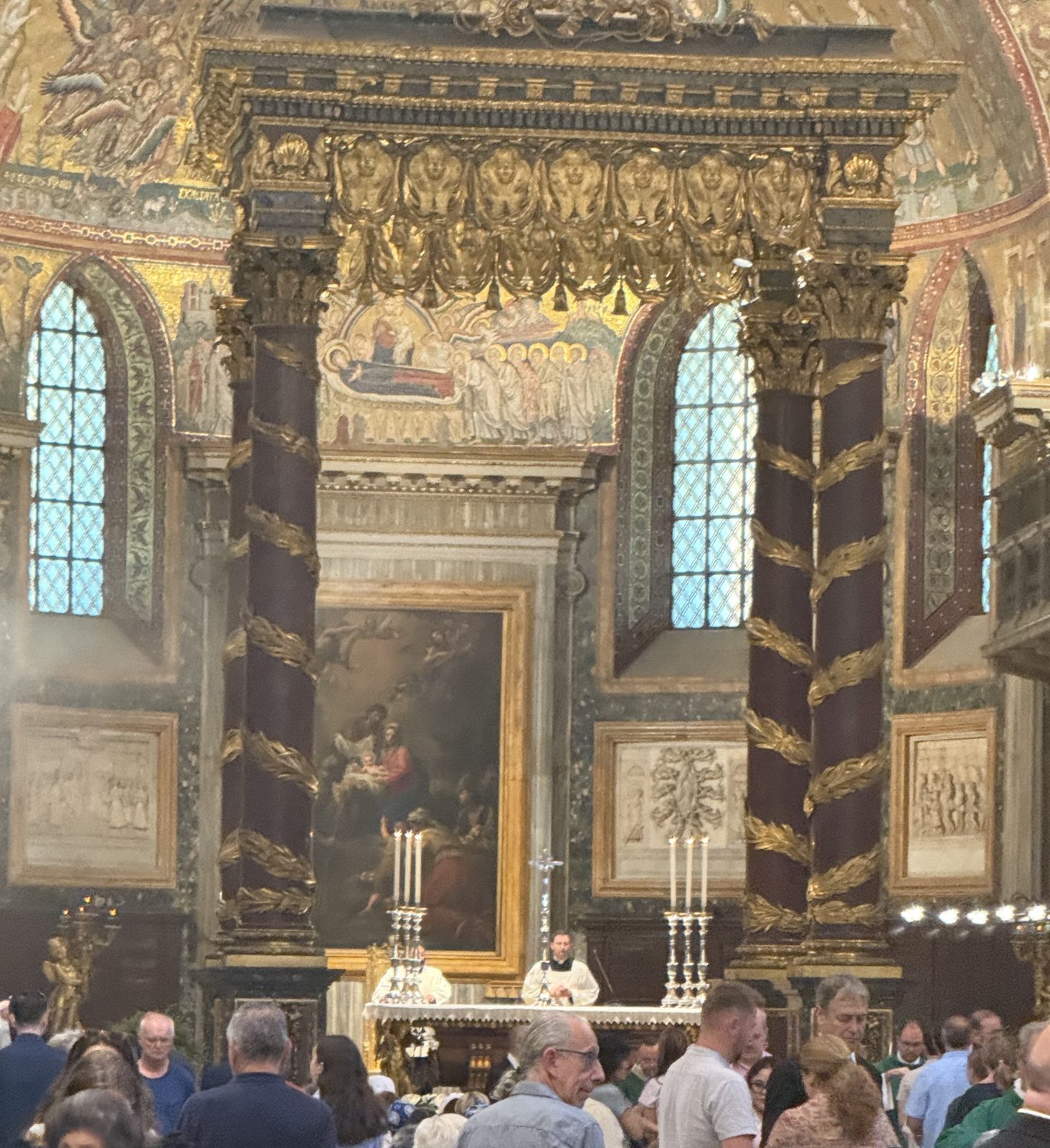
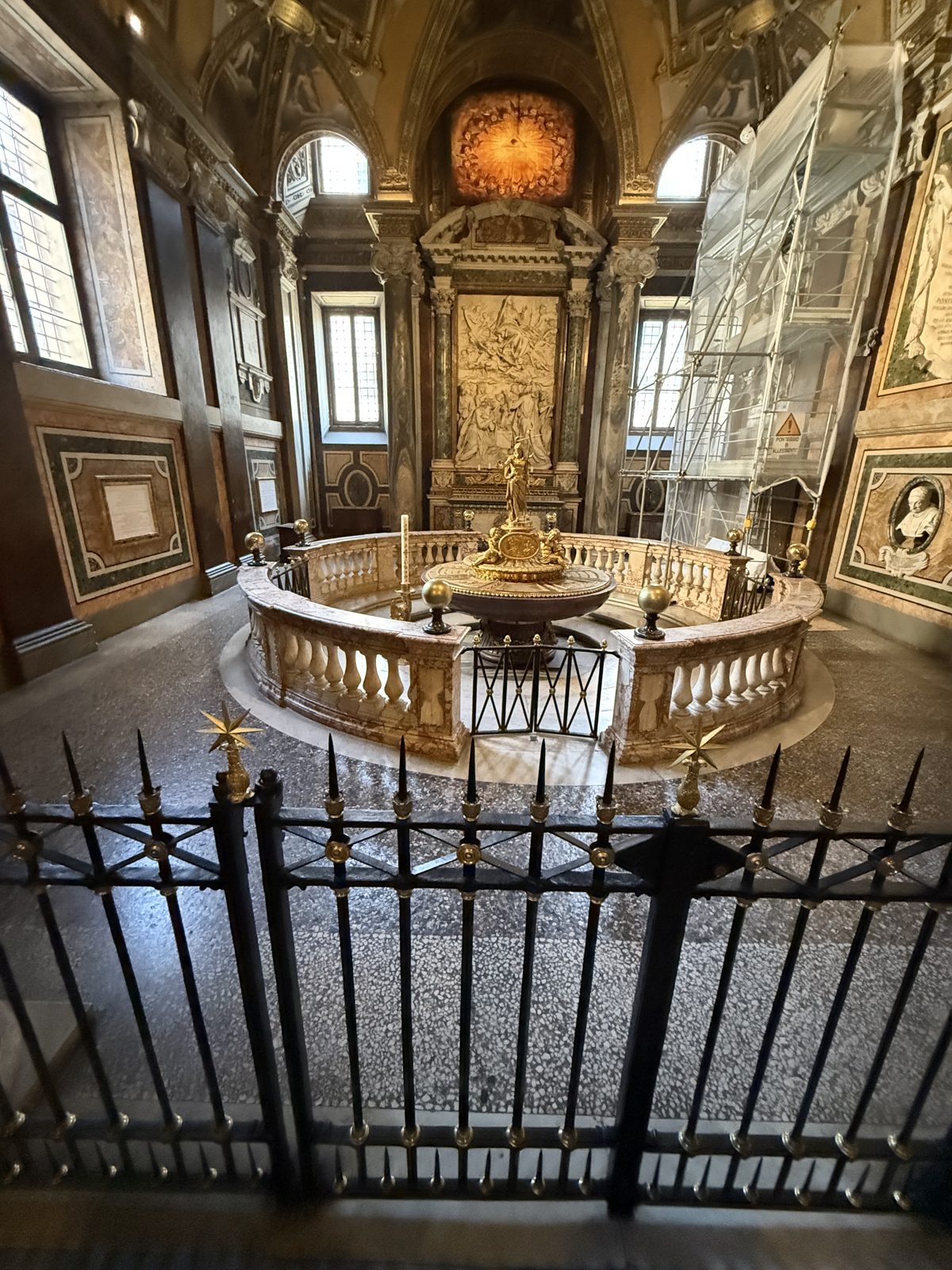
LocationSanctuary, Santa Maria Maggiore, Rome
UbicaciónPresbiterio, Santa María la Mayor, Roma
The sanctuary: the high altar beneath a baldachin carried on porphyry columns, crowned by the great apse mosaic of the Coronation of the Virgin; and, sunk before it, the Confessio — the Crypt of the Holy Crib — with its semicircular balustrade and a kneeling papal statue.
El presbiterio: el altar mayor bajo un baldaquino sostenido por columnas de pórfido, coronado por el gran mosaico absidal de la Coronación de la Virgen; y, hundida ante él, la Confessio — la Cripta del Santo Pesebre — con su balaustrada semicircular y una estatua papal arrodillada.
The apse mosaic dates to 1295; the baldachin is mid-18th-century; the kneeling statue in the Confessio is 19th-century.
El mosaico del ábside data de 1295; el baldaquino es de mediados del siglo XVIII; la estatua arrodillada de la Confessio es del siglo XIX.
The apse mosaic of the Coronation of the Virgin is by Jacopo Torriti (1295). The baldachin over the high altar, with its four porphyry columns, is part of Ferdinando Fuga's work for Pope Benedict XIV in the 1740s. In the Confessio, the kneeling statue of Pope Pius IX is by Ignazio Jacometti (1819–83), placed there by Pope Leo XIII.
El mosaico absidal de la Coronación de la Virgen es de Jacopo Torriti (1295). El baldaquino sobre el altar mayor, con sus cuatro columnas de pórfido, forma parte de la obra de Ferdinando Fuga para el papa Benedicto XIV en la década de 1740. En la Confessio, la estatua arrodillada del papa Pío IX es de Ignazio Jacometti (1819–83), colocada allí por el papa León XIII.
The Confessio enshrines what tradition holds to be relics of the manger of Bethlehem, kept in a crystal reliquary — the reason the basilica is also called the “Bethlehem of the West.” Torriti's mosaic above is one of the masterpieces of medieval Rome.
La Confessio guarda lo que la tradición considera reliquias del pesebre de Belén, en un relicario de cristal — por lo que la basílica también se llama la “Belén de Occidente.” El mosaico de Torriti es una de las obras maestras de la Roma medieval.
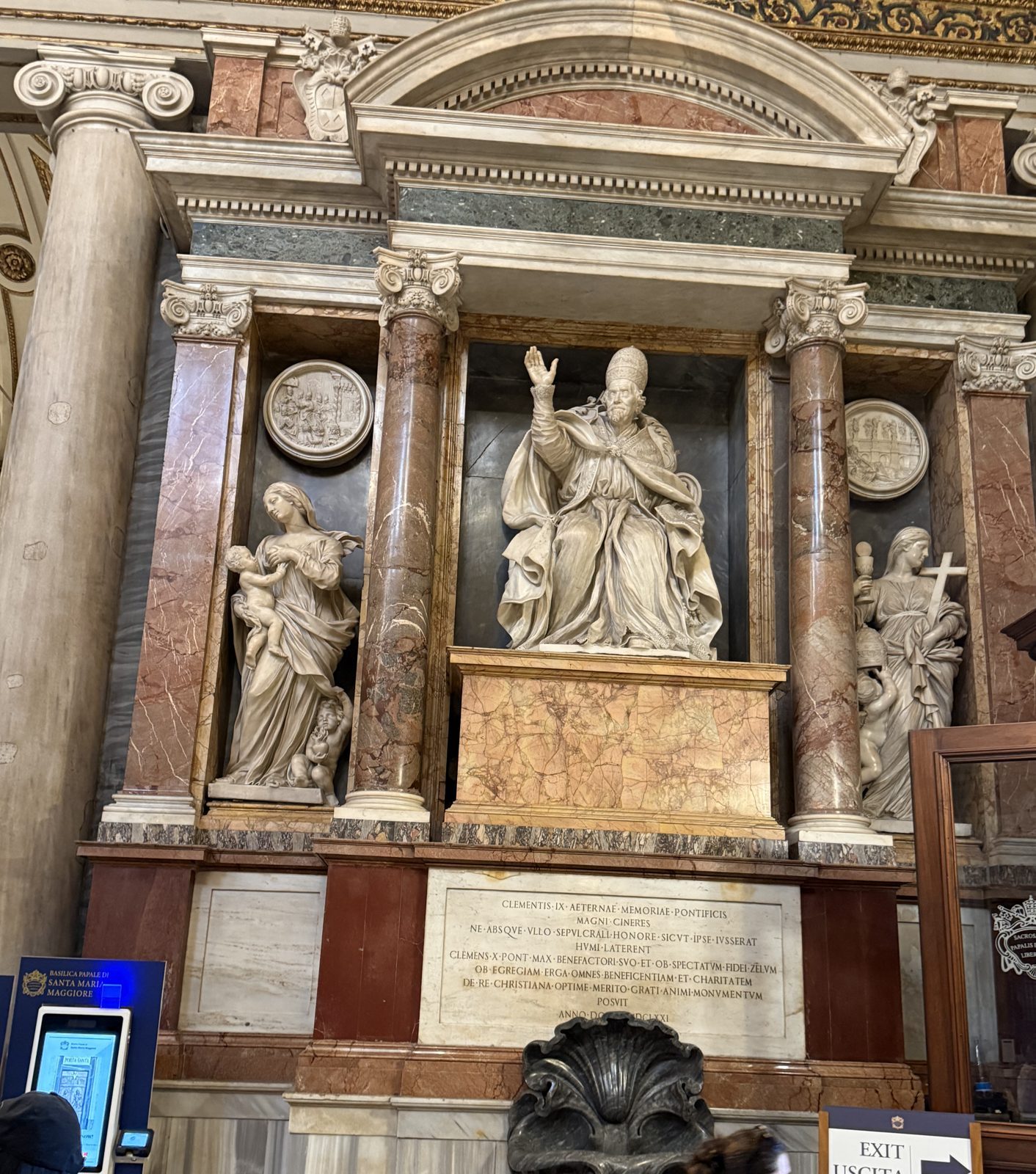
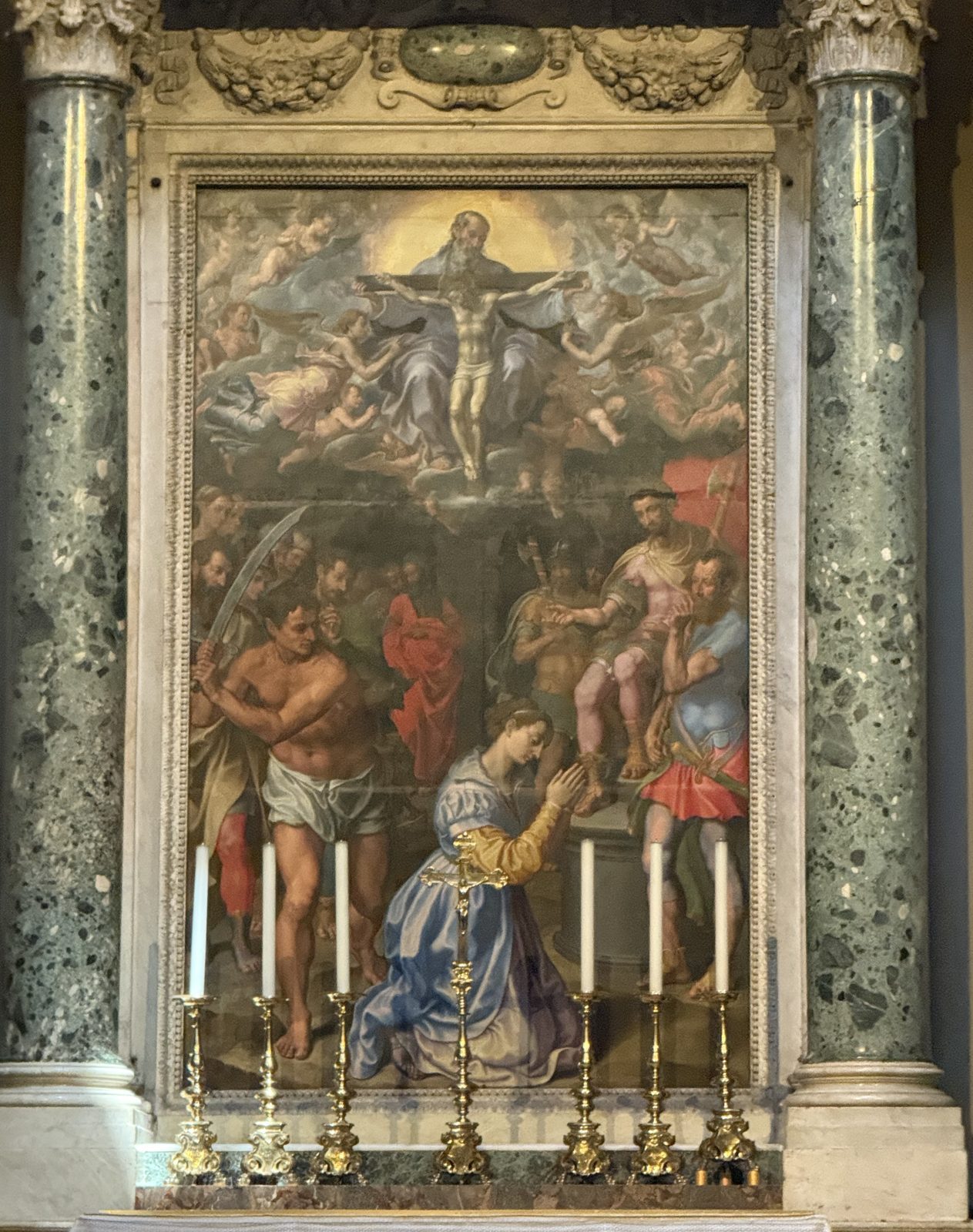
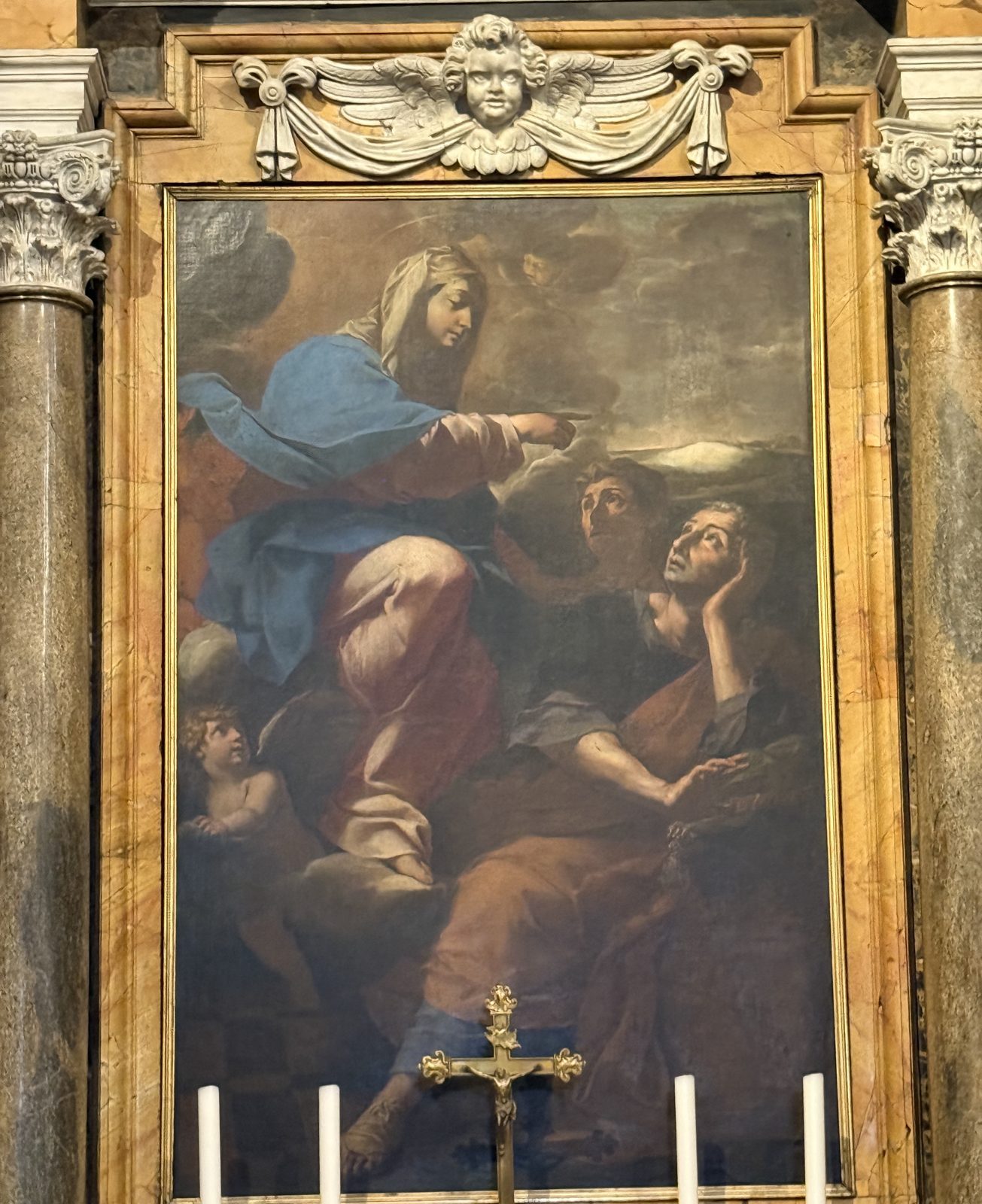
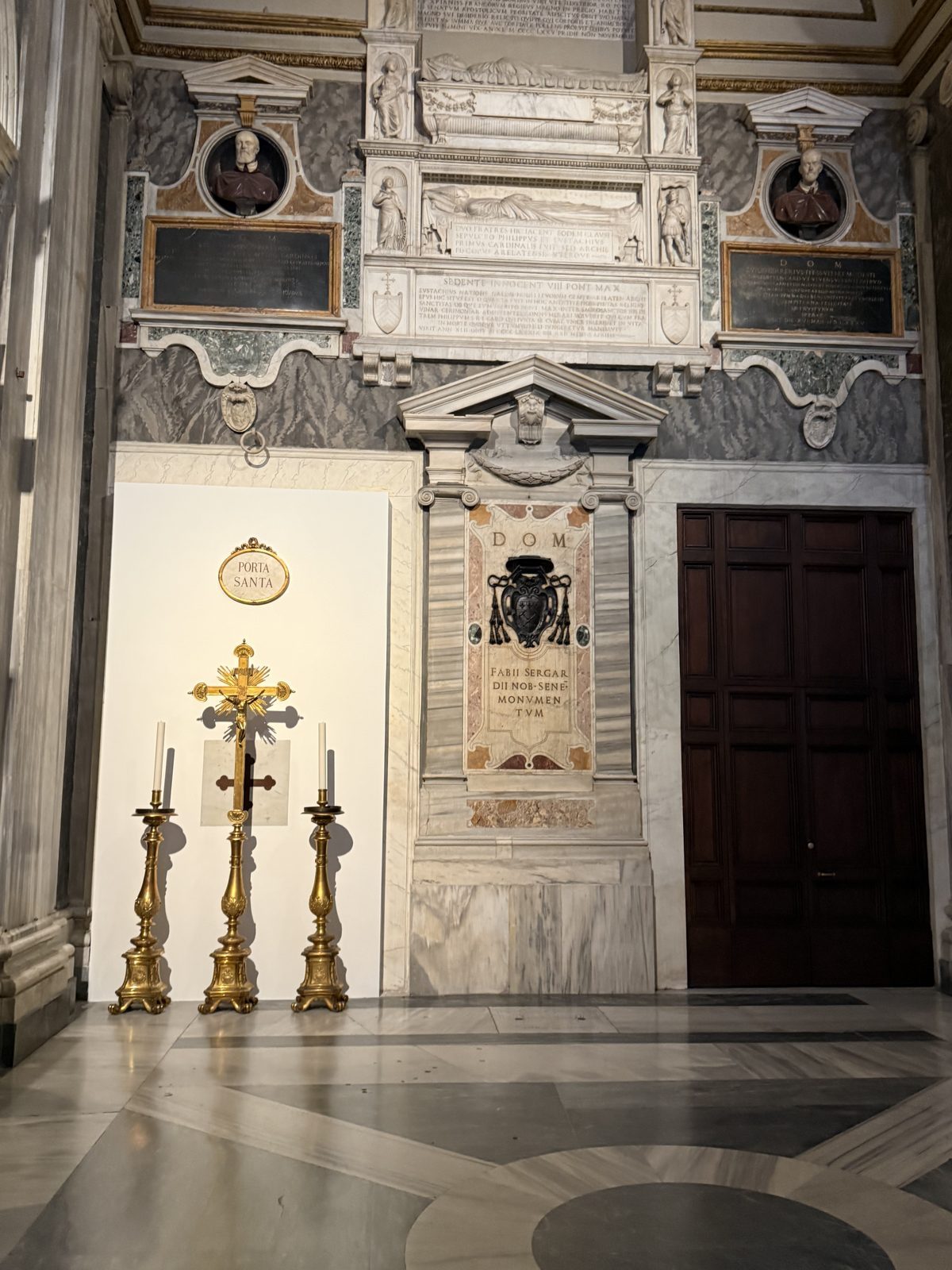
LocationAisles and chapels, Santa Maria Maggiore, Rome
UbicaciónNaves y capillas, Santa María la Mayor, Roma
A group of the basilica's wall monuments and altar paintings: a benefactor's funerary monument with a central figure between two allegories; a large multi-figure altarpiece with a heavenly glory above a landscape; a tall altarpiece of a robed saint; and an aisle memorial near a side door.
Un conjunto de monumentos murales y pinturas de altar de la basílica: un monumento funerario de un benefactor con una figura central entre dos alegorías; un gran retablo de múltiples figuras con una gloria celestial sobre un paisaje; un retablo alto de un santo con túnica; y un monumento de la nave junto a una puerta lateral.
From the benefactor's monument: “For his notable zeal of faith ... his beneficence and Christian charity ... a monument of well-deserved gratitude.”
Del monumento del benefactor: “Por su notable celo de fe ... su beneficencia y caridad cristiana ... un monumento de merecida gratitud.”
These are post-Renaissance works of the basilica's 16th–18th-century decoration; precise dates are not established here.
Son obras posrenacentistas de la decoración de los siglos XVI–XVIII de la basílica; aquí no se establecen fechas precisas.
These paintings and monuments are described by subject. Their authors are not recorded in the sources we could verify, and the inscriptions naming the individuals commemorated could not be fully read from the photographs — so we have kept to what can be honestly stated.
Estas pinturas y monumentos se describen por su tema. Sus autores no constan en las fuentes que pudimos verificar, y las inscripciones que nombran a las personas conmemoradas no pudieron leerse por completo en las fotografías — por lo que nos atenemos a lo que puede afirmarse con honestidad.
Together they show how Santa Maria Maggiore served for centuries as a place of burial and patronage for popes, prelates and benefactors, each leaving a mark in marble and paint.
En conjunto muestran cómo Santa María la Mayor sirvió durante siglos como lugar de sepultura y mecenazgo para papas, prelados y benefactores, cada uno dejando su huella en mármol y pintura.
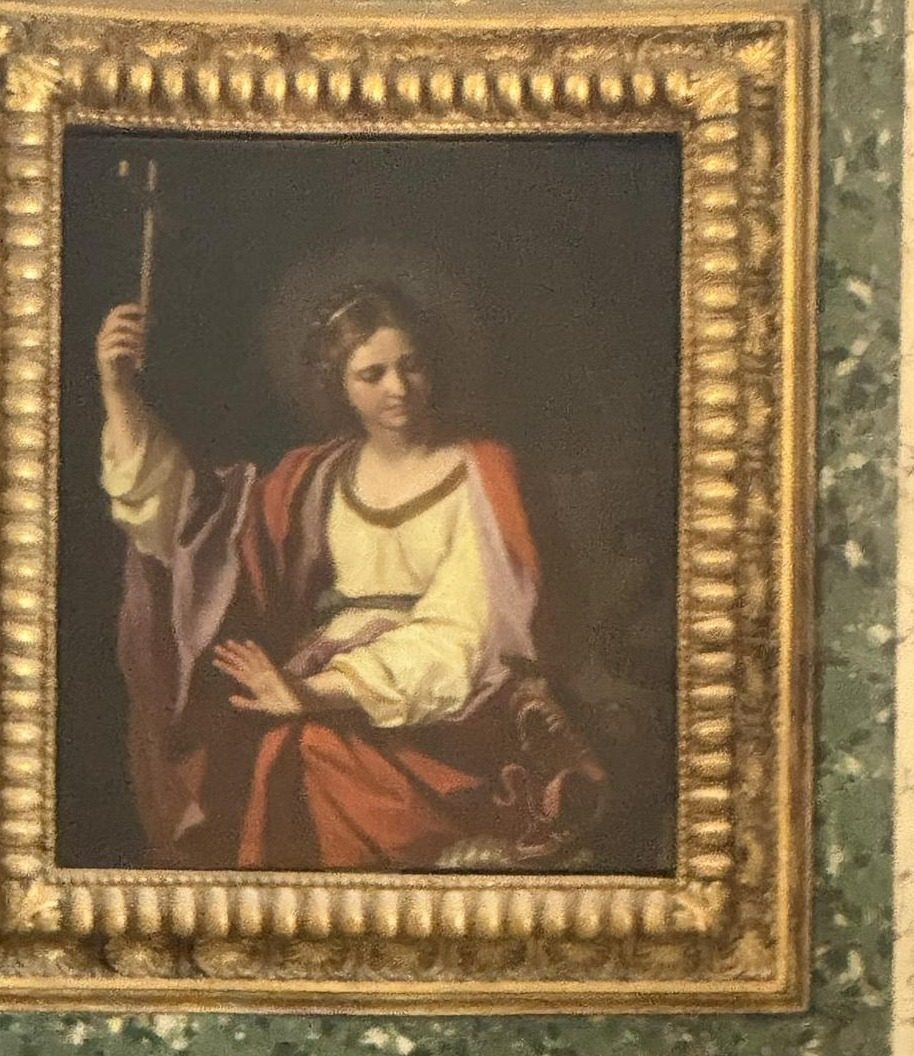
LocationPiazza di San Pietro in Vincoli, Esquiline Hill, Rome
UbicaciónPiazza di San Pietro in Vincoli, monte Esquilino, Roma
San Pietro in Vincoli — ‘Saint Peter in Chains’ — is an early-Christian basilica on the Esquiline, world-famous as the home of Michelangelo’s Moses (on the Tomb of Pope Julius II) and of the relic of St Peter’s chains. These photographs don’t reach those two great sights; instead they gather some of the church’s other treasures — the altarpieces of its side chapels and one of its most theatrical tombs.
San Pietro in Vincoli — ‘San Pedro Encadenado’ — es una basílica paleocristiana en el Esquilino, mundialmente famosa por albergar el Moisés de Miguel Ángel (en la Tumba del papa Julio II) y la reliquia de las cadenas de San Pedro. Estas fotografías no alcanzan esos dos grandes atractivos; en su lugar reúnen algunos de los demás tesoros de la iglesia — los retablos de sus capillas laterales y una de sus tumbas más teatrales.
By tradition the two chains were brought together here and miraculously fused into a single length — the ‘miracle of the chains’ that the basilica still commemorates.
Según la tradición, las dos cadenas se reunieron aquí y se fundieron milagrosamente en una sola — el ‘milagro de las cadenas’ que la basílica aún conmemora.
The basilica was founded in the 5th century and remodelled in the 15th and early 16th. The paintings shown are of the 16th and 17th centuries: Pomarancio’s Lamentation (16th century), Guercino’s Saint Margaret (about 1644), and Pietro Santi Bartoli’s Liberation of St Peter (1683, after Domenichino’s 1604 original). The Aldobrandini tomb was raised in 1705–07.
La basílica se fundó en el siglo V y se remodeló en el XV y principios del XVI. Las pinturas mostradas son de los siglos XVI y XVII: la Lamentación de Pomarancio (siglo XVI), la Santa Margarita de Guercino (hacia 1644) y la Liberación de San Pedro de Pietro Santi Bartoli (1683, según el original de Domenichino de 1604). La tumba Aldobrandini se erigió en 1705–07.
A roll-call of Baroque Rome. The Saint Margaret is by Guercino (Giovanni Francesco Barbieri); the Lamentation by Cristoforo Roncalli, called Pomarancio; the Liberation of St Peter is Pietro Santi Bartoli’s copy of a Domenichino original kept in the sacristy. The tomb of Cardinal Cinzio Aldobrandini was designed by the architect Carlo Francesco Bizzaccheri, its arresting winged skeleton carved by the French sculptor Pierre Le Gros the Younger.
Una nómina de la Roma barroca. La Santa Margarita es de Guercino (Giovanni Francesco Barbieri); la Lamentación, de Cristoforo Roncalli, llamado Pomarancio; la Liberación de San Pedro es la copia de Pietro Santi Bartoli de un original de Domenichino conservado en la sacristía. La tumba del cardenal Cinzio Aldobrandini fue diseñada por el arquitecto Carlo Francesco Bizzaccheri, y su sobrecogedor esqueleto alado lo talló el escultor francés Pierre Le Gros el Joven.
Even setting aside Michelangelo’s Moses, San Pietro in Vincoli is a gallery of Roman art across many centuries. Its chapels hold paintings by some of the finest hands of the 16th and 17th centuries, and its tombs range from the quiet dignity of the Renaissance to the Baroque theatre of a skeleton brandishing its scythe. Founded — tradition holds — by the empress Eudoxia to shelter St Peter’s chains, the church remains both a working sanctuary and a treasury of sculpture and paint.
Incluso dejando de lado el Moisés de Miguel Ángel, San Pietro in Vincoli es una galería de arte romano a lo largo de muchos siglos. Sus capillas guardan pinturas de algunas de las mejores manos de los siglos XVI y XVII, y sus tumbas van de la serena dignidad del Renacimiento al teatro barroco de un esqueleto que blande su guadaña. Fundada — según la tradición — por la emperatriz Eudoxia para custodiar las cadenas de San Pedro, la iglesia sigue siendo a la vez un santuario en uso y un tesoro de escultura y pintura.
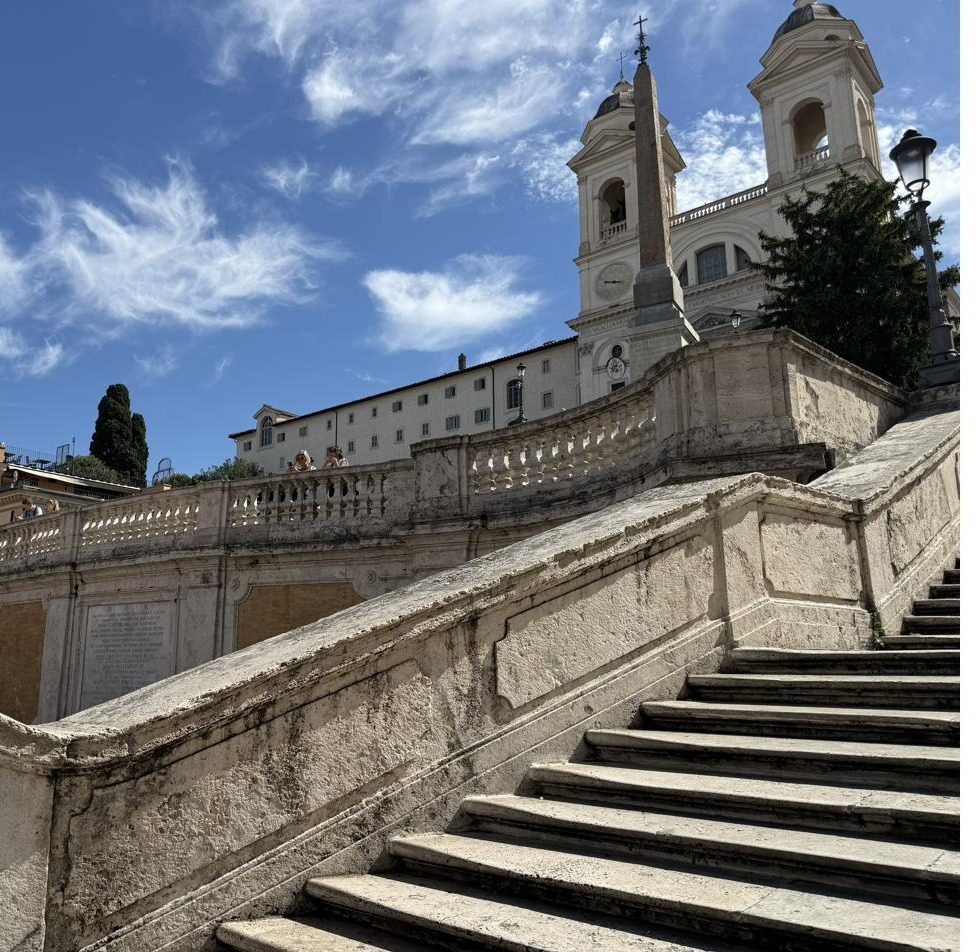
LocationScalinata di Trinità dei Monti, between Piazza di Spagna and the Pincio, Rome
UbicaciónScalinata di Trinità dei Monti, entre la Piazza di Spagna y el Pincio, Roma
One of the most famous sights in Rome: the great staircase — 135 steps of curving travertine — that climbs from Piazza di Spagna to the church of Trinità dei Monti on the Pincio. At the top stand the church’s twin bell towers and a tall obelisk; from the terraces the city opens out below. The steps take their English name from the Spanish Embassy to the Holy See, long resident in the piazza.
Una de las vistas más famosas de Roma: la gran escalinata — 135 peldaños de travertino en curva — que sube desde la Piazza di Spagna hasta la iglesia de Trinità dei Monti, en el Pincio. En lo alto se alzan las dos torres campanario de la iglesia y un alto obelisco; desde las terrazas la ciudad se abre abajo. La escalinata debe su nombre en inglés a la Embajada de España ante la Santa Sede, largamente residente en la plaza.
At the foot of the steps lies the Barcaccia fountain, a half-sunken stone boat by Pietro and Gian Lorenzo Bernini (1623–26); the whole composition became world-famous on film in Roman Holiday (1953).
Al pie de la escalinata está la fuente de la Barcaccia, una barca de piedra medio hundida de Pietro y Gian Lorenzo Bernini (1623–26); todo el conjunto se hizo mundialmente famoso en el cine con Vacaciones en Roma (1953).
Designed by the Roman architect Francesco De Sanctis — whose project won an early-18th-century competition over rivals including Specchi and Juvarra — and built between 1723 and 1726, under Popes Innocent XIII and Benedict XIII. The church of Trinità dei Monti above is older, founded in 1502; the Sallustian obelisk was set before it in 1789.
Diseñada por el arquitecto romano Francesco De Sanctis — cuyo proyecto ganó un concurso de principios del siglo XVIII frente a rivales como Specchi y Juvarra — y construida entre 1723 y 1726, bajo los papas Inocencio XIII y Benedicto XIII. La iglesia de Trinità dei Monti es más antigua, fundada en 1502; el obelisco Salustiano se colocó delante de ella en 1789.
The staircase is the work of Francesco De Sanctis, paid for in part by the legacy of the French diplomat Stéphane Gueffier. The church of Trinità dei Monti was founded by King Louis XII of France for the Order of Minims; it remains a French church to this day, often called ‘the most famous French church not in France.’ The obelisk — a Roman-made imitation of an Egyptian one, from the ancient Gardens of Sallust — was raised here by Pope Pius VI.
La escalinata es obra de Francesco De Sanctis, financiada en parte por el legado del diplomático francés Stéphane Gueffier. La iglesia de Trinità dei Monti fue fundada por el rey Luis XII de Francia para la Orden de los Mínimos; sigue siendo una iglesia francesa hasta hoy, llamada a menudo ‘la iglesia francesa más famosa que no está en Francia.’ El obelisco — una imitación romana de uno egipcio, de los antiguos Jardines de Salustio — lo erigió aquí el papa Pío VI.
The Spanish Steps are a piece of pure theatre: a Baroque staircase built not for any practical need but to stage the climb from the city to the church on the hill, and to give Rome one of its grandest open-air gathering places. Framed by the twin towers of a French church and an ancient-looking obelisk, and looking out over the rooftops toward St Peter’s, they remain among the most beloved and most photographed places in the city.
La Escalinata es puro teatro: una escalera barroca construida no por necesidad práctica alguna, sino para escenificar el ascenso de la ciudad a la iglesia de la colina, y para dar a Roma uno de sus más grandiosos lugares de reunión al aire libre. Enmarcada por las dos torres de una iglesia francesa y un obelisco de aire antiguo, y asomada a los tejados hacia San Pedro, sigue siendo uno de los lugares más queridos y fotografiados de la ciudad.
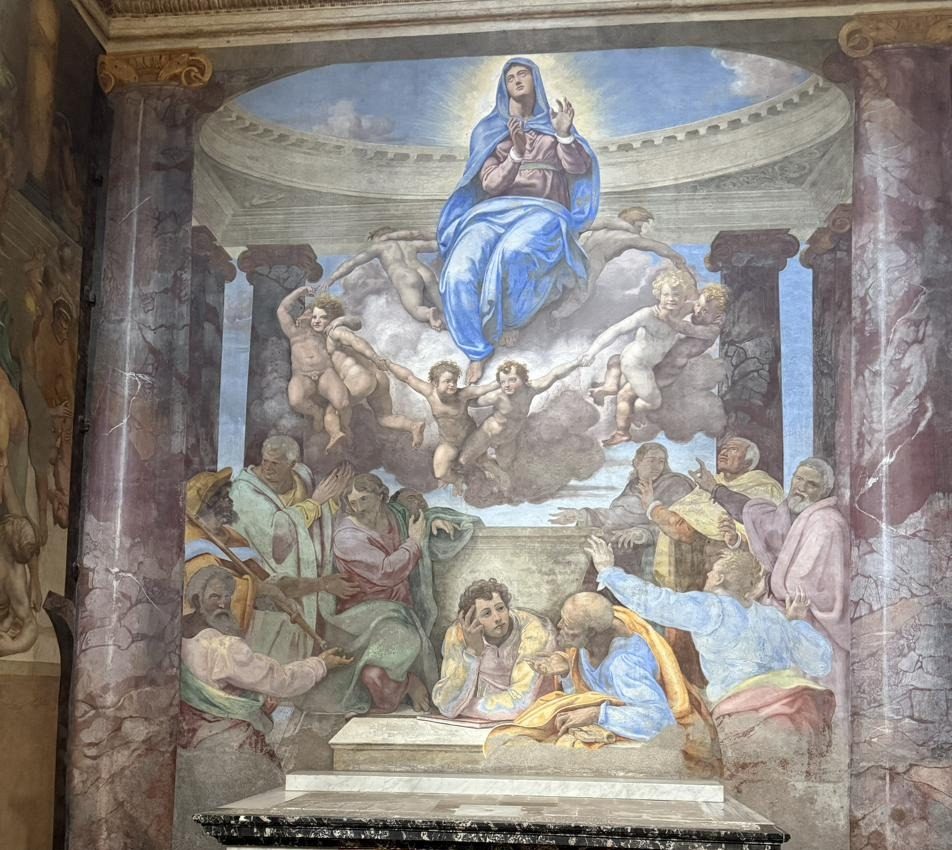
LocationChurch of Trinità dei Monti, at the top of the Spanish Steps, Rome
UbicaciónIglesia de Trinità dei Monti, en lo alto de la Escalinata, Roma
The church at the top of the steps is a treasury of 16th-century Mannerist painting. Behind a sober single-nave interior in the French taste, its side chapels hold fresco cycles and altarpieces by pupils and followers of Michelangelo and Raphael. These views gather some of them — a famous Assumption, a Baptism of Christ, a marble Deposition and an Immaculate Conception.
La iglesia en lo alto de la escalinata es un tesoro de la pintura manierista del siglo XVI. Tras un interior sobrio de una sola nave, al gusto francés, sus capillas laterales guardan ciclos de frescos y retablos de discípulos y seguidores de Miguel Ángel y Rafael. Estas vistas reúnen algunos — una célebre Asunción, un Bautismo de Cristo, un Descendimiento en mármol y una Inmaculada Concepción.
Daniele — Michelangelo’s pupil — earned the nickname ‘Il Braghettone,’ ‘the breeches-maker,’ for the loincloths he was later ordered to add to the nude figures of Michelangelo’s Last Judgment.
Daniele — discípulo de Miguel Ángel — se ganó el apodo de ‘Il Braghettone,’ ‘el calzonero,’ por los paños que más tarde se le ordenó añadir a los desnudos del Juicio Final de Miguel Ángel.
The chapels are largely of the later 16th century. The Chapel of Lucrezia della Rovere was frescoed by Daniele da Volterra and his collaborators about 1548–50; the Cappella Dosio–Altoviti was painted by Naldini around 1580. The marble Deposition and the Immaculate Conception belong to the church’s later, 19th-century life under its French community.
Las capillas son en su mayoría de finales del siglo XVI. La Capilla de Lucrezia della Rovere la decoró al fresco Daniele da Volterra con sus colaboradores hacia 1548–50; la Cappella Dosio–Altoviti la pintó Naldini hacia 1580. El Descendimiento en mármol y la Inmaculada Concepción pertenecen a la vida posterior de la iglesia, del siglo XIX, bajo su comunidad francesa.
The Assumption of the Virgin is by Daniele da Volterra — in the Chapel of Lucrezia della Rovere, where he led a team of Mannerist painters including Marco Pino, Pellegrino Tibaldi and Gaspar Becerra — and the Baptism of Christ is by Giovanni Battista Naldini. The marble Deposition group and the Immaculate Conception altarpiece are unsigned on site, and are given here by subject rather than by a name I could confirm.
La Asunción de la Virgen es de Daniele da Volterra — en la Capilla de Lucrezia della Rovere, donde dirigió a un equipo de pintores manieristas que incluía a Marco Pino, Pellegrino Tibaldi y Gaspar Becerra — y el Bautismo de Cristo es de Giovanni Battista Naldini. El grupo del Descendimiento en mármol y el retablo de la Inmaculada Concepción no están firmados en el lugar, y se dan aquí por su tema y no por un nombre que pudiera confirmar.
Trinità dei Monti is one of Rome’s richest galleries of Mannerist art — the generation that came directly after Michelangelo and Raphael — and Daniele da Volterra’s work here carries Michelangelo’s influence straight into paint. That the church survived at all is a small wonder: closed and stripped during the Napoleonic occupation, with an attempt even made to cut its frescoes from the walls, it was restored by the French crown after 1815 and remains a French church in the heart of Rome.
Trinità dei Monti es una de las galerías más ricas de arte manierista de Roma — la generación que vino justo después de Miguel Ángel y Rafael — y la obra de Daniele da Volterra aquí lleva la influencia de Miguel Ángel directamente a la pintura. Que la iglesia sobreviviera es casi un milagro: cerrada y despojada durante la ocupación napoleónica, cuando hasta se intentó arrancar sus frescos de los muros, fue restaurada por la corona francesa después de 1815 y sigue siendo una iglesia francesa en el corazón de Roma.
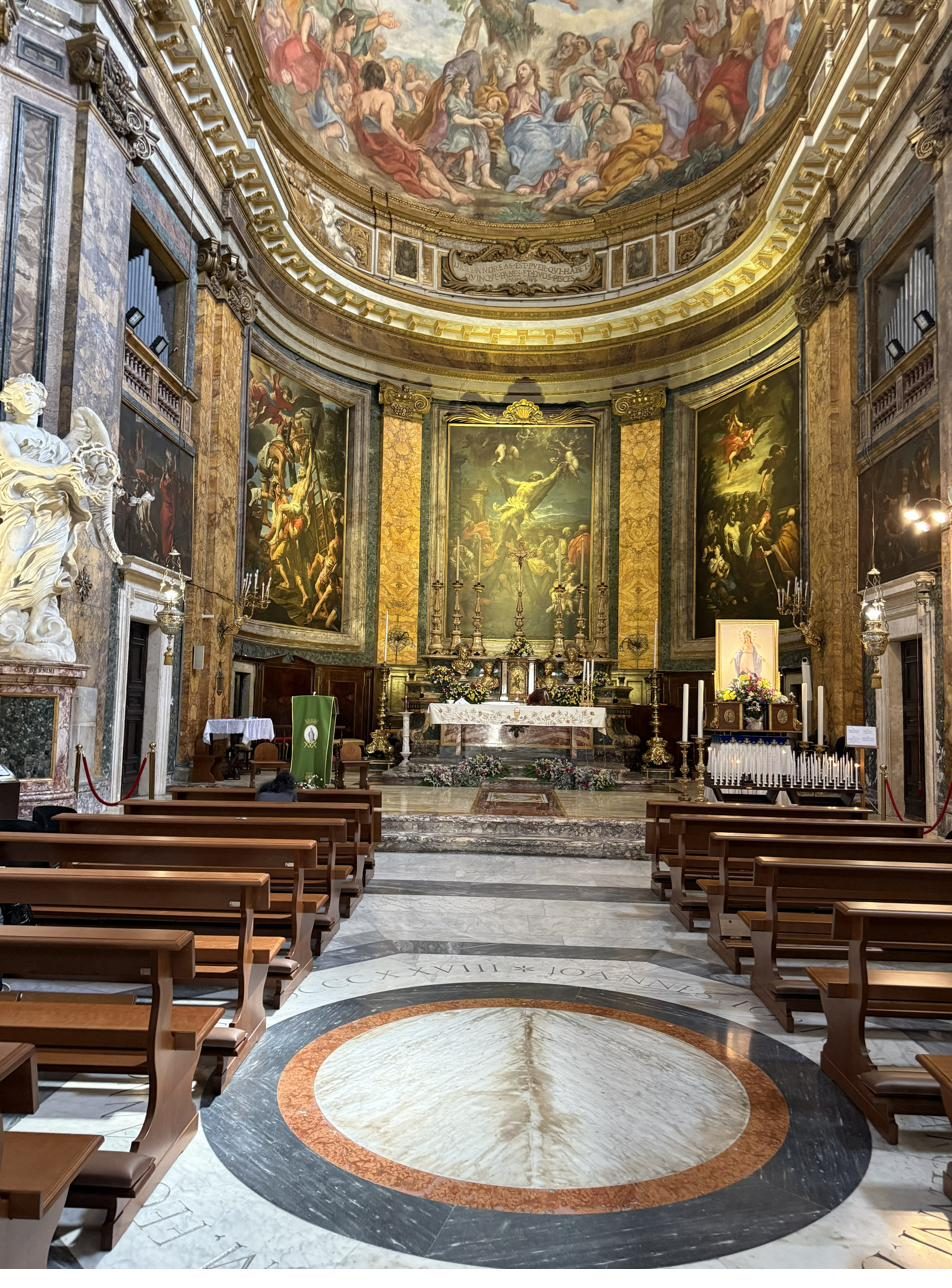
LocationVia di Sant’Andrea delle Fratte, near the Spanish Steps, Rome
UbicaciónVia di Sant’Andrea delle Fratte, cerca de la Escalinata, Roma
A 17th-century Baroque church near the Spanish Steps, dedicated to St Andrew the Apostle — ‘delle Fratte’ meaning ‘of the thickets,’ from the days when this was the edge of the built-up city. Its dome and celebrated bell tower are the work of Francesco Borromini; inside, a richly painted sanctuary tells the story of St Andrew’s martyrdom, and a venerated image of the Virgin still draws pilgrims.
Una iglesia barroca del siglo XVII cerca de la Escalinata, dedicada a San Andrés Apóstol — ‘delle Fratte’ significa ‘de los matorrales,’ de los tiempos en que esto era el límite de la ciudad edificada. Su cúpula y su célebre campanario son obra de Francesco Borromini; dentro, un presbiterio ricamente pintado narra el martirio de San Andrés, y una venerada imagen de la Virgen aún atrae a los peregrinos.
Rebuilt across the 17th century, it became one of Rome’s great stages for the rival geniuses of the Baroque — Borromini in its architecture, Bernini in its sculpture.
Reconstruida a lo largo del siglo XVII, se convirtió en uno de los grandes escenarios de Roma para los genios rivales del Barroco — Borromini en su arquitectura, Bernini en su escultura.
A church has stood here since 1192; the present building was begun in 1604 by Gaspare Guerra, carried on by Francesco Borromini in the mid-17th century, and completed by Mattia de Rossi in 1691. The neoclassical facade was added in 1826.
Hay una iglesia aquí desde 1192; el edificio actual se comenzó en 1604 con Gaspare Guerra, lo continuó Francesco Borromini a mediados del siglo XVII y lo completó Mattia de Rossi en 1691. La fachada neoclásica se añadió en 1826.
Borromini designed the apse, the drum of the dome and the extraordinary bell tower (left incomplete at his death in 1667). The dome and apse were frescoed by Pasquale Marini; the great paintings of St Andrew’s martyrdom at the high altar are by Lazzaro Baldi, Francesco Trevisani and Giovanni Battista Leonardi. The church belongs to the Order of Minims, founded by St Francis of Paola.
Borromini diseñó el ábside, el tambor de la cúpula y el extraordinario campanario (inacabado a su muerte en 1667). La cúpula y el ábside los pintó al fresco Pasquale Marini; las grandes pinturas del martirio de San Andrés en el altar mayor son de Lazzaro Baldi, Francesco Trevisani y Giovanni Battista Leonardi. La iglesia pertenece a la Orden de los Mínimos, fundada por San Francisco de Paula.
Sant’Andrea delle Fratte is a meeting-place of the two titans of the Roman Baroque: Borromini built its soaring dome and its restless, inventive bell tower, while Bernini’s hand survives inside in two of his finest angels. It is also a living shrine — the ‘Madonna del Miracolo’ — where in 1842 the Virgin is said to have appeared to a young Jewish banker, Alphonse Ratisbonne, who converted on the spot, and where in 1918 St Maximilian Kolbe celebrated his first Mass.
Sant’Andrea delle Fratte es un punto de encuentro de los dos titanes del Barroco romano: Borromini levantó su elevada cúpula y su inquieto e ingenioso campanario, mientras que la mano de Bernini pervive dentro en dos de sus mejores ángeles. Es también un santuario vivo — la ‘Madonna del Miracolo’ — donde en 1842 se dice que la Virgen se apareció a un joven banquero judío, Alphonse Ratisbonne, que se convirtió en el acto, y donde en 1918 san Maximiliano Kolbe celebró su primera Misa.
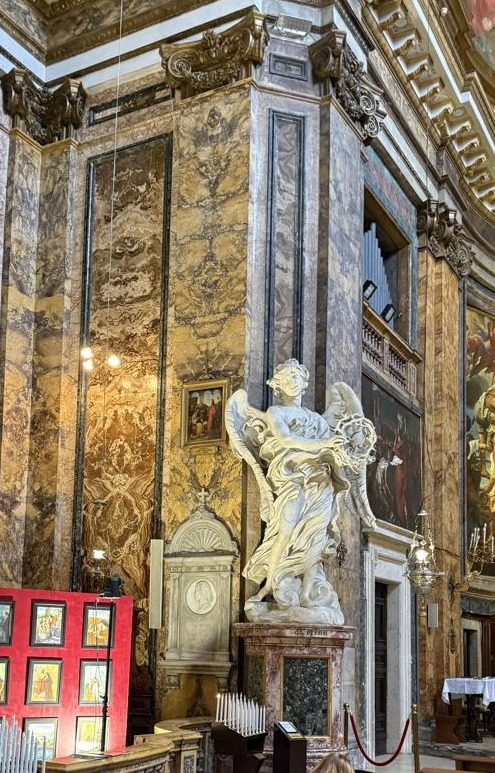
LocationInside Sant’Andrea delle Fratte, Rome
UbicaciónEn el interior de Sant’Andrea delle Fratte, Roma
The chief treasures inside Sant’Andrea delle Fratte are two marble angels by Gian Lorenzo Bernini, set on either side of the sanctuary. Around them the church’s chapels hold Baroque altarpieces and monuments — a dramatic St Michael, a chapel of St Anne with a Bernini-esque reclining figure, and a memorial with a remarkable story behind it.
Los principales tesoros del interior de Sant’Andrea delle Fratte son dos ángeles de mármol de Gian Lorenzo Bernini, a ambos lados del presbiterio. A su alrededor, las capillas de la iglesia guardan retablos barrocos y monumentos — un dramático San Miguel, una capilla de Santa Ana con una figura yacente de aire berniniano, y un monumento con una historia notable detrás.
I.N.R.I. — Iesus Nazarenus Rex Iudaeorum, ‘Jesus of Nazareth, King of the Jews,’ the inscription Pilate ordered placed on the Cross.
I.N.R.I. — Iesus Nazarenus Rex Iudaeorum, ‘Jesús de Nazaret, Rey de los Judíos,’ la inscripción que Pilato mandó poner en la Cruz.
Bernini carved the two angels in 1667–69; they were given to the church by his heirs and set up here in the early 19th century. The St Michael and the chapel sculptures are of the late 17th and 18th centuries; the Mauroceni memorial dates to 1739.
Bernini talló los dos ángeles en 1667–69; sus herederos los donaron a la iglesia y se colocaron aquí a principios del siglo XIX. El San Miguel y las esculturas de las capillas son de finales del siglo XVII y del XVIII; el monumento Mauroceni data de 1739.
The angels are by Gian Lorenzo Bernini — the Angel with the Crown of Thorns and the Angel with the Superscription, the only two of the ten Ponte Sant’Angelo angels he carved himself; Pope Clement IX judged them too precious for the open air and had copies placed on the bridge instead. The St Michael is by Ludovico Gimignani; the reclining figure in the Chapel of St Anne is by Giovanni Battista Maini, openly indebted to Bernini’s Blessed Ludovica Albertoni.
Los ángeles son de Gian Lorenzo Bernini — el Ángel con la corona de espinas y el Ángel con el cartel, los únicos de los diez ángeles del Ponte Sant’Angelo que talló él mismo; el papa Clemente IX los juzgó demasiado preciosos para la intemperie e hizo colocar copias en el puente. El San Miguel es de Ludovico Gimignani; la figura yacente de la Capilla de Santa Ana es de Giovanni Battista Maini, abiertamente deudora de la Beata Ludovica Albertoni de Bernini.
These angels are Bernini at the height of his powers — marble made to look weightless, grief and tenderness carved into stone — and the fact that the originals stand here, indoors, rather than on the windswept bridge is why they survive so crisp and luminous. The church gathers around them a cross-section of Baroque Rome, down to the memorial of a Moroccan prince, a grandson of the King of Fez, who came to Rome, was baptized, and was buried here in 1739 beneath a winged skull.
Estos ángeles son Bernini en la cima de su maestría — mármol que parece ingrávido, el dolor y la ternura tallados en piedra — y el que los originales estén aquí, a cubierto, y no en el puente batido por el viento, es la razón de que se conserven tan nítidos y luminosos. La iglesia reúne a su alrededor una muestra de la Roma barroca, hasta el monumento de un príncipe marroquí, nieto del rey de Fez, que vino a Roma, fue bautizado y fue sepultado aquí en 1739 bajo una calavera alada.
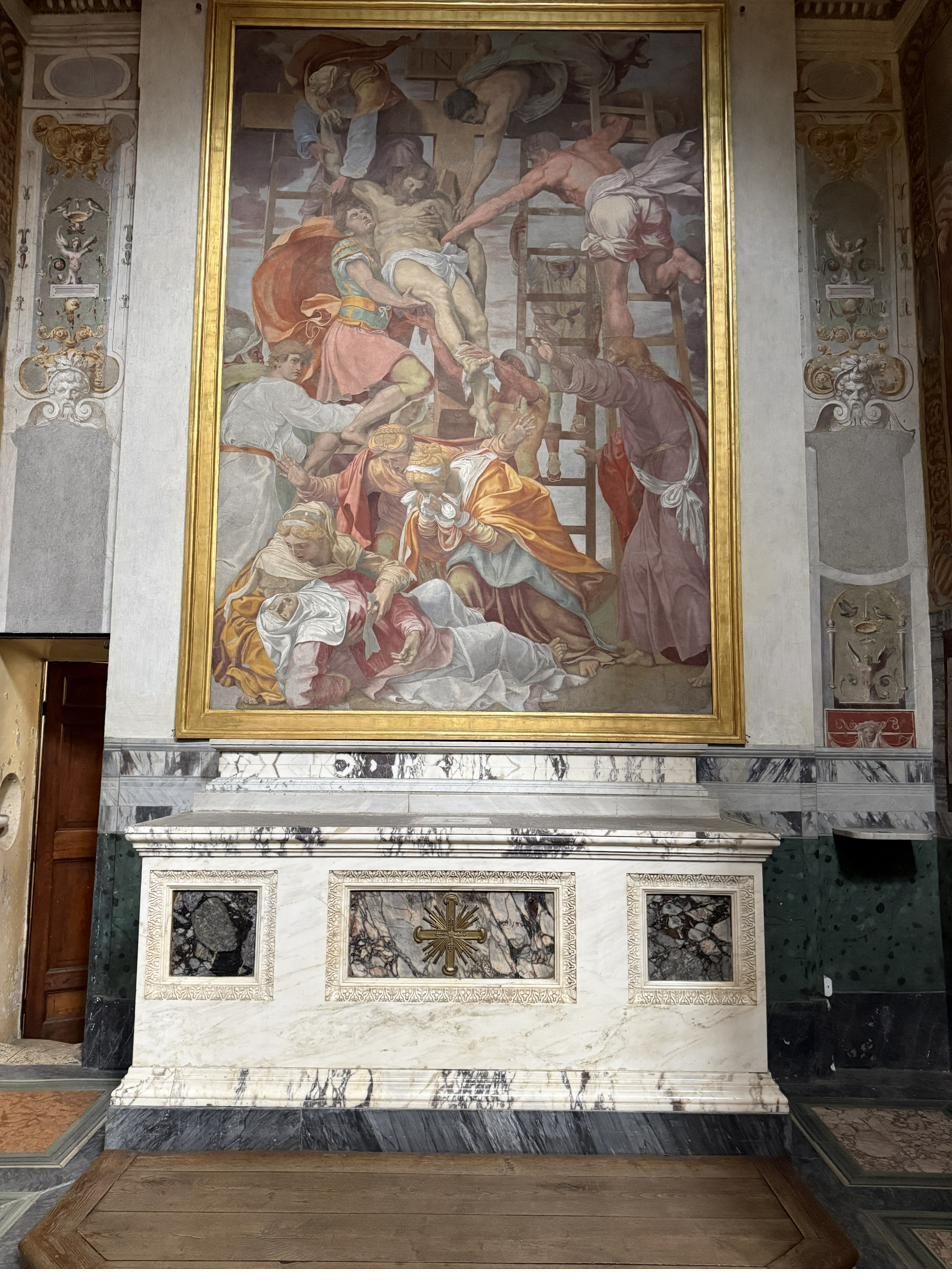
LocationSide chapels of Trinità dei Monti, above the Spanish Steps, Rome
UbicaciónCapillas laterales de Trinità dei Monti, sobre la Escalinata de la Plaza de España, Roma
The church holds two great images of Christ taken down from the Cross, made three centuries apart. One is a painted Mannerist Descent from the Cross by Daniele da Volterra; the other a luminous white sculptural group, a 19th-century Deposition modelled in plaster. Seen together they show how the same moment of grief was reimagined from the Renaissance to the Romantic age.
La iglesia guarda dos grandes imágenes de Cristo bajado de la Cruz, hechas con tres siglos de diferencia. Una es un Descendimiento manierista pintado por Daniele da Volterra; la otra, un luminoso grupo escultórico blanco, un Descendimiento del siglo XIX modelado en yeso. Juntas muestran cómo un mismo instante de dolor se reimaginó del Renacimiento a la época romántica.
I.N.R.I. — Iesus Nazarenus Rex Iudaeorum, ‘Jesus of Nazareth, King of the Jews.’
I.N.R.I. — Iesus Nazarenus Rex Iudaeorum, ‘Jesús de Nazaret, Rey de los Judíos.’
Daniele da Volterra painted his Descent from the Cross about 1545, in the first flush of his Roman career; it was first set over the altar of the Cappella Orsini and later moved to its present chapel. The sculptural Deposition is far younger: a plaster cast made around 1860 after a marble group Wilhelm Achtermann had carved for Münster Cathedral — the marble original was destroyed in the Second World War, so the Roman plaster now preserves a lost work.
Daniele da Volterra pintó su Descendimiento de la Cruz hacia 1545, al inicio de su carrera romana; primero estuvo sobre el altar de la Capilla Orsini y más tarde se trasladó a su capilla actual. El Descendimiento escultórico es mucho más reciente: un vaciado en yeso hecho hacia 1860 a partir de un grupo de mármol que Wilhelm Achtermann había tallado para la catedral de Münster — el mármol original se destruyó en la Segunda Guerra Mundial, de modo que el yeso romano conserva hoy una obra perdida.
The painting is by Daniele Ricciarelli, called Daniele da Volterra (c. 1509–1566), a close friend and follower of Michelangelo, who is said to have supplied the drawings behind the composition. The sculpted group is by the German sculptor Wilhelm Theodor Achtermann (1799–1884), who lived in Rome from 1839 until his death and gave the cast to the church.
La pintura es de Daniele Ricciarelli, llamado Daniele da Volterra (h. 1509–1566), amigo cercano y seguidor de Miguel Ángel, de quien se dice que aportó los dibujos de la composición. El grupo escultórico es del escultor alemán Wilhelm Theodor Achtermann (1799–1884), que vivió en Roma desde 1839 hasta su muerte y regaló el vaciado a la iglesia.
Volterra’s Descent from the Cross was once so admired that it was grouped with Raphael’s Transfiguration as one of the greatest paintings in Rome; visiting artists came to copy it, Rubens among them. To stand between this Mannerist drama in paint and the cool white grief of Achtermann’s plaster is to feel three hundred years of European art turning over the same sacred subject.
El Descendimiento de Volterra fue tan admirado que llegó a agruparse con la Transfiguración de Rafael entre las mayores pinturas de Roma; artistas de visita venían a copiarlo, Rubens entre ellos. Estar entre este drama manierista en pintura y el frío duelo blanco del yeso de Achtermann es sentir trescientos años de arte europeo volviendo sobre un mismo tema sagrado.
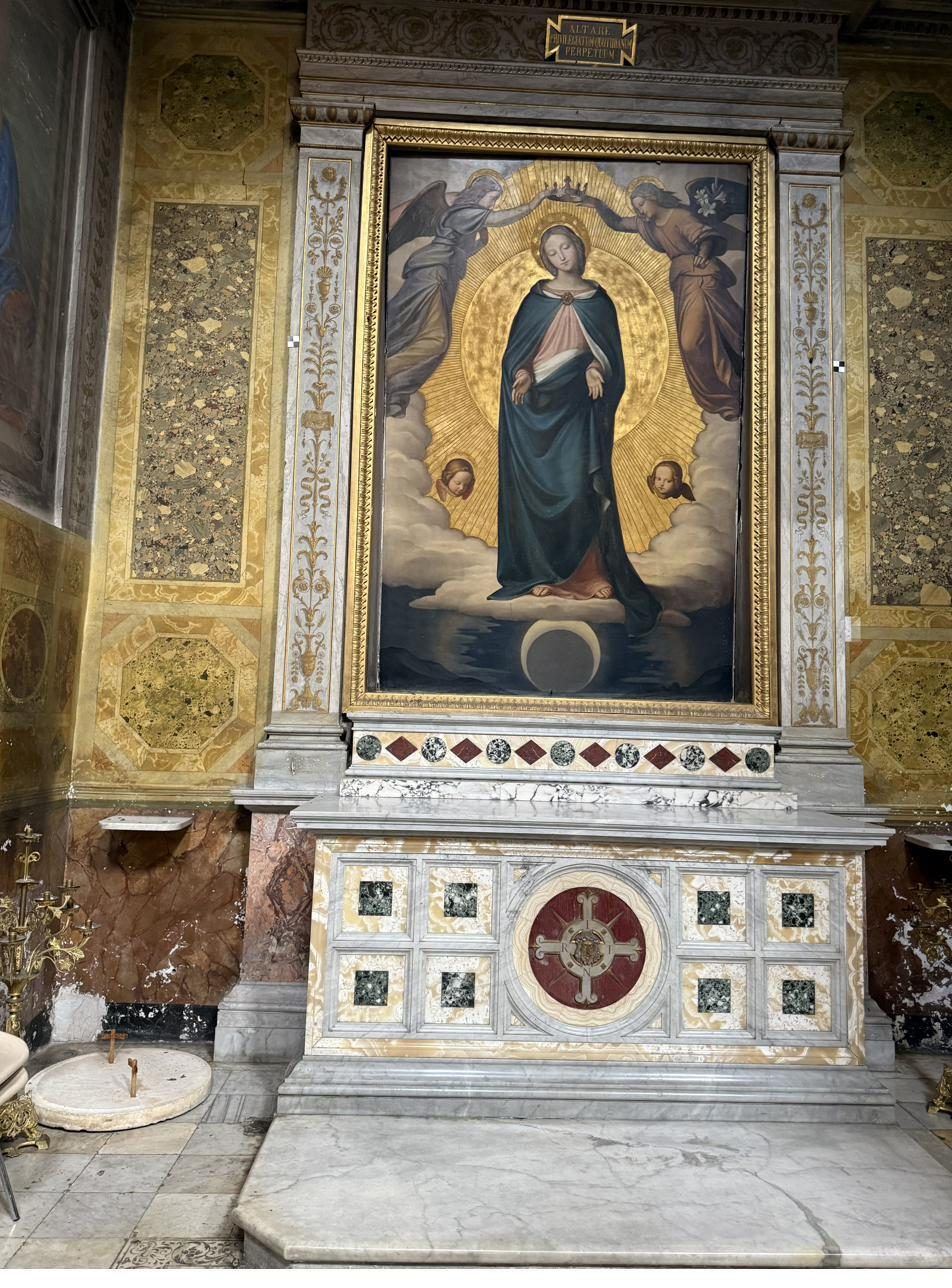
LocationThe Orsini chapel (formerly of St Helena), Trinità dei Monti, Rome
UbicaciónLa capilla Orsini (antes de Santa Elena), Trinità dei Monti, Roma
A chapel whose altarpiece steps clean out of the Mannerist world around it: a clear, bright Immaculate Conception in the German Nazarene manner, the Virgin standing on a crescent moon and crowned by angels before a field of gold. The same chapel was, long before, the first home of Volterra’s Descent from the Cross.
Una capilla cuyo retablo se aparta por completo del mundo manierista que lo rodea: una Inmaculada Concepción clara y luminosa al modo nazareno alemán, con la Virgen de pie sobre una luna creciente y coronada por ángeles ante un campo de oro. Esta misma capilla fue, mucho antes, el primer emplazamiento del Descendimiento de Volterra.
‘A perpetually privileged altar’ — a designation attaching a permanent indulgence to Masses said here for the dead.
‘Altar privilegiado a perpetuidad’ — designación que concede una indulgencia permanente a las misas que aquí se celebren por los difuntos.
The altarpiece was painted in 1830; the flanking scenes of the Annunciation and Visitation are dated to about the same year.
El retablo se pintó en 1830; las escenas laterales de la Anunciación y la Visitación se fechan hacia ese mismo año.
The Immaculate Conception is by Philipp Veit (1793–1877), a German painter and a leader of the Nazarene movement, which sought to revive the pure outline and devotional clarity of early Renaissance art. The side scenes are attributed to his pupil Joseph Ernst Tunner.
La Inmaculada Concepción es de Philipp Veit (1793–1877), pintor alemán y figura principal del movimiento nazareno, que buscaba recuperar la línea pura y la claridad devocional del arte del primer Renacimiento. Las escenas laterales se atribuyen a su discípulo Joseph Ernst Tunner.
The Nazarenes were young German artists who settled in Rome in the early 19th century to paint religious pictures in a deliberately archaic, sincere style. To find one of their leaders here, in a French national church above the Spanish Steps, is a reminder of how thoroughly international this corner of Rome had become — and the bright Marian image makes a striking foil to the dark Mannerist frescoes elsewhere in the same building.
Los nazarenos fueron jóvenes artistas alemanes que se instalaron en Roma a principios del siglo XIX para pintar temas religiosos en un estilo deliberadamente arcaico y sincero. Encontrar aquí a uno de sus líderes, en una iglesia nacional francesa sobre la Escalinata, recuerda lo profundamente internacional que se había vuelto este rincón de Roma — y la luminosa imagen mariana contrasta de forma notable con los oscuros frescos manieristas del mismo edificio.
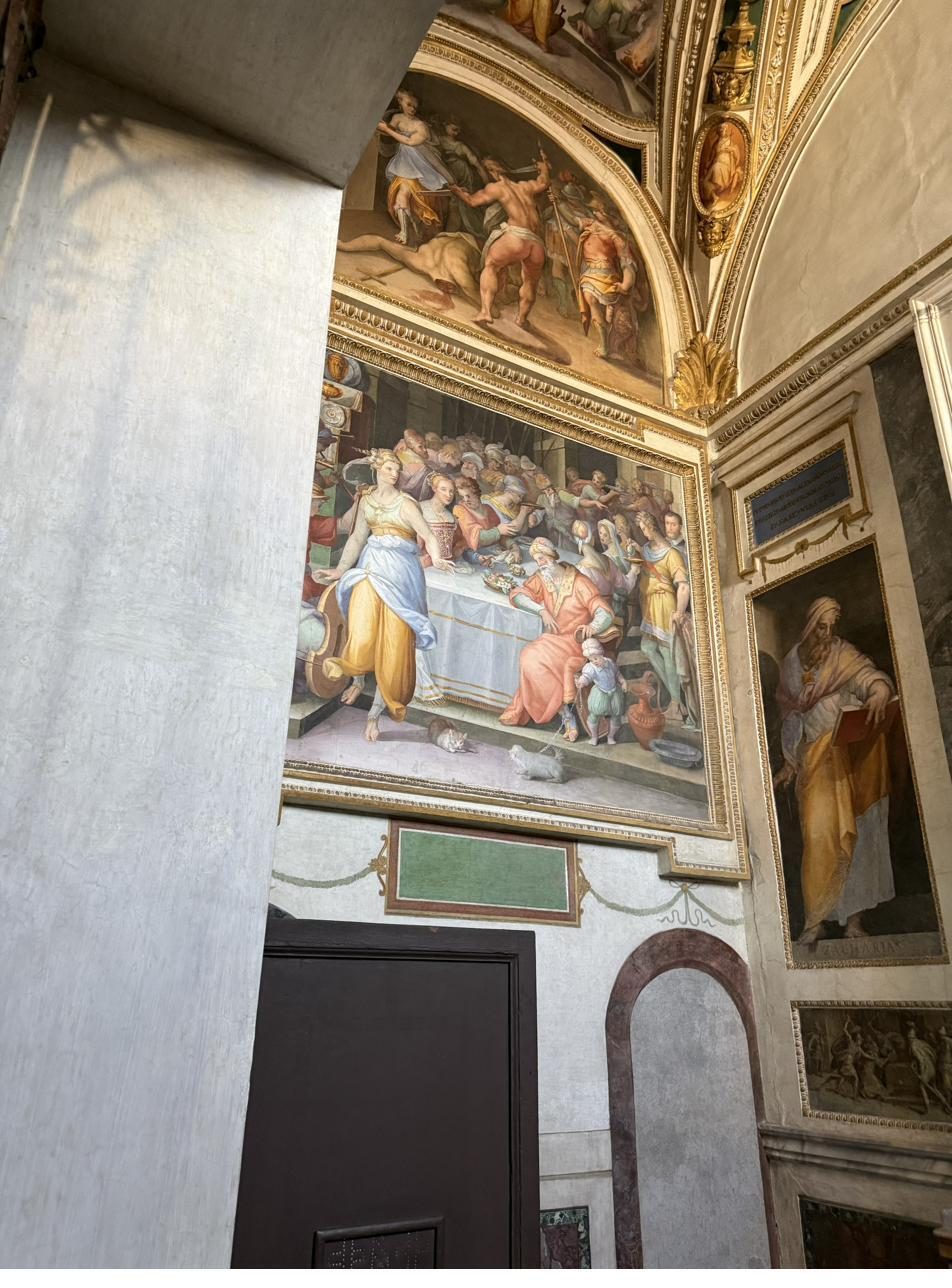
LocationInterior and forecourt of Trinità dei Monti, above the Spanish Steps, Rome
UbicaciónInterior y atrio de Trinità dei Monti, sobre la Escalinata de la Plaza de España, Roma
A gathering of the smaller things that tell the church’s story: a Mannerist fresco from the life of John the Baptist, the carved dedication that records the building of the Spanish Steps, and two worn slabs in the floor that mark the graves of those who worshipped here. Together they trace the church’s long, particular bond with France.
Una reunión de las cosas menores que cuentan la historia de la iglesia: un fresco manierista de la vida de San Juan Bautista, la dedicatoria grabada que recuerda la construcción de la Escalinata, y dos losas gastadas en el suelo que señalan las tumbas de quienes aquí rezaron. Juntas trazan el largo y singular vínculo de la iglesia con Francia.
To God, most high. While Benedict XIII was Supreme Pontiff and Louis XV reigned in France — his envoy to the Holy See being Cardinal Melchior de Polignac, Archbishop of Auch — the marble staircase was completed for the adornment of the holy church and the city and the good of its citizens, a work worthy of such great auspices. In the year of the Lord 1725.
A Dios, altísimo. Siendo Benedicto XIII Sumo Pontífice y reinando Luis XV en Francia — siendo su enviado ante la Santa Sede el cardenal Melchor de Polignac, arzobispo de Auch — se terminó la escalinata de mármol para ornato de la santa iglesia y de la ciudad y provecho de sus ciudadanos, obra digna de tan grandes auspicios. En el año del Señor de 1725.
The Baptist frescoes are by Naldini, about 1580; the staircase dedication is dated 1725; the floor tombs are of the 17th–18th centuries, with one older slab whose worn lettering can no longer be securely read.
Los frescos del Bautista son de Naldini, hacia 1580; la dedicatoria de la escalinata se fecha en 1725; las losas sepulcrales son de los siglos XVII–XVIII, con una losa más antigua cuyas letras gastadas ya no pueden leerse con seguridad.
The life-of-the-Baptist scenes are by the Florentine Mannerist Giambattista Naldini (c. 1535–1591), who decorated the Altoviti chapel around 1580, including the Baptism of Christ over its altar. The carved inscriptions are anonymous monumental epigraphy; the floor slabs are family memorials, named here only where the stone is still legible.
Las escenas de la vida del Bautista son del manierista florentino Giambattista Naldini (h. 1535–1591), que decoró la capilla Altoviti hacia 1580, incluido el Bautismo de Cristo sobre su altar. Las inscripciones grabadas son epigrafía monumental anónima; las losas del suelo son memoriales familiares, nombrados aquí solo donde la piedra sigue legible.
Trinità dei Monti is the French national church in Rome — founded by the French crown for the Order of Minims and owned by the French state to this day. That history is written into its very stones: the staircase below was raised while Louis XV reigned, its completion recorded under the name of the French king and his cardinal-envoy; and the floor inside is paved with the graves of the church’s people, among them the Drouet family — a French name underfoot in the most French of Roman churches.
Trinità dei Monti es la iglesia nacional francesa en Roma — fundada por la corona francesa para la Orden de los Mínimos y propiedad del Estado francés hasta hoy. Esa historia está escrita en sus propias piedras: la escalinata de abajo se levantó mientras reinaba Luis XV, y su término quedó registrado bajo el nombre del rey francés y de su cardenal-enviado; y el suelo del interior está empedrado con las tumbas de la gente de la iglesia, entre ellas la familia Drouet — un apellido francés bajo el suelo de la más francesa de las iglesias romanas.
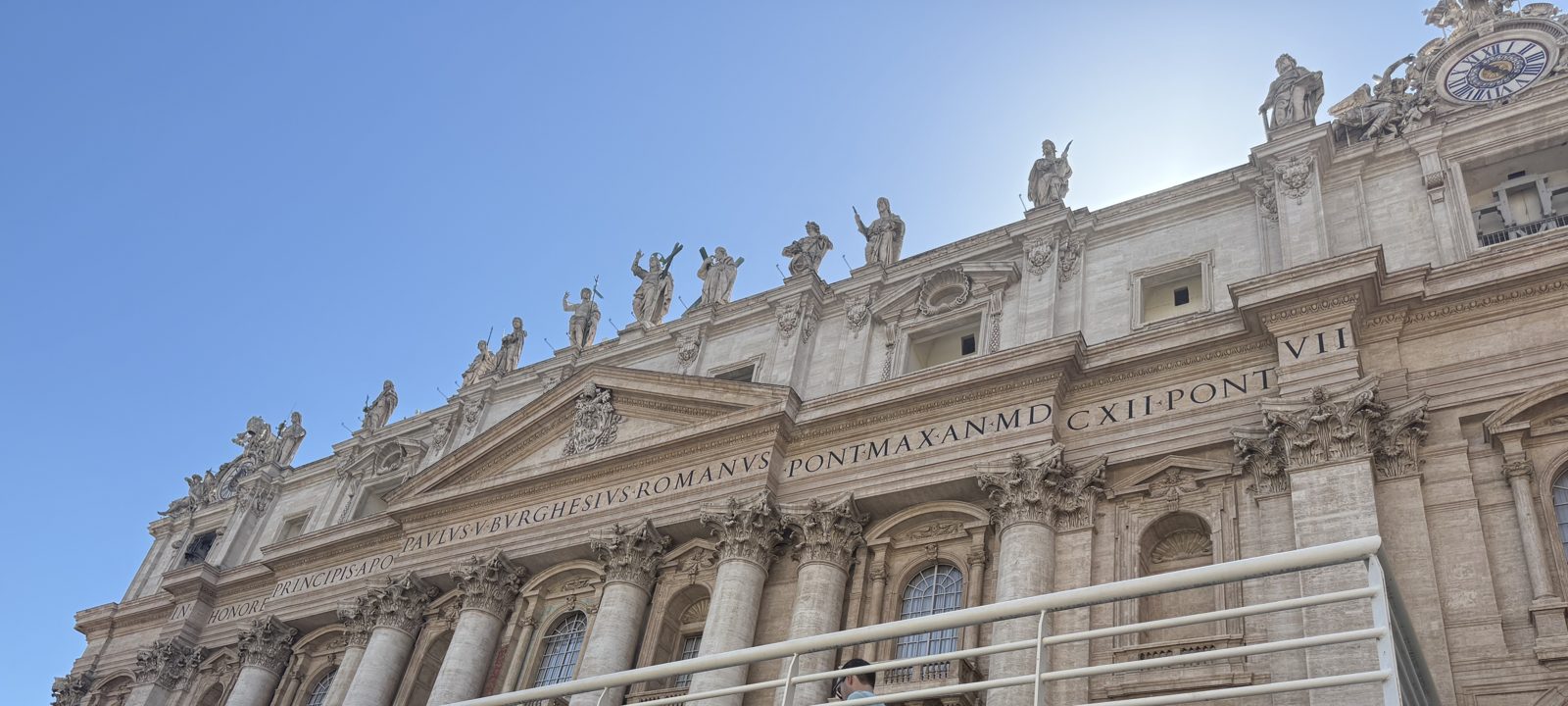
LocationSt Peter’s Basilica (Basilica di San Pietro), Vatican City
UbicaciónBasílica de San Pedro (Basilica di San Pietro), Ciudad del Vaticano
The largest church in the world, rebuilt over more than a century above the tomb of St Peter. Carlo Maderno’s travertine façade carries giant columns, statues of Christ and the apostles along its balustrade, and a vast dedicatory frieze. Through the portico, the central Holy Door opens onto the nave — Maderno’s immense gilded and coffered barrel vault, which carries the eye the length of the church to Bernini’s bronze Baldacchino at the crossing.
La iglesia más grande del mundo, reconstruida a lo largo de más de un siglo sobre la tumba de san Pedro. La fachada de travertino de Carlo Maderno luce columnas gigantes, estatuas de Cristo y los apóstoles a lo largo de su balaustrada y un vasto friso dedicatorio. A través del pórtico, la Puerta Santa central da paso a la nave — la inmensa bóveda de cañón dorada y artesonada de Maderno, que lleva la mirada a lo largo de la iglesia hasta el Baldaquino de bronce de Bernini en el crucero.
“In honour of the Prince of the Apostles, Paul V Borghese, a Roman, Supreme Pontiff, in the year 1612, the seventh of his pontificate.” The Holy Door beneath it is opened only in Jubilee years.
«En honor del Príncipe de los Apóstoles, Pablo V Borghese, romano, Sumo Pontífice, en el año 1612, el séptimo de su pontificado.» La Puerta Santa, debajo, se abre solo en los Años Jubilares.
The basilica was built between 1506 and 1626; Maderno’s façade was completed in 1612.
La basílica se construyó entre 1506 y 1626; la fachada de Maderno se terminó en 1612.
Built over more than a century by a succession of great architects — Donato Bramante, then Raphael, then Michelangelo (who designed the dome), with the nave and façade by Carlo Maderno and the square and many of the fittings by Gian Lorenzo Bernini.
Construida a lo largo de más de un siglo por una sucesión de grandes arquitectos — Donato Bramante, luego Rafael, luego Miguel Ángel (que diseñó la cúpula), con la nave y la fachada de Carlo Maderno y la plaza y muchos de los elementos de Gian Lorenzo Bernini.
St Peter’s is the largest church in Christendom and the symbolic centre of the Catholic world, raised over the tomb of the apostle Peter, regarded as the first pope. The Holy Door is its most charged threshold: walled shut between Jubilees and opened by the pope only in a Holy Year, when pilgrims pass through it to receive the indulgence. The marble plaques beside it record the most recent Holy Years — including the Jubilee of Hope of 2025, opened by Pope Francis on Christmas Eve 2024 and, after his death, closed by his successor Pope Leo XIV in January 2026: only the second time after 1700 that one pope has opened a Holy Year and another has closed it. The door is now sealed again until the Holy Year of 2033.
San Pedro es la mayor iglesia de la cristiandad y el centro simbólico del mundo católico, levantada sobre la tumba del apóstol Pedro, considerado el primer papa. La Puerta Santa es su umbral más cargado de significado: tapiada entre Jubileos y abierta por el papa solo en un Año Santo, cuando los peregrinos la cruzan para recibir la indulgencia. Las placas de mármol junto a ella registran los Años Santos más recientes — incluido el Jubileo de la Esperanza de 2025, abierto por el papa Francisco en la Nochebuena de 2024 y, tras su muerte, cerrado por su sucesor, el papa León XIV, en enero de 2026: solo la segunda vez después de 1700 en que un papa abre un Año Santo y otro lo cierra. La puerta queda de nuevo sellada hasta el Año Santo de 2033.
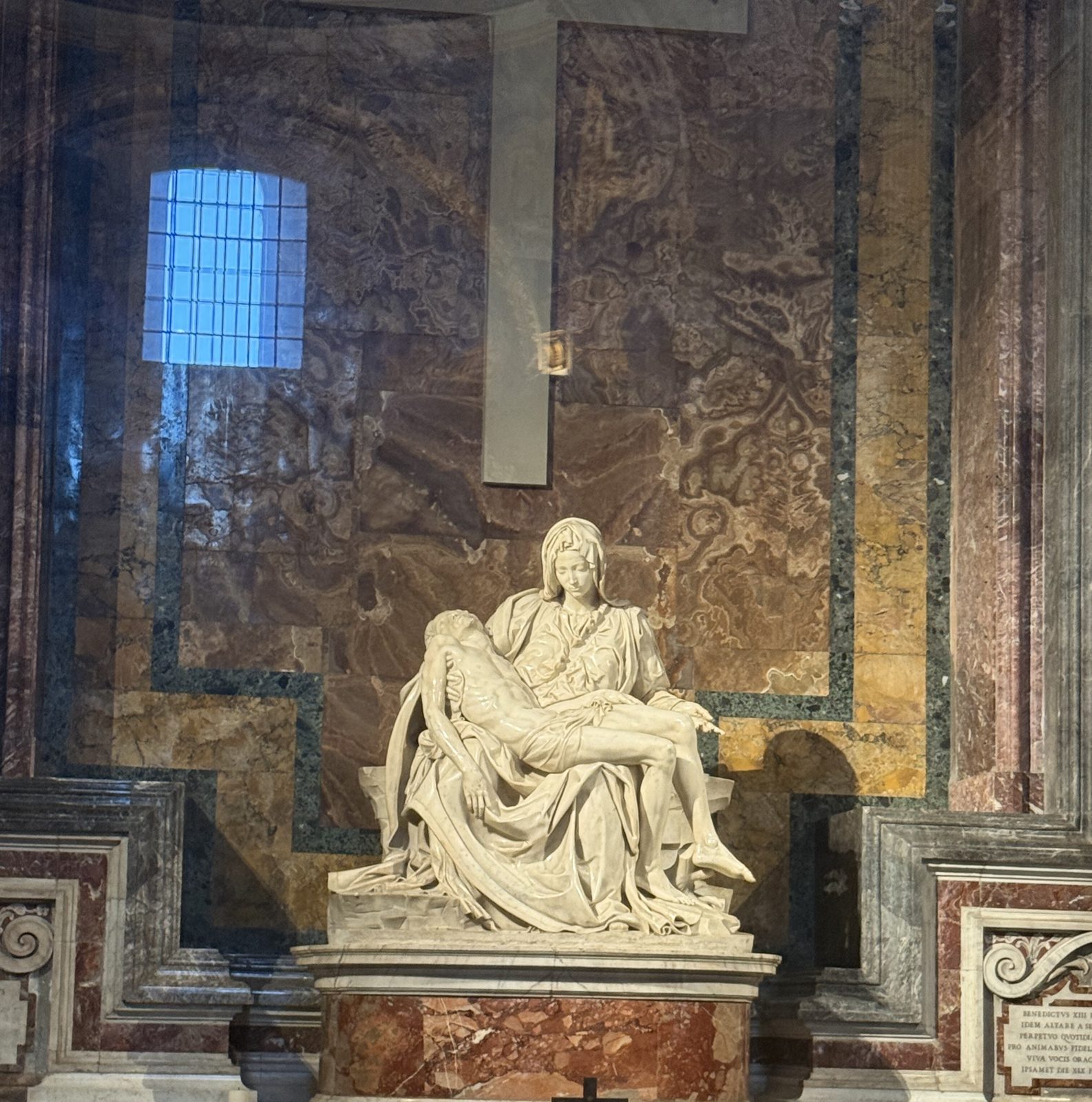
LocationSt Peter’s Basilica, Vatican City — the Chapel of the Pietà
UbicaciónBasílica de San Pedro, Ciudad del Vaticano — la Capilla de la Piedad
Michelangelo’s Pietà shows the Virgin Mary holding the body of her dead son across her lap, just after the Crucifixion. Carved from a single block of Carrara marble, the group is astonishing for the polish of its surfaces and for the youth and serenity of Mary’s face. It stands behind protective glass in the first chapel of the right aisle, against a backdrop of coloured marble.
La Piedad de Miguel Ángel muestra a la Virgen María sosteniendo el cuerpo de su hijo muerto sobre su regazo, justo después de la Crucifixión. Tallada de un solo bloque de mármol de Carrara, el grupo asombra por el pulido de sus superficies y por la juventud y serenidad del rostro de María. Se alza tras un cristal protector en la primera capilla de la nave derecha, ante un fondo de mármoles de colores.
“Michelangelo Buonarroti, the Florentine, made this.” It is the only work he ever signed — said to have been added after he heard it credited to another sculptor.
«Miguel Ángel Buonarroti, el florentino, lo hizo.» Es la única obra que firmó — se dice que la añadió tras oír que la atribuían a otro escultor.
Carved in 1498–1499, when Michelangelo was in his early twenties.
Tallada en 1498–1499, cuando Miguel Ángel tenía poco más de veinte años.
Michelangelo Buonarroti (1475–1564), who carved it for the French cardinal Jean de Bilhères-Lagraulas as the centrepiece of the cardinal’s tomb.
Miguel Ángel Buonarroti (1475–1564), que la talló para el cardenal francés Jean de Bilhères-Lagraulas como pieza central de la tumba del cardenal.
The Pietà is one of the supreme achievements of Renaissance sculpture and the work that made Michelangelo’s name while he was still in his twenties. Its tender, polished beauty and the impossible grace of the dead Christ across his mother’s lap have moved viewers for five centuries. It is also the only sculpture Michelangelo ever signed — and the chapel invites visitors to read the silent dialogue between the two faces, which speaks of suffering, hope and acceptance.
La Piedad es uno de los logros supremos de la escultura renacentista y la obra que consagró el nombre de Miguel Ángel cuando aún tenía veintitantos años. Su belleza tierna y pulida y la imposible gracia del Cristo muerto sobre el regazo de su madre han conmovido a los espectadores durante cinco siglos. Es además la única escultura que Miguel Ángel firmó — y la capilla invita a leer el diálogo silencioso entre los dos rostros, que habla de sufrimiento, esperanza y aceptación.
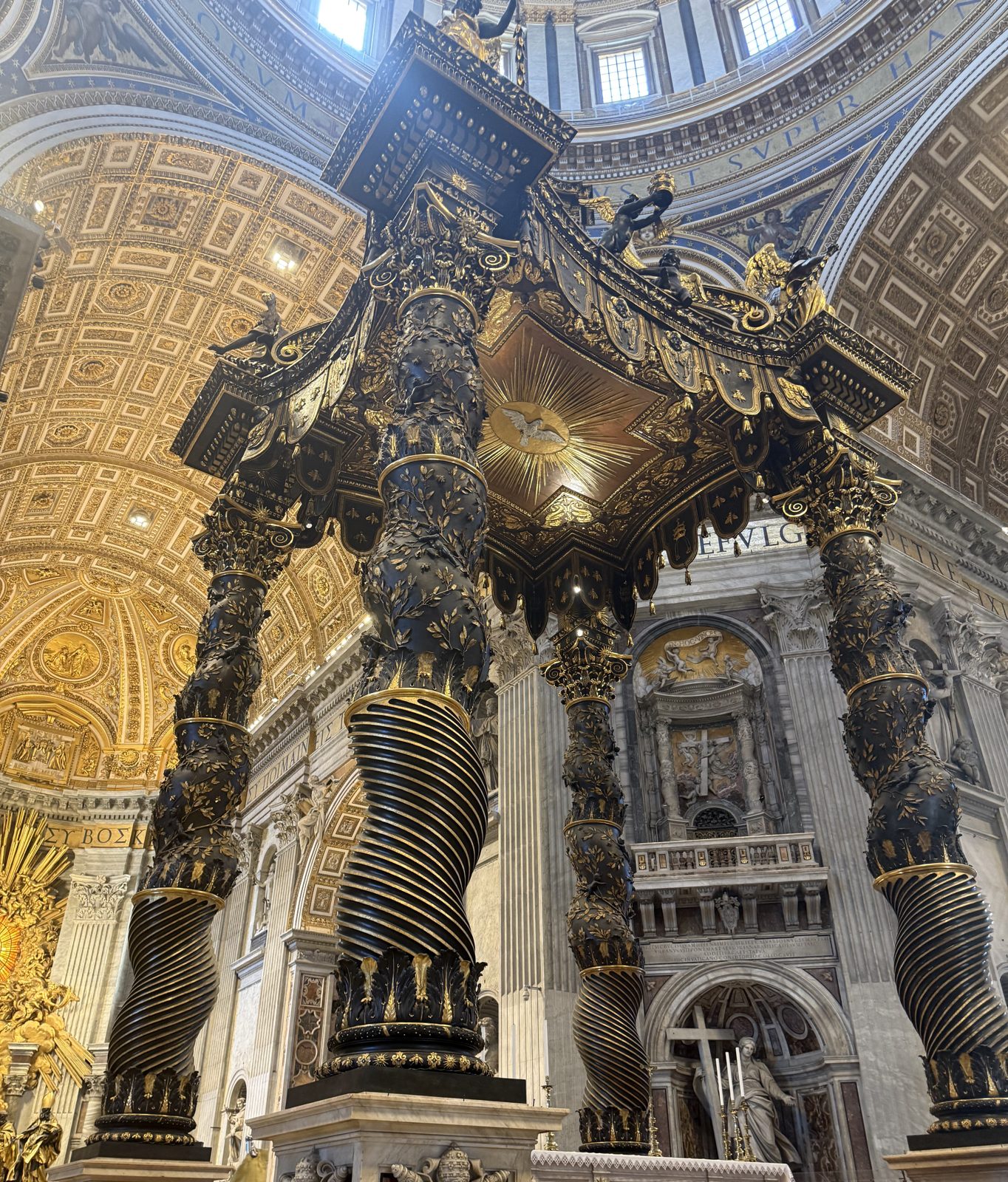
LocationSt Peter’s Basilica, Vatican City — the crossing and apse
UbicaciónBasílica de San Pedro, Ciudad del Vaticano — el crucero y el ábside
At the heart of the basilica, beneath Michelangelo’s dome, Bernini’s bronze Baldacchino rises on four twisting Solomonic columns over the papal altar and the tomb of St Peter. Beyond it, in the apse, blazes the Cathedra Petri: a gilded throne held aloft by four Doctors of the Church, crowned by a Glory of clouds and angels around an alabaster window bearing the dove of the Holy Spirit. High above, the coffered cupola soars to its lantern.
En el corazón de la basílica, bajo la cúpula de Miguel Ángel, el Baldaquino de bronce de Bernini se alza sobre cuatro columnas salomónicas retorcidas, encima del altar papal y de la tumba de san Pedro. Más allá, en el ábside, resplandece la Cátedra de San Pedro: un trono dorado sostenido por cuatro Doctores de la Iglesia, coronado por una Gloria de nubes y ángeles en torno a una vidriera de alabastro con la paloma del Espíritu Santo. Muy en lo alto, el casquete artesonado se eleva hasta su linterna.
“You are Peter, and upon this rock I will build my Church” (Matthew 16:18) — the words on which the basilica and the papacy claim to rest.
«Tú eres Pedro, y sobre esta piedra edificaré mi Iglesia» (Mateo 16,18) — las palabras sobre las que la basílica y el papado dicen sostenerse.
The dome was designed by Michelangelo and completed in 1590; Bernini’s Baldacchino dates to 1624–1633 and his Cathedra Petri to 1647–1666.
La cúpula la diseñó Miguel Ángel y se terminó en 1590; el Baldaquino de Bernini data de 1624–1633 y su Cátedra de San Pedro de 1647–1666.
The dome was designed by Michelangelo Buonarroti and completed after his death by Giacomo della Porta and Domenico Fontana. The Baldacchino and the Cathedra Petri are both by Gian Lorenzo Bernini (1598–1680) — the Baldacchino for Pope Urban VIII, the Cathedra for Pope Alexander VII.
La cúpula la diseñó Miguel Ángel Buonarroti y la completaron tras su muerte Giacomo della Porta y Domenico Fontana. El Baldaquino y la Cátedra de San Pedro son ambos de Gian Lorenzo Bernini (1598–1680) — el Baldaquino para el papa Urbano VIII, la Cátedra para el papa Alejandro VII.
This is the spiritual and visual heart of St Peter’s. The Baldacchino marks the high altar directly above the apostle’s tomb, its twisting bronze columns recalling those believed to have come from the Temple in Jerusalem. The Cathedra encloses an ancient wooden chair long revered as St Peter’s own, and Bernini fuses sculpture, architecture and light into a single Baroque vision — the throne seeming to float in a burst of golden glory beneath the Holy Spirit. Overhead, Michelangelo’s dome, the model for domes from London to Washington, completes the ascent from altar to heaven.
Este es el corazón espiritual y visual de San Pedro. El Baldaquino señala el altar mayor justo encima de la tumba del apóstol, y sus columnas de bronce retorcidas evocan las que se creía procedentes del Templo de Jerusalén. La Cátedra encierra una antigua silla de madera venerada largo tiempo como la del propio san Pedro, y Bernini funde escultura, arquitectura y luz en una sola visión barroca — el trono parece flotar en un estallido de gloria dorada bajo el Espíritu Santo. Por encima, la cúpula de Miguel Ángel, modelo de cúpulas desde Londres hasta Washington, completa el ascenso del altar al cielo.
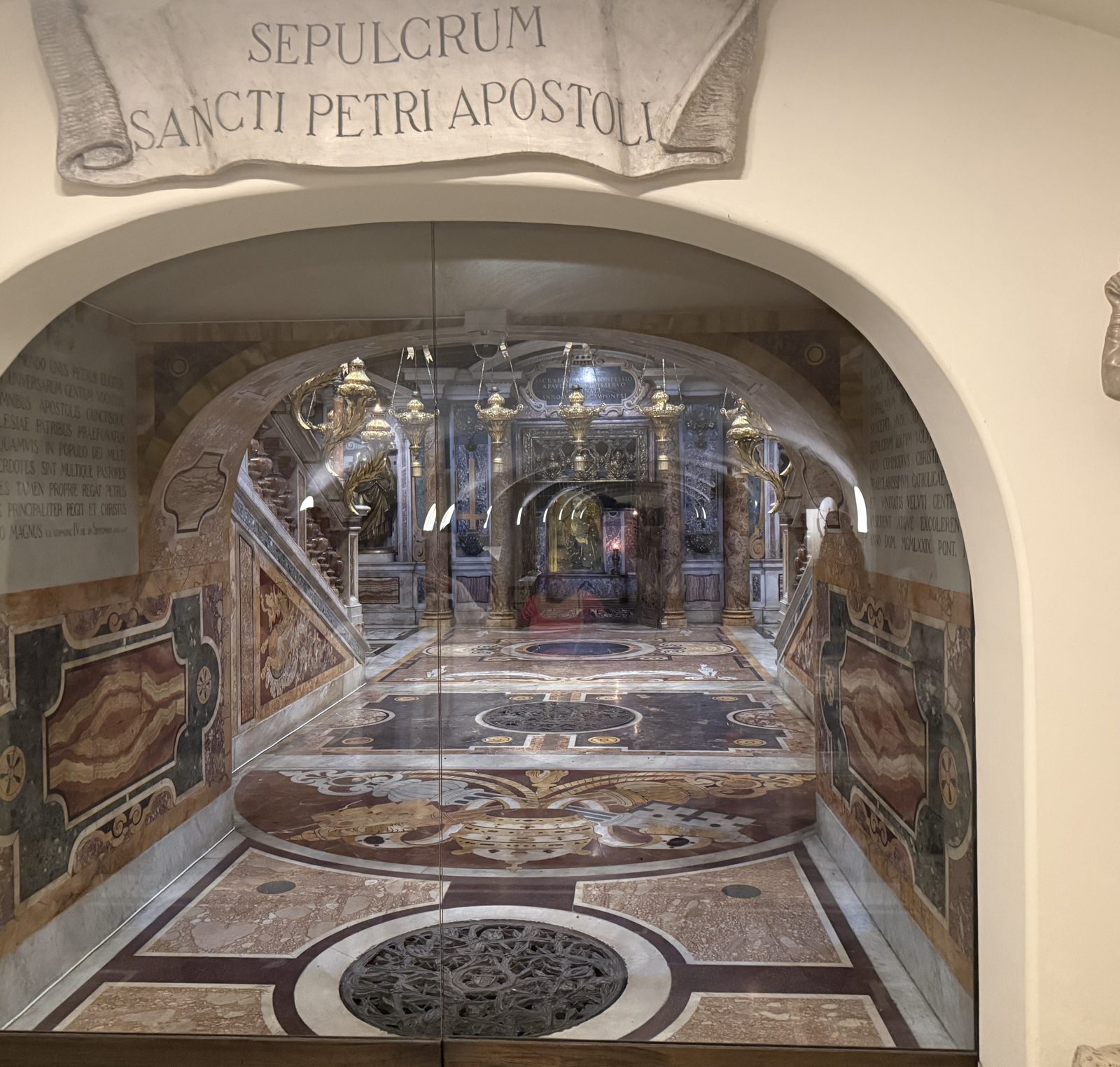
LocationSt Peter’s Basilica, Vatican City — the Confessio and the crossing
UbicaciónBasílica de San Pedro, Ciudad del Vaticano — la Confesión y el crucero
Directly beneath the high altar and Bernini’s Baldacchino lies the reason the basilica stands where it does: the tomb of St Peter. The sunken Confessio descends toward his burial place, and in the gilded Niche of the Pallium — where the woollen pallia worn by archbishops are kept — a marble scroll proclaims “SEPVLCRVM SANCTI PETRI APOSTOLI,” the Tomb of St Peter the Apostle. Nearby, against a pier, sits the venerable bronze statue of St Peter enthroned, blessing with one hand and holding the keys of heaven in the other; one foot has been worn smooth by the touch and kisses of pilgrims over seven centuries.
Justo debajo del altar mayor y del Baldaquino de Bernini se encuentra la razón por la que la basílica se alza donde está: la tumba de san Pedro. La Confesión, hundida, desciende hacia su lugar de sepultura, y en el dorado Nicho de los Palios — donde se guardan los palios de lana que visten los arzobispos — un rótulo de mármol proclama «SEPVLCRVM SANCTI PETRI APOSTOLI», la Tumba de san Pedro Apóstol. Cerca, contra un pilar, se sienta la venerable estatua de bronce de san Pedro entronizado, que bendice con una mano y sostiene las llaves del cielo en la otra; un pie ha quedado liso por el roce y los besos de los peregrinos a lo largo de siete siglos.
“The Tomb of St Peter the Apostle.” The whole basilica is built directly above this spot.
«La Tumba de san Pedro Apóstol.» Toda la basílica está construida justo encima de este lugar.
The bronze St Peter is generally attributed to Arnolfo di Cambio, around 1300; the Confessio was designed by Carlo Maderno in the early 17th century.
El san Pedro de bronce se atribuye generalmente a Arnolfo di Cambio, hacia 1300; la Confesión la diseñó Carlo Maderno a principios del siglo XVII.
The Confessio — the sunken chapel before the tomb — is by Carlo Maderno. The bronze statue of St Peter Enthroned is attributed to the Tuscan sculptor Arnolfo di Cambio (active in the late 13th century) and is among the oldest works in the basilica.
La Confesión — la capilla hundida ante la tumba — es de Carlo Maderno. La estatua de bronce de san Pedro entronizado se atribuye al escultor toscano Arnolfo di Cambio (activo a finales del siglo XIII) y está entre las obras más antiguas de la basílica.
This is the heart of the matter: Catholic tradition holds that the apostle Peter — the “rock” on whom Christ founded his Church, and the first pope — was martyred nearby and buried here, and the entire basilica rises above his grave. For centuries pilgrims have descended to the Confessio to be near the tomb and have queued to touch the foot of the bronze St Peter, a gesture of devotion so constant that the metal itself has been worn away.
Este es el meollo del asunto: la tradición católica sostiene que el apóstol Pedro — la “piedra” sobre la que Cristo fundó su Iglesia y el primer papa — fue martirizado cerca y sepultado aquí, y toda la basílica se levanta sobre su tumba. Durante siglos los peregrinos han bajado a la Confesión para estar cerca de la tumba y han hecho cola para tocar el pie del san Pedro de bronce, un gesto de devoción tan constante que ha desgastado el propio metal.
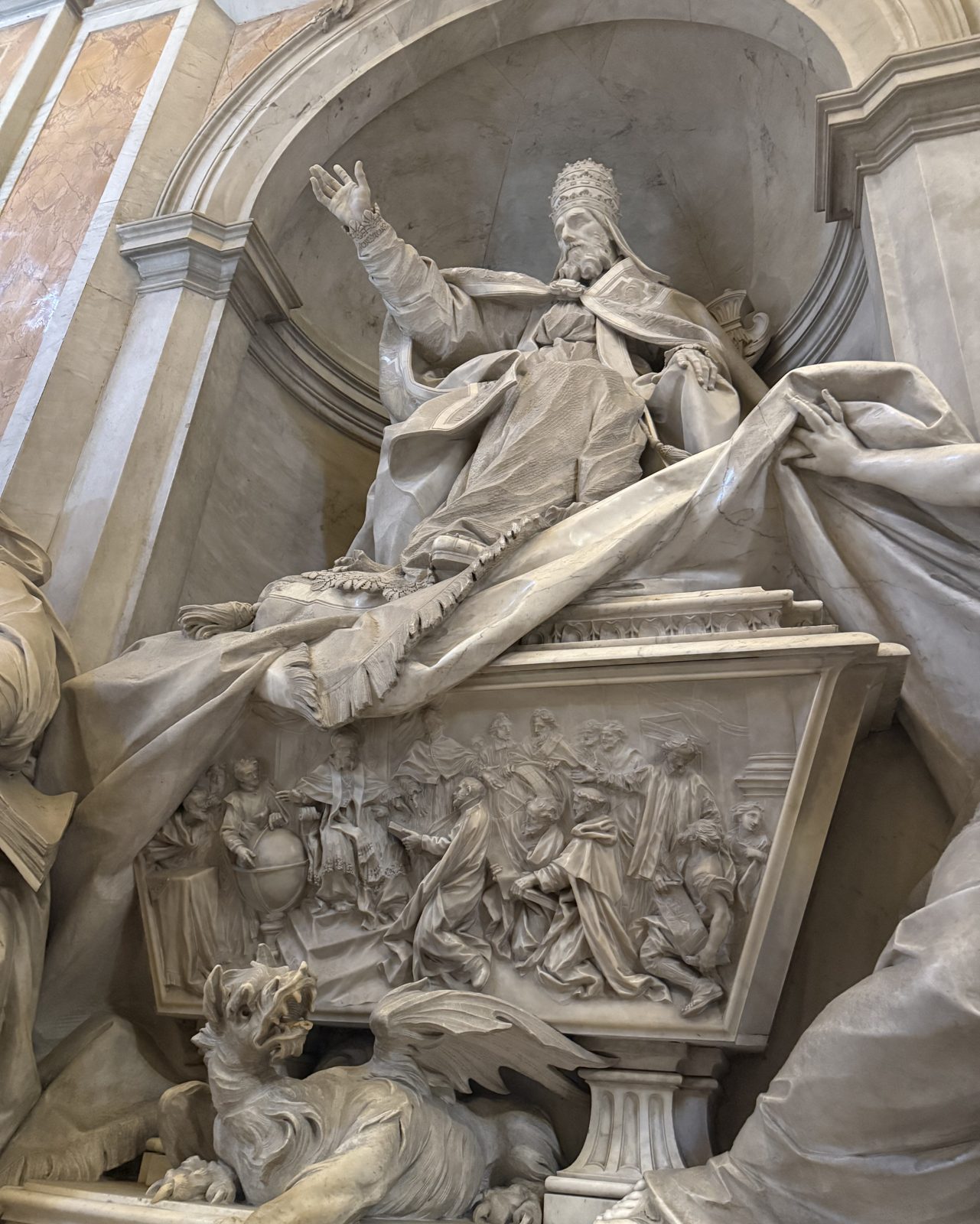
LocationSt Peter’s Basilica, Vatican City — the right aisle
UbicaciónBasílica de San Pedro, Ciudad del Vaticano — la nave derecha
This grand marble monument honours Pope Gregory XIII — the pope who gave the world the calendar we still use. The enthroned pope raises his hand in blessing, flanked by figures of Religion and Wisdom; Wisdom lifts a drape to reveal a relief of the moment in 1582 when the new calendar was proclaimed. At the base crouches a dragon — the heraldic emblem of the pope’s family, the Boncompagni.
Este gran monumento de mármol honra al papa Gregorio XIII — el papa que dio al mundo el calendario que aún usamos. El papa entronizado levanta la mano en señal de bendición, flanqueado por figuras de la Religión y la Sabiduría; la Sabiduría alza un paño para revelar un relieve del momento, en 1582, en que se proclamó el nuevo calendario. En la base se agazapa un dragón — el emblema heráldico de la familia del papa, los Boncompagni.
“To Gregory XIII, Supreme Pontiff” — praised as guardian of justice and protector of the faith “in both worlds,” the Old and the New.
«A Gregorio XIII, Sumo Pontífice» — alabado como guardián de la justicia y protector de la fe «en ambos mundos», el Viejo y el Nuevo.
The monument was carved between 1715 and 1723 by Camillo Rusconi.
El monumento fue tallado entre 1715 y 1723 por Camillo Rusconi.
Camillo Rusconi (1658–1728), a Milanese sculptor. It is the tomb of Pope Gregory XIII (Ugo Boncompagni, 1502–1585, pope from 1572).
Camillo Rusconi (1658–1728), escultor milanés. Es la tumba del papa Gregorio XIII (Ugo Boncompagni, 1502–1585, papa desde 1572).
Gregory XIII’s enduring legacy is the Gregorian calendar. In 1582 he corrected the old Julian calendar, which had drifted out of step with the seasons, by dropping ten days — so that the 4th of October was followed directly by the 15th (Romans joked that the pope had stolen ten days of their lives). The reform spread across the world and remains the standard civil calendar today — the very calendar by which this trip is dated. The relief on the tomb shows the moment of its promulgation, while the family dragon keeps watch below.
El legado perdurable de Gregorio XIII es el calendario gregoriano. En 1582 corrigió el viejo calendario juliano, que se había desfasado de las estaciones, suprimiendo diez días — de modo que al 4 de octubre le siguió directamente el 15 (los romanos bromeaban con que el papa les había robado diez días de vida). La reforma se extendió por el mundo y sigue siendo hoy el calendario civil habitual — el mismísimo calendario con que se fecha este viaje. El relieve de la tumba muestra el momento de su promulgación, mientras el dragón de la familia vigila debajo.
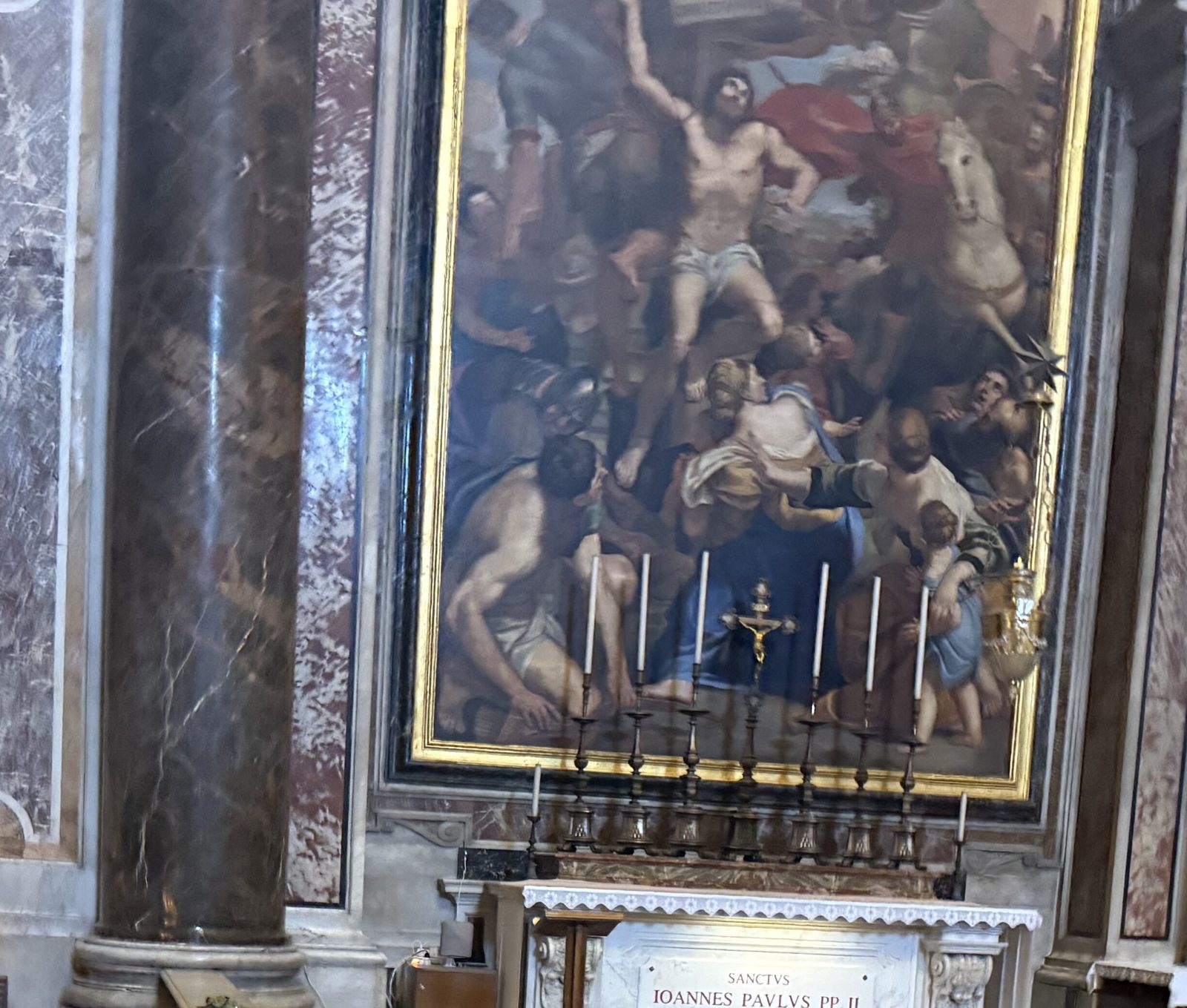
LocationSt Peter’s Basilica, Vatican City — the chapels and the Grottoes
UbicaciónBasílica de San Pedro, Ciudad del Vaticano — las capillas y las Grutas
Alongside its Renaissance and Baroque treasures, St Peter’s is a living place of devotion, and three modern shrines draw constant crowds. In the Chapel of St Sebastian, beneath a mosaic of the saint’s martyrdom, lies the tomb of St John Paul II, inscribed simply “SANCTVS IOANNES PAVLVS PP II.” Beneath the Altar of St Jerome, the body of St John XXIII rests in a crystal urn, vested in red and gold. And down in the Vatican Grottoes, a chapel holds an image of Our Lady of Guadalupe, patroness of the Americas and of Mexico.
Junto a sus tesoros renacentistas y barrocos, San Pedro es un lugar vivo de devoción, y tres santuarios modernos atraen multitudes constantes. En la Capilla de San Sebastián, bajo un mosaico del martirio del santo, yace la tumba de san Juan Pablo II, con la sencilla inscripción «SANCTVS IOANNES PAVLVS PP II». Bajo el Altar de San Jerónimo, el cuerpo de san Juan XXIII descansa en una urna de cristal, revestido de rojo y oro. Y abajo, en las Grutas Vaticanas, una capilla guarda una imagen de Nuestra Señora de Guadalupe, patrona de las Américas y de México.
“Saint John Paul II, Pope.” He was entombed here after his beatification and was canonized in 2014.
«San Juan Pablo II, papa.» Fue sepultado aquí tras su beatificación y fue canonizado en 2014.
John XXIII’s body was placed beneath the Altar of St Jerome in 2001; John Paul II was entombed in the Chapel of St Sebastian in 2011; the chapel of Our Lady of Guadalupe in the Grottoes was dedicated in 1992.
El cuerpo de Juan XXIII se colocó bajo el Altar de San Jerónimo en 2001; Juan Pablo II fue sepultado en la Capilla de San Sebastián en 2011; la capilla de Nuestra Señora de Guadalupe en las Grutas se dedicó en 1992.
The Chapel of St Sebastian is dominated by a mosaic copy of Domenichino’s Martyrdom of St Sebastian. The chapel of Our Lady of Guadalupe in the Grottoes was dedicated by Pope John Paul II, a great devotee of the Virgin.
La Capilla de San Sebastián está dominada por una copia en mosaico del Martirio de San Sebastián de Domenichino. La capilla de Nuestra Señora de Guadalupe en las Grutas fue dedicada por el papa Juan Pablo II, gran devoto de la Virgen.
These three shrines speak to the living Church. John Paul II (pope 1978–2005) and John XXIII (pope 1958–1963) were canonized together in 2014 and are among the most visited tombs in the basilica. The chapel of Our Lady of Guadalupe carries special meaning for the peoples of Latin America: under this title, revered after the 1531 apparition to St Juan Diego near Mexico City, Mary is honoured as Patroness of the Americas — a thread of home running through the greatest church in Christendom.
Estos tres santuarios hablan de la Iglesia viva. Juan Pablo II (papa 1978–2005) y Juan XXIII (papa 1958–1963) fueron canonizados juntos en 2014 y están entre las tumbas más visitadas de la basílica. La capilla de Nuestra Señora de Guadalupe tiene un significado especial para los pueblos de América Latina: bajo esta advocación, venerada tras la aparición de 1531 a san Juan Diego cerca de Ciudad de México, María es honrada como Patrona de las Américas — un hilo de hogar que recorre la mayor iglesia de la cristiandad.
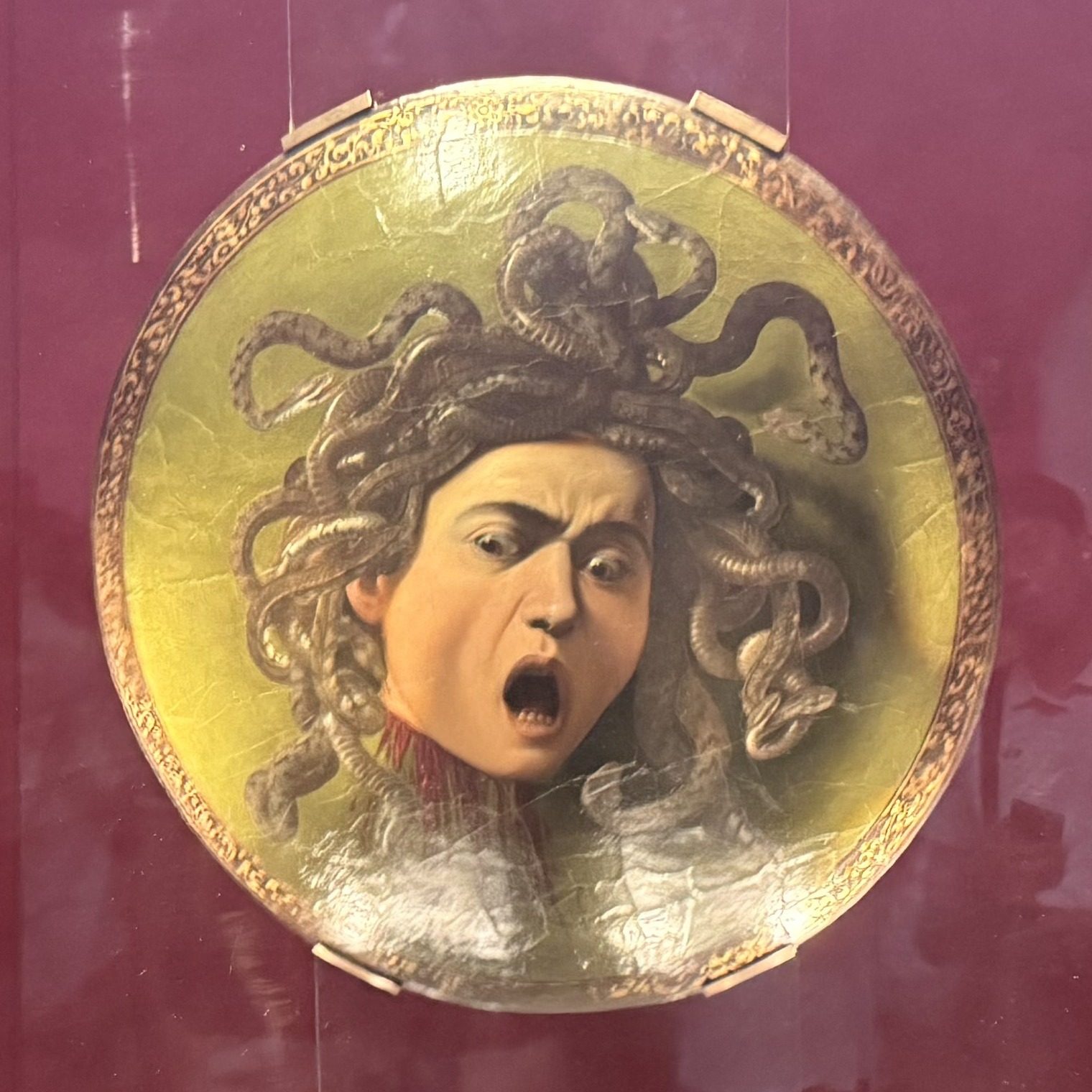
LocationThe Uffizi Galleries (Gallerie degli Uffizi), Florence — the Caravaggio rooms
UbicaciónLas Galerías de los Uffizi (Gallerie degli Uffizi), Florencia — las salas de Caravaggio
Two paintings by Caravaggio, the artist who turned European painting toward raw naturalism and theatrical light. The Head of Medusa shows the snake-haired Gorgon at the instant of her beheading, mouth open in a scream; it is painted not on a flat panel but on a convex ceremonial shield. The Sacrifice of Isaac catches the angel seizing Abraham’s wrist just as the knife reaches the boy, whose face is twisted in terror, with a luminous Tuscan landscape opening behind.
Dos pinturas de Caravaggio, el artista que volcó la pintura europea hacia el naturalismo crudo y la luz teatral. La Cabeza de Medusa muestra a la Gorgona de cabellos de serpiente en el instante de su decapitación, con la boca abierta en un grito; no está pintada sobre una tabla plana, sino sobre un escudo ceremonial convexo. El Sacrificio de Isaac capta al ángel sujetando la muñeca de Abraham justo cuando el cuchillo alcanza al niño, cuyo rostro se retuerce de terror, con un luminoso paisaje toscano abriéndose detrás.
The shield was a Medici diplomatic gift: Cardinal Francesco Maria del Monte, Caravaggio’s protector, presented it to Grand Duke Ferdinando I de’ Medici in 1598.
El escudo fue un regalo diplomático de los Médici: el cardenal Francesco Maria del Monte, protector de Caravaggio, lo entregó al gran duque Fernando I de Médici en 1598.
The Medusa dates to about 1597 and the Sacrifice of Isaac to about 1603–4 — both from Caravaggio’s Roman years, before he fled the city in 1606.
La Medusa data de hacia 1597 y el Sacrificio de Isaac de hacia 1603–4 — ambos de los años romanos de Caravaggio, antes de huir de la ciudad en 1606.
Both are by Michelangelo Merisi da Caravaggio (Milan 1571 – Porto Ercole 1610). The Sacrifice of Isaac was painted for Cardinal Maffeo Barberini, who twenty years later was elected pope as Urban VIII.
Ambas son de Michelangelo Merisi da Caravaggio (Milán 1571 – Porto Ercole 1610). El Sacrificio de Isaac fue pintado para el cardenal Maffeo Barberini, que veinte años después fue elegido papa con el nombre de Urbano VIII.
Caravaggio’s unflinching realism — real faces, real fear, light cut from darkness — broke with the idealized grace of the late Renaissance and shaped a century of European painting. The Medusa, shrieking from a shield meant to reflect and petrify, is among the most famous images in the Uffizi; the Sacrifice of Isaac is one of the great early statements of his dramatic naturalism.
El realismo implacable de Caravaggio — rostros reales, miedo real, la luz recortada en la oscuridad — rompió con la gracia idealizada del Renacimiento tardío y marcó un siglo de pintura europea. La Medusa, que grita desde un escudo destinado a reflejar y petrificar, es una de las imágenes más célebres de los Uffizi; el Sacrificio de Isaac es una de las grandes declaraciones tempranas de su naturalismo dramático.
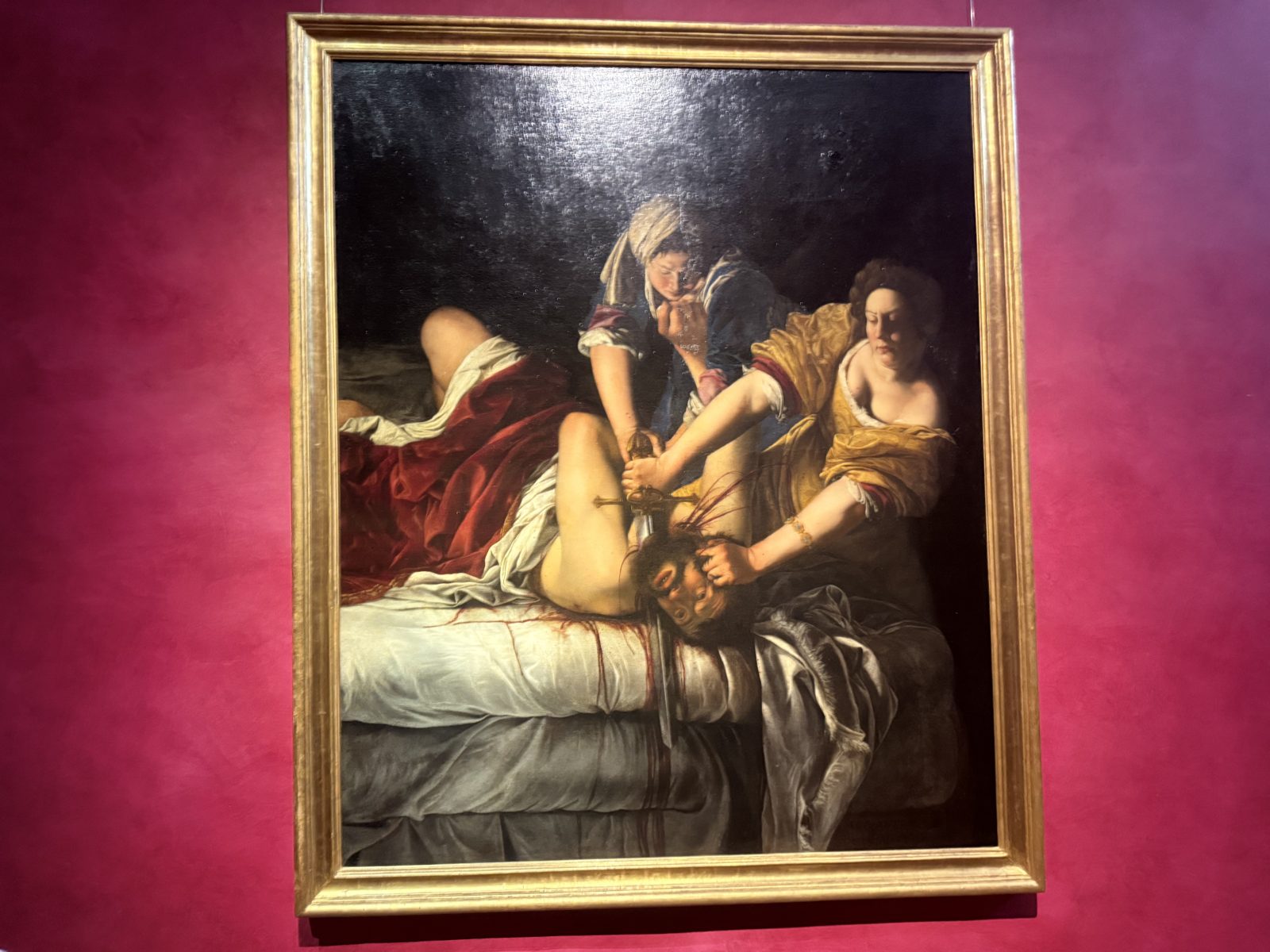
LocationThe Uffizi Galleries, Florence — the rooms of Caravaggio and his age
UbicaciónLas Galerías de los Uffizi, Florencia — las salas de Caravaggio y su época
Three paintings from the generation around 1600 that absorbed the new realism. Artemisia Gentileschi’s Judith drives the sword home with her maid’s help, blood crossing the white sheets. Battistello’s Salome receives the Baptist’s severed head in a dark, close-pressed huddle. Annibale Carracci’s Venus turns her luminous nude back to the viewer while a satyr lifts the cloth — warm, sensuous, Venetian.
Tres pinturas de la generación de hacia 1600 que asimiló el nuevo realismo. La Judit de Artemisia Gentileschi clava la espada con la ayuda de su criada, mientras la sangre cruza las sábanas blancas. La Salomé de Battistello recibe la cabeza cortada del Bautista en un corro oscuro y apretado. La Venus de Annibale Carracci vuelve su luminosa espalda desnuda hacia el espectador mientras un sátiro alza el paño — cálida, sensual, veneciana.
‘I, Artemisia Lomi, made this’ — the proud signature with which Artemisia Gentileschi claimed one of the most powerful pictures of her age.
‘Yo, Artemisia Lomi, hice esto’ — la firma orgullosa con la que Artemisia Gentileschi reivindicó uno de los cuadros más poderosos de su tiempo.
Carracci’s Venus is the earliest, 1587–88; Battistello’s Salome dates to 1615–25; Artemisia’s Judith to about 1620–21.
La Venus de Carracci es la más temprana, 1587–88; la Salomé de Battistello data de 1615–25; la Judit de Artemisia, de hacia 1620–21.
The Judith is by Artemisia Gentileschi (Rome 1593 – Naples 1652/53), the most celebrated woman painter of the Baroque. The Salome is by Giovan Battista Caracciolo, called Battistello (Naples 1578–1635), a leading Neapolitan follower of Caravaggio. The Venus is by Annibale Carracci (Bologna 1560 – Rome 1609), co-founder of the reforming Bolognese school.
La Judit es de Artemisia Gentileschi (Roma 1593 – Nápoles 1652/53), la pintora más célebre del Barroco. La Salomé es de Giovan Battista Caracciolo, llamado Battistello (Nápoles 1578–1635), destacado seguidor napolitano de Caravaggio. La Venus es de Annibale Carracci (Bolonia 1560 – Roma 1609), cofundador de la reformadora escuela boloñesa.
Around 1600 two currents remade Italian painting: Caravaggio’s stark naturalism and the Carracci’s reformed classicism. Artemisia and Battistello carry Caravaggio’s dramatic light and unflinching violence into the next generation; Carracci’s Venus, made for a private patron, revives the warm sensuality of Titian. Artemisia’s Judith — painted by a woman who had herself survived assault and a public trial — is often called the fiercest of all versions of the subject.
Hacia 1600, dos corrientes rehicieron la pintura italiana: el naturalismo descarnado de Caravaggio y el clasicismo reformado de los Carracci. Artemisia y Battistello llevan la luz dramática y la violencia sin concesiones de Caravaggio a la generación siguiente; la Venus de Carracci, hecha para un cliente privado, recupera la cálida sensualidad de Tiziano. La Judit de Artemisia — pintada por una mujer que había sobrevivido a una agresión y a un juicio público — suele considerarse la más feroz de todas las versiones del tema.
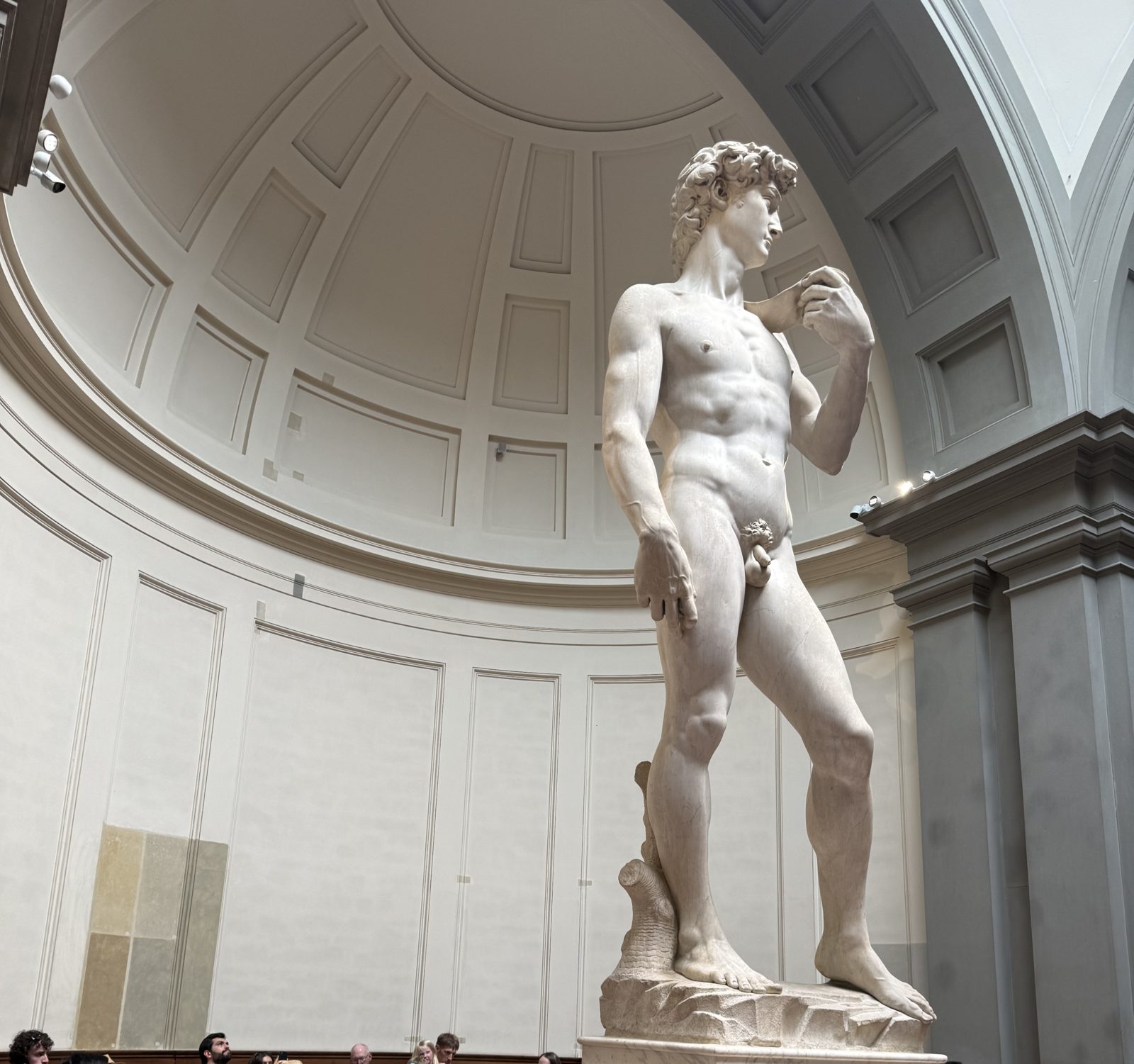
LocationThe Tribune of the Galleria dell’Accademia, Florence
UbicaciónLa Tribuna de la Galería de la Academia, Florencia
Michelangelo’s David stands at the end of a long gallery beneath a purpose-built domed Tribune, lit from above. The colossal nude shows the young hero in the tense moment before his fight with Goliath — the sling over his shoulder, his weight on one leg, his head turned and his brow furrowed in concentration. These views move around the figure to show the front, the left side, and the back.
El David de Miguel Ángel se alza al fondo de una larga galería, bajo una Tribuna abovedada construida para él e iluminada desde lo alto. El coloso desnudo muestra al joven héroe en el instante de tensión previo a su lucha con Goliat — la honda al hombro, el peso sobre una pierna, la cabeza vuelta y el ceño fruncido en concentración. Estas vistas rodean la figura para mostrar el frente, el costado izquierdo y la espalda.
Vasari marvelled that no work had ever shown so fluent a pose, nor feet, hands and head so finely matched in skill and design.
Vasari se maravilló de que ninguna obra había mostrado una postura tan fluida, ni pies, manos y cabeza tan finamente armonizados en destreza y diseño.
Carved in 1501–1504, when Michelangelo was in his late twenties. Marble, about 5.17 m (17 feet) high.
Tallado en 1501–1504, cuando Miguel Ángel tenía poco menos de treinta años. Mármol, de unos 5,17 m (17 pies) de altura.
Michelangelo Buonarroti (Caprese 1475 – Rome 1564), who took on a block of marble that had lain half-worked and discarded in the Cathedral courtyard for decades and drew the Giant out of it.
Miguel Ángel Buonarroti (Caprese 1475 – Roma 1564), que tomó un bloque de mármol abandonado a medio labrar durante décadas en el patio de la Catedral y extrajo de él al Gigante.
The David is one of the supreme achievements of Western sculpture and a symbol of Florence itself. Carved for the Republic, the young David — the underdog who fells a giant — stood for the city’s defiance of far greater powers, and so the finished statue was set not high on the Cathedral but at the door of the Palazzo Vecchio, the seat of government, in 1504. It was moved here to the Accademia in 1873 to protect it; a marble copy now stands in Piazza della Signoria and a bronze one looks over the city from Piazzale Michelangelo.
El David es uno de los logros supremos de la escultura occidental y un símbolo de la propia Florencia. Tallado para la República, el joven David — el débil que derriba a un gigante — encarnaba el desafío de la ciudad frente a potencias mucho mayores, y por eso la estatua terminada se colocó no en lo alto de la Catedral, sino a la puerta del Palazzo Vecchio, sede del gobierno, en 1504. Se trasladó aquí, a la Academia, en 1873 para protegerlo; hoy una copia en mármol está en la Piazza della Signoria y otra en bronce contempla la ciudad desde el Piazzale Michelangelo.
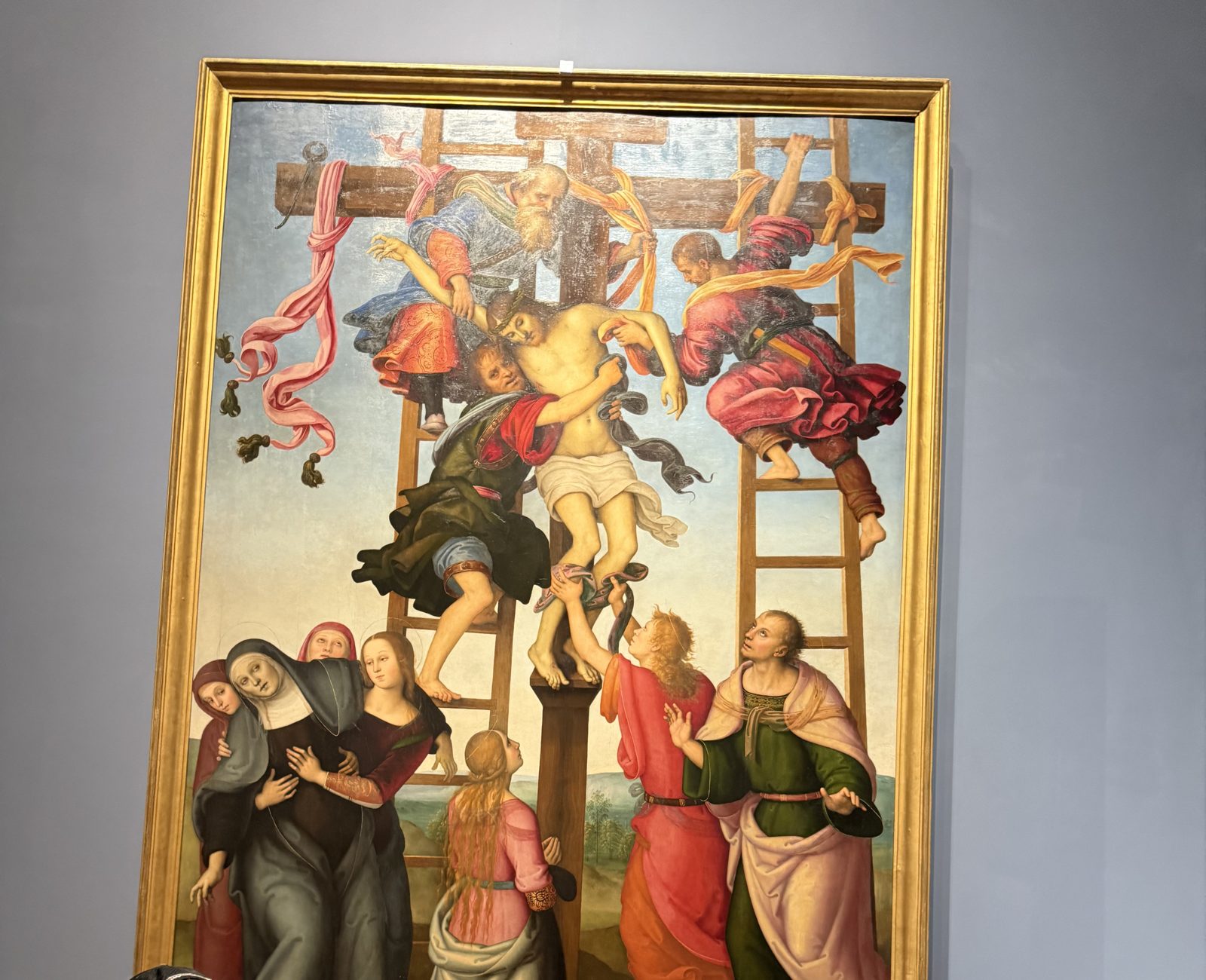
LocationThe painting galleries of the Galleria dell’Accademia, Florence
UbicaciónLas salas de pintura de la Galería de la Academia, Florencia
Beyond the David, the Accademia holds a rich gallery of Florentine painting. These four panels trace it from the high Renaissance into the 16th century: a dramatic Deposition with figures climbing ladders to lower Christ’s body; a tender Annunciation set in a classical loggia; a Resurrection in which Christ rises above sleeping soldiers before a view of Florence; and a crowded Mannerist Dispute of the Church Fathers over the Immaculate Conception.
Más allá del David, la Academia guarda una rica galería de pintura florentina. Estos cuatro paneles la recorren desde el alto Renacimiento hasta el siglo XVI: un dramático Descendimiento con figuras que suben por escaleras para bajar el cuerpo de Cristo; una tierna Anunciación en una logia clásica; una Resurrección en que Cristo se eleva sobre los soldados dormidos ante una vista de Florencia; y una abigarrada Disputa manierista de los Padres de la Iglesia sobre la Inmaculada Concepción.
The Resurrection borrows the bold poses of its soldiers from Leonardo’s lost Battle of Anghiari, and sets the dome of Florence Cathedral in the distance.
La Resurrección toma las audaces poses de sus soldados de la perdida Batalla de Anghiari de Leonardo, y sitúa al fondo la cúpula de la catedral de Florencia.
The Resurrection dates to about 1500–05 and the Deposition to 1503–07, both around the years of the David; the Annunciation is of the later 15th century; Sogliani’s Dispute was painted in 1531–36.
La Resurrección data de hacia 1500–05 y el Descendimiento de 1503–07, ambos en torno a los años del David; la Anunciación es de finales del siglo XV; la Disputa de Sogliani se pintó en 1531–36.
The Deposition is by Filippino Lippi (Prato c. 1457 – Florence 1504) and Pietro Vannucci, called Perugino (c. 1450 – 1523). The Annunciation is by Domenico di Zanobi (the “Master of the Johnson Nativity”), working with the young Filippino Lippi. The Resurrection is by Raffaellino del Garbo (c. 1466 – 1524), and the Dispute over the Immaculate Conception by Giovanni Antonio Sogliani (Florence 1492 – 1544).
El Descendimiento es de Filippino Lippi (Prato h. 1457 – Florencia 1504) y Pietro Vannucci, llamado Perugino (h. 1450 – 1523). La Anunciación es de Domenico di Zanobi (el “Maestro de la Natividad Johnson”), en colaboración con el joven Filippino Lippi. La Resurrección es de Raffaellino del Garbo (h. 1466 – 1524), y la Disputa sobre la Inmaculada Concepción de Giovanni Antonio Sogliani (Florencia 1492 – 1544).
These panels show Florentine painting at the height of its powers, in the very years Michelangelo was carving the David a few rooms away. The Lippi–Perugino Deposition is the jewel — begun by one master and finished by another, a meeting of Florentine line and Umbrian sweetness — while the Resurrection’s debt to Leonardo and Sogliani’s monumental Dispute trace how the next generation absorbed the lessons of the giants.
Estos paneles muestran la pintura florentina en la cima de su capacidad, en los mismos años en que Miguel Ángel tallaba el David a unas salas de distancia. El Descendimiento de Lippi y Perugino es la joya — comenzado por un maestro y terminado por otro, encuentro de la línea florentina con la dulzura umbra — mientras que la deuda de la Resurrección con Leonardo y la monumental Disputa de Sogliani muestran cómo la generación siguiente asimiló las lecciones de los gigantes.
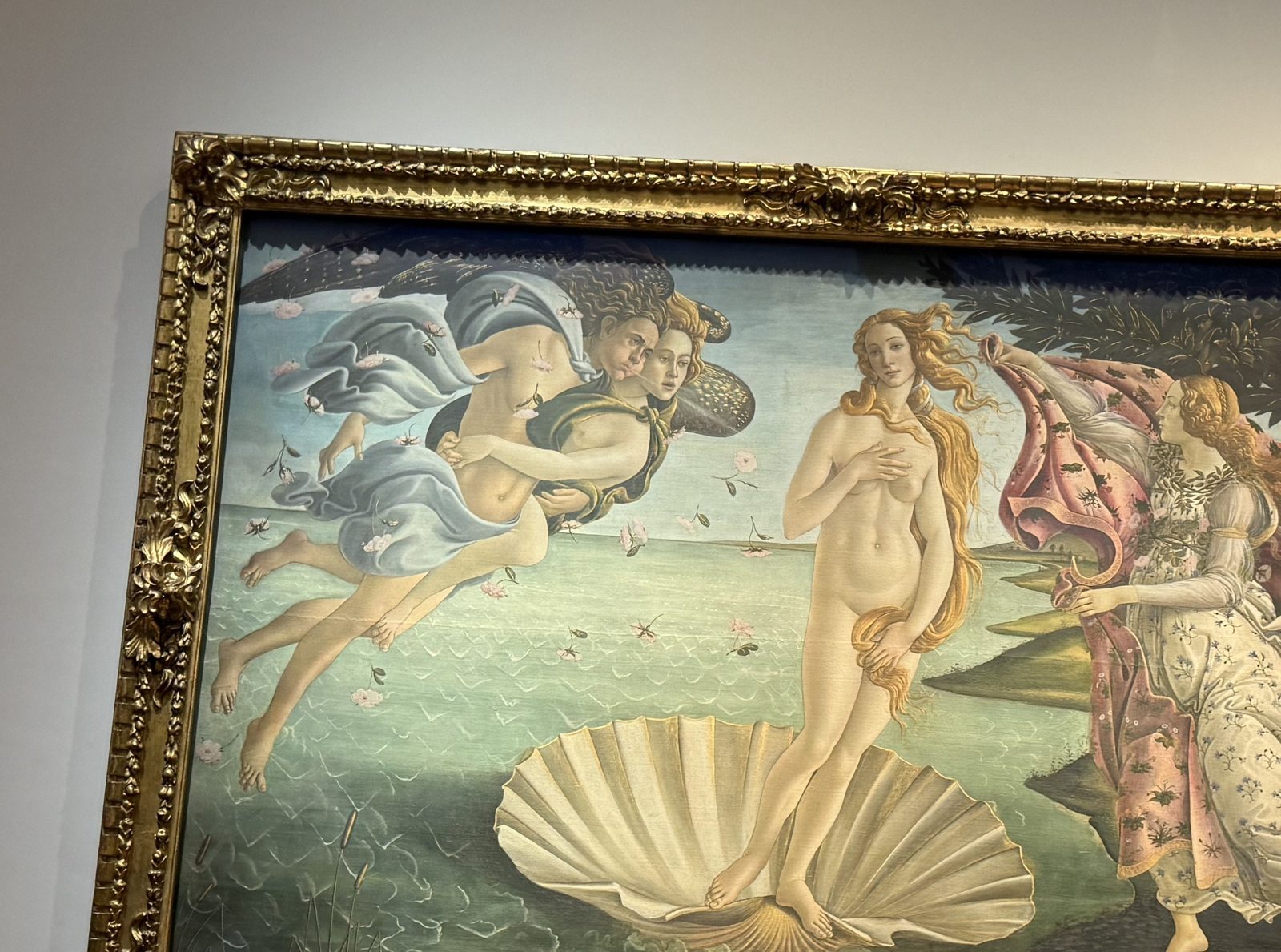
LocationThe Uffizi Galleries (Gallerie degli Uffizi), Florence — the Botticelli room
UbicaciónLas Galerías de los Uffizi (Gallerie degli Uffizi), Florencia — la sala de Botticelli
One of the most famous paintings in the world. The goddess Venus, newly born from the sea, arrives on the shore upon a giant scallop shell. At the left the wind-gods Zephyr and Aura blow her to land in a shower of roses; at the right a Hora, a goddess of the seasons, hurries to wrap her in a flowered cloak. Venus covers herself with one hand and her long golden hair, her pose taken from antique statues of the goddess.
Una de las pinturas más famosas del mundo. La diosa Venus, recién nacida del mar, llega a la orilla sobre una gran concha. A la izquierda, los dioses del viento Céfiro y Aura la empujan a tierra entre una lluvia de rosas; a la derecha, una Hora, diosa de las estaciones, se apresura a envolverla en un manto floreado. Venus se cubre con una mano y con su larga cabellera dorada, en una pose tomada de las estatuas antiguas de la diosa.
The orange trees behind the Hora are an emblem of the Medici, who almost certainly commissioned the picture.
Los naranjos detrás de la Hora son un emblema de los Médici, que casi con certeza encargaron la obra.
Painted about 1484–1486; tempera on canvas, roughly 1.7 by 2.8 metres.
Pintada hacia 1484–1486; temple sobre lienzo, de unos 1,7 por 2,8 metros.
Sandro Botticelli (Florence 1445–1510). The subject was probably suggested by the humanist poet Poliziano, drawing on classical hymns, and the work was almost certainly commissioned by a member of the Medici family — perhaps Lorenzo di Pierfrancesco de’ Medici — for their villa at Castello.
Sandro Botticelli (Florencia 1445–1510). El tema probablemente lo sugirió el poeta humanista Poliziano, inspirándose en himnos clásicos, y la obra fue encargada casi con certeza por un miembro de la familia Médici — quizá Lorenzo di Pierfrancesco de’ Medici — para su villa de Castello.
A defining image of the Italian Renaissance. A large-scale, prominent female nude drawn from mythology was virtually unprecedented since antiquity, and Botticelli’s flowing line and dreamlike grace made it an icon of beauty. Steeped in the Neo-Platonic ideas of the Medici circle, the goddess’s “birth” reads at once as classical myth and as an allegory of beauty and the soul. Her pose echoes the antique Medici Venus displayed nearby in the Tribuna.
Una imagen emblemática del Renacimiento italiano. Un desnudo femenino de gran tamaño y protagonismo tomado de la mitología era algo prácticamente sin precedentes desde la Antigüedad, y la línea fluida y la gracia onírica de Botticelli la convirtieron en un icono de la belleza. Impregnado de las ideas neoplatónicas del círculo Médici, el “nacimiento” de la diosa se lee a la vez como mito clásico y como alegoría de la belleza y del alma. Su pose recuerda a la antigua Venus de’ Medici expuesta cerca, en la Tribuna.
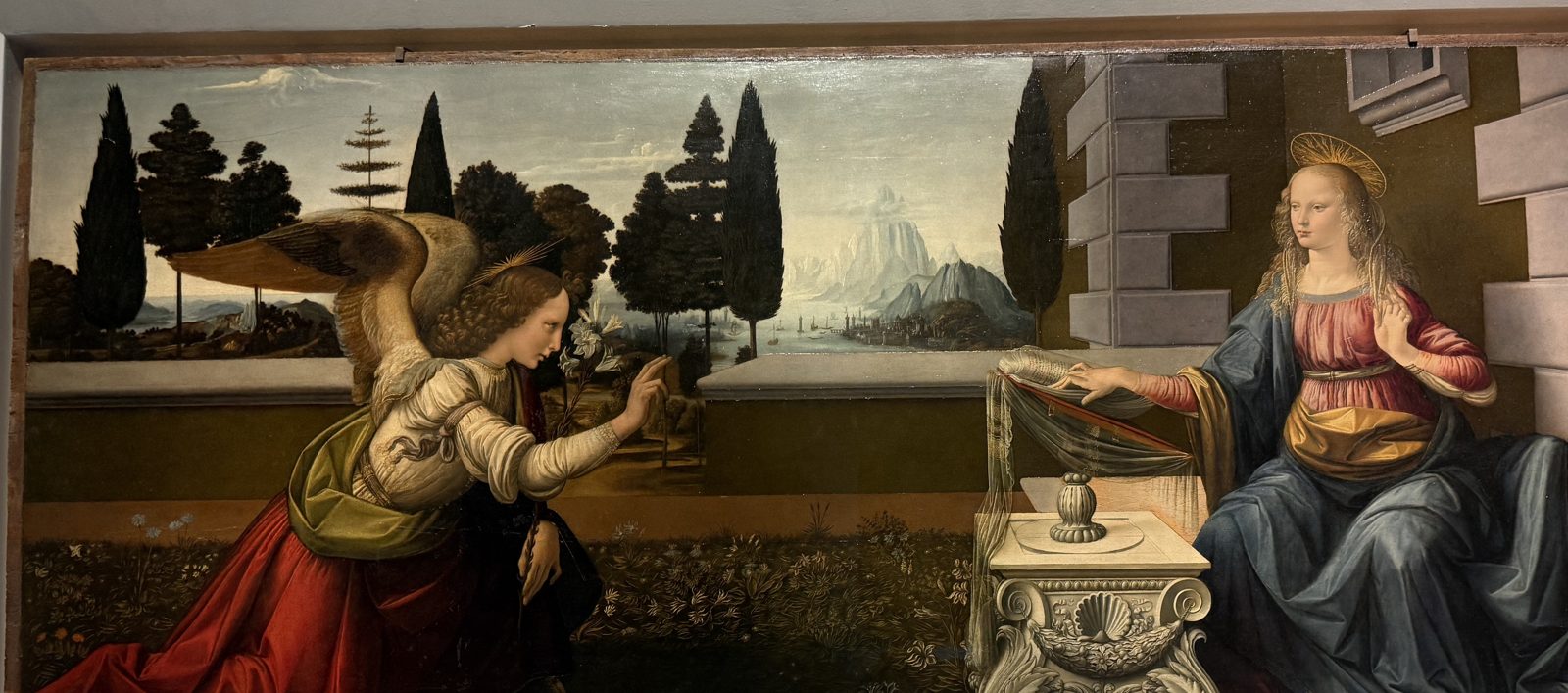
LocationThe Uffizi Galleries, Florence — the Renaissance rooms
UbicaciónLas Galerías de los Uffizi, Florencia — las salas del Renacimiento
Three masterpieces from the heart of the Renaissance. Leonardo’s Annunciation, his earliest major painting, sets the angel and the Virgin in a luminous garden before a misty landscape. Raphael’s portrait of the Medici Pope Leo X with two cardinals renders velvet, gold, silver and an illuminated book with astonishing realism. Perugino’s serene altarpiece places the enthroned Madonna between Saints John the Baptist and Sebastian against a soft Umbrian landscape.
Tres obras maestras del corazón del Renacimiento. La Anunciación de Leonardo, su primera gran pintura, sitúa al ángel y a la Virgen en un jardín luminoso ante un paisaje brumoso. El retrato de Rafael del papa Médici León X con dos cardenales reproduce el terciopelo, el oro, la plata y un libro iluminado con un realismo asombroso. El sereno retablo de Perugino coloca a la Virgen entronizada entre los santos Juan Bautista y Sebastián ante un suave paisaje umbro.
“Pietro Perugino painted this in the year 1493.” The Madonna’s face is a portrait of the painter’s wife, Chiara Fancelli.
«Pietro Perugino pintó esto en el año 1493.» El rostro de la Virgen es un retrato de la esposa del pintor, Chiara Fancelli.
Leonardo’s Annunciation dates to about 1472–1476; Perugino’s altarpiece is signed and dated 1493; Raphael’s Pope Leo X was painted about 1518–1520.
La Anunciación de Leonardo data de hacia 1472–1476; el retablo de Perugino está firmado y fechado en 1493; el León X de Rafael se pintó hacia 1518–1520.
The Annunciation is an early work by Leonardo da Vinci (Vinci 1452 – Amboise 1519), made while he was an apprentice in Verrocchio’s Florentine workshop. The Pope Leo X is by Raphael (Urbino 1483 – Rome 1520) and shows the Medici pope, son of Lorenzo the Magnificent, with his cousins Cardinals Giulio de’ Medici — the future Pope Clement VII — and Luigi de’ Rossi. The altarpiece is by Pietro Vannucci, called Perugino (c. 1450 – 1523), Raphael’s teacher.
La Anunciación es una obra temprana de Leonardo da Vinci (Vinci 1452 – Amboise 1519), realizada cuando era aprendiz en el taller florentino de Verrocchio. El León X es de Rafael (Urbino 1483 – Roma 1520) y muestra al papa Médici, hijo de Lorenzo el Magnífico, con sus primos los cardenales Giulio de’ Medici — el futuro papa Clemente VII — y Luigi de’ Rossi. El retablo es de Pietro Vannucci, llamado Perugino (h. 1450 – 1523), maestro de Rafael.
Together these works span the Renaissance at its summit. Leonardo’s Annunciation already shows the naturalism and atmospheric landscape that would transform European painting. Perugino brought a new harmony and sweetness that he passed to his pupil Raphael — whose Leo X reinvented the papal portrait, showing the pope not as an idealized icon but as a worried, vividly human ruler, painted just as Luther’s Reformation was breaking over the Church.
Juntas, estas obras abarcan el Renacimiento en su cima. La Anunciación de Leonardo ya muestra el naturalismo y el paisaje atmosférico que transformarían la pintura europea. Perugino aportó una nueva armonía y dulzura que transmitió a su discípulo Rafael, cuyo León X reinventó el retrato papal, mostrando al papa no como un icono idealizado, sino como un gobernante preocupado y vívidamente humano, pintado justo cuando la Reforma de Lutero se desataba sobre la Iglesia.
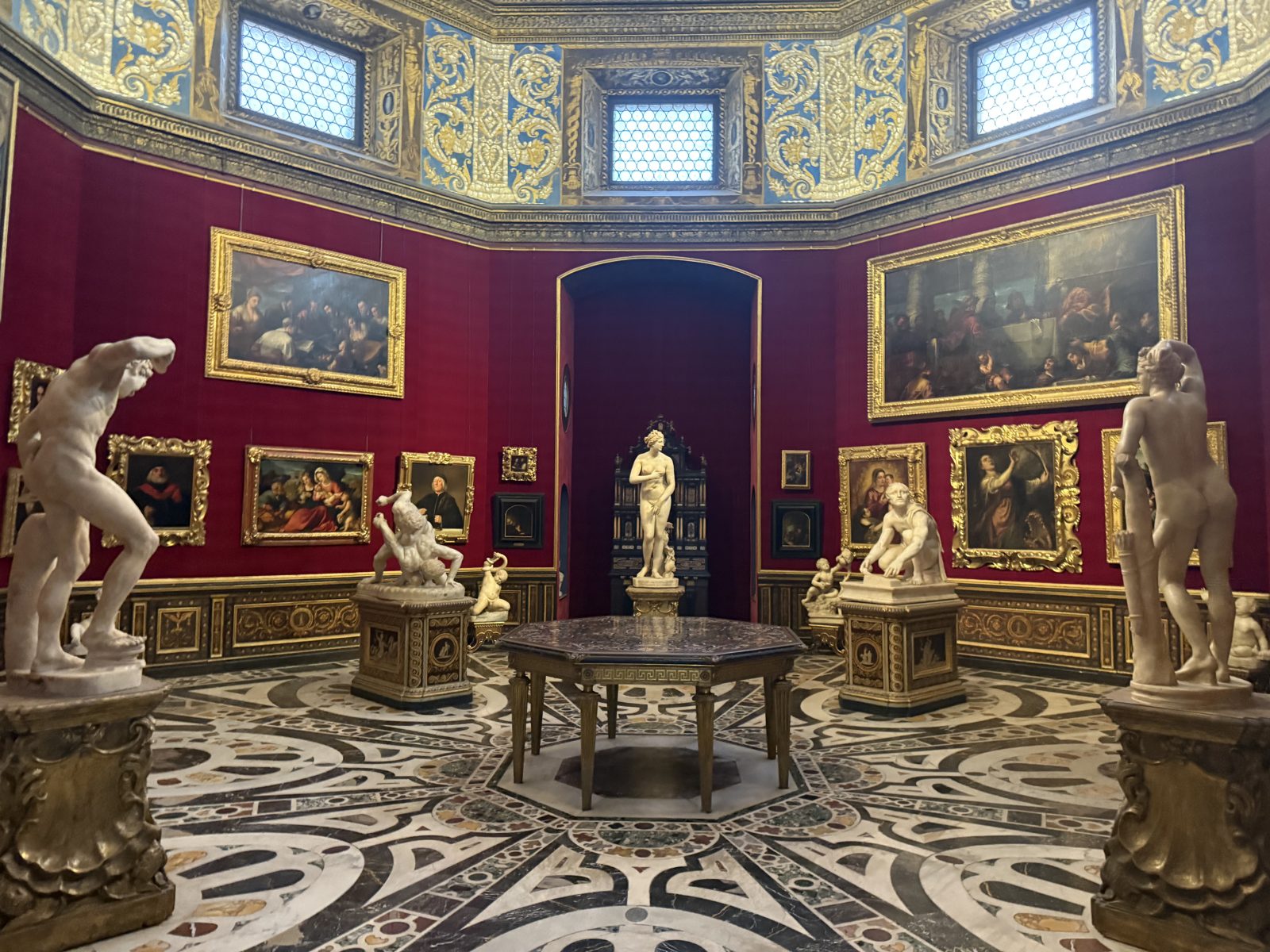
LocationThe Uffizi Galleries, Florence — the Tribuna
UbicaciónLas Galerías de los Uffizi, Florencia — la Tribuna
The Tribuna is the jewel-box at the heart of the Uffizi: an octagonal chamber with deep red velvet walls, a dome encrusted with thousands of mother-of-pearl shells, and a floor of inlaid coloured marble. Around the central table stand the most prized antique sculptures of the Medici — among them the Medici Venus in the niche, the Wrestlers, the crouching Arrotino (Knife-Grinder) and the Dancing Faun — while the walls are hung with portraits and paintings from the collection.
La Tribuna es el joyero en el corazón de los Uffizi: una sala octogonal de paredes de terciopelo rojo intenso, una cúpula incrustada con miles de conchas de nácar y un suelo de mármoles de colores taraceados. En torno a la mesa central se alzan las esculturas antiguas más preciadas de los Médici — entre ellas la Venus de’ Medici en el nicho, los Luchadores, el Arrotino (el Afilador) agachado y el Fauno Danzante — mientras que las paredes lucen retratos y pinturas de la colección.
Its marble floor is now too fragile to walk on, so the Tribuna — long a highlight of the Grand Tour — is admired from its doorways.
Su suelo de mármol es hoy demasiado frágil para pisarlo, de modo que la Tribuna — largo tiempo un punto culminante del Grand Tour — se admira desde sus puertas.
Designed by Bernardo Buontalenti for Grand Duke Francesco I de’ Medici and completed in 1584.
Diseñada por Bernardo Buontalenti para el gran duque Francesco I de Médici y terminada en 1584.
Architecture by Bernardo Buontalenti (1531–1608) for Francesco I de’ Medici. The Medici Venus at the centre is a Hellenistic-type marble (a Roman work after a Greek original); the surrounding statues are celebrated antiquities of the Medici collection.
Arquitectura de Bernardo Buontalenti (1531–1608) para Francesco I de Médici. La Venus de’ Medici del centro es un mármol de tipo helenístico (obra romana según un original griego); las estatuas que la rodean son célebres antigüedades de la colección Médici.
The Tribuna was the first nucleus of the Uffizi and, in effect, one of the first modern museum galleries — a room built expressly to display a collection as art. It became one of the most famous rooms in Europe, an essential stop on the Grand Tour, and was immortalized in Johan Zoffany’s painting made for Queen Charlotte of England.
La Tribuna fue el primer núcleo de los Uffizi y, en la práctica, una de las primeras salas de museo modernas — una estancia construida expresamente para exhibir una colección como arte. Llegó a ser una de las salas más famosas de Europa, parada esencial del Grand Tour, e inmortalizada en la pintura que Johan Zoffany realizó para la reina Carlota de Inglaterra.